






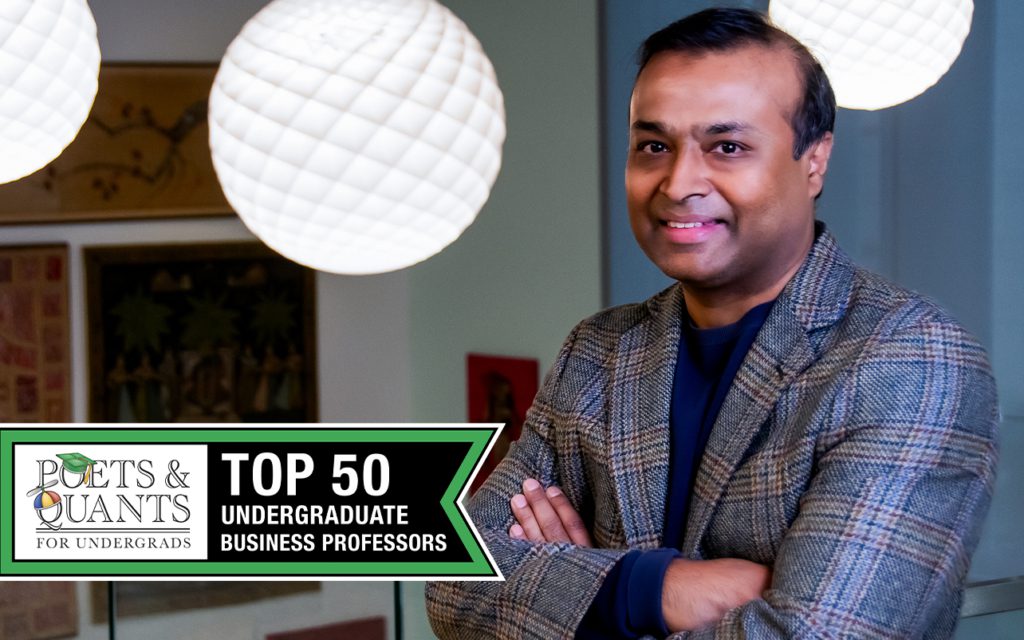
Euvin Naidoo
Thunderbird School of Global Management
Arizona State University
“Professor Euvin Naidoo has transformed the undergraduate experience at Thunderbird. A hallmark of his teaching is the creation of a formal case writing pathway for undergraduates. This initiative provides a rare opportunity for students to publish management cases and tackle real world business dilemmas, a platform previously reserved for graduate students.
“He is recognized for an inclusive and highly interactive teaching style that transforms lectures into collaborative learning experiences. By presenting concepts clearly and avoiding unnecessary technical language, he ensures that students from diverse educational and cultural backgrounds can fully engage with the material. This approach is particularly impactful at Thunderbird, where nearly half of the undergraduate population comes from outside the United States.
“Professor Naidoo organizes voluntary weekend bootcamps that consistently draw strong attendance, reflecting his extraordinary dedication to student growth. He also regularly speaks at student clubs and events, sharing insights and inspiring students with his expertise and passion for management education. In 2024, he received the Case Centre Global Award for Teaching Impact, an international recognition of his innovative and influential teaching methods.” – Carola Maria De Rada
Euvin Naidoo, 54, is Distinguished Professor of Practice in Global Accounting, Risk and Agility at Arizona State University’s Thunderbird School of Global Management.
Naidoo’s work centers on financial services innovation, agility, AI, governance, and risk. Prior to entering academia, he held senior leadership roles at two global pan-African banks and served as a Partner and Managing Director at the Boston Consulting Group (BCG), where he co-led the firm’s Banking, Insurance, and Public Sector practices for Africa. He later joined the full-time faculty of his alma mater, the Harvard Business School, where he successfully pioneered and co-launched the school’s first Short Intensive Program (SIP) focused on the latest thinking on agility and OKRs.
A World Economic Forum (WEF) Young Global Leader (YGL) alumnus, he has contributed to several WEF Global Councils, including serving two terms on the United States Global Agenda Council (GAC), focused on strategies supporting U.S. competitiveness, and most recently on the Global Future Council (GFC) on the future of job creation, examining how best to prepare companies and regions in the age of AI.
Naidoo brings in the latest global thinking from industry combined with innovative teaching and engagement methods, with his programs often filling to capacity within seconds of the platform opening for registration each semester.
He is currently launching the Thunderbird Case Lab, focused on best-practice case teaching and writing, including the delivery of simulations and new case formats that aim to pull participants into a learning transformation journey that is grounded in practice and the ability to make an impact from day one.
BACKGROUND
At current institution since: 2021
Education: MBA, Harvard Business School
List of Undergraduate Courses You Teach: Principles of Accounting for Global Organizations
TELL US ABOUT LIFE AS A BUSINESS SCHOOL PROFESSOR
I knew I wanted to be a business school professor when … in 2003, Professor Rosabeth Moss Kanter invited me to co-author what became the Harvard Business School case “Nelson Mandela: Change Leader.” She wanted to show how lessons from a public-sector leader in Africa could meaningfully inform the decisions of Fortune 500 executives. Witnessing Mandela’s disciplined, values-driven approach to stabilizing a nation that could have easily slipped into hopelessness, opened my eyes to the power of management education to illuminate possibility, where others see limits.
Another moment came at Davos, when Peter Tufano, then Dean of Oxford’s Saïd Business School, walked off stage after announcing Oxford’s first course on doing business in Africa and asked me: “Can you build it?” With his unwavering support, we created a superb program expecting a small class in this inaugural launch. The class filled to capacity in a few days and over 2 weeks had to be expanded several times such was the demand. It showed me the defining power of courageous leadership paired with understanding student and participant curiosity.
A final formative moment occurred when I was invited by the TED leadership to spend a day one on one, alone, engaging the late Professor Stephen Hawking as he prepared to meet President Nelson Mandela. I read the Mandela case to him in the morning, stayed through the afternoon reading several newspapers per his request, and remained for dinner per his invitation to join him and several friends, both Nobel mathematics laureates. It crystallized for me that teaching leaders is fundamentally about cultivating humility, curiosity, and resilience in a world that never stops changing and despite any challenge faced, the human spirit can rise against it and thrive.
These three experiences- Mandela, Oxford, and Hawking- anchored my path toward becoming a professor and playing a role in joining others to impact the classrooms and boardrooms of the world in a positive way no matter what the challenges faced.
What are you currently researching and what is the most significant discovery you’ve made from it? I research AI, agility, and the future of work—specifically how organizations adapt, learn, and thrive amid rapid technological shifts. One of the most striking insights is how dramatically the half-life of knowledge has shortened. We now live in an era of continuous learning and “never graduating,” where what someone studies is often no longer directly linked to the work they end up doing, and where solutions increasingly span sectors and cut across traditional silos. A key discovery from my research is that collective intelligence consistently outperforms artificial intelligence alone. The most successful organizations are those that integrate agile ways of working with intent, with AI used as an enabler rather than a competitor. This combination not only improves decision-making but also helps teams innovate, adapt, and build resilience in a world defined by constant change.
Most significant discovery: Organizations that succeed with AI are not the ones with the most technology, but the ones with the most humanity inculcating the right mindset.
They treat learning as a daily habit and create cultures where experimentation is encouraged with a focus on moving from output thinking to outcomes thinking.
This echoes Stephen Hawking’s insight that continues to guide my work: “Intelligence is the ability to adapt to change.” Agility, at its core, is the organizational expression of that truth.
If I weren’t a business school professor, I’d be … part of the leadership team in financial services, focused on inclusion and on deeply serving customers across every tier- from high-net-worth individuals to the unbanked and uninsured. I’m passionate about designing tailored financial-services approaches that deliver best-in-class value and measurable impact, using AI and risk management to expand access to opportunity across the entire value spectrum. No matter where a customer sits, I believe the current level of personalized, intelligent, real-time, high-impact service they receive remains far below what it should be across global markets. Expectations of customers are rising, yet a significant gap still persists. Filling that vacuum- by creating financial services that truly meet people where they are- is the work I would be driven to pursue. The opportunity is especially great for legacy banks, which have extraordinary assets and capabilities waiting to be activated and harnessed to deliver real transformation.
What do you think makes you stand out as a professor? My classroom runs like an active boardroom- fast, rigorous, and grounded in real leadership decisions drawn from global business experience. I work to create a high impact environment where students don’t just learn from me; they reach a stage where they coach themselves and one another. The goal is a room filled with leaders who think critically, challenge respectfully, and elevate the collective intelligence far beyond any single voice.
One word that describes my first time teaching: Joyful
Here’s what I wish someone would’ve told me about being a business school professor: That teaching is a mutual learning journey. Students deepen your understanding just as much as you deepen theirs. The most rewarding moment is when the classroom evolves into a vibrant exchange of ideas—where participants spark insights in one another, and the professor becomes a curator of an extraordinary conversation. The aim is to build an environment where collective intelligence thrives and every voice contributes to the momentum of learning. Approaching teaching with a spirit of generosity and shared growth brings out the very best in everyone in the room.
Professor I most admire and why: It is a combination of leaders I have been fortunate to engage: Rosabeth Moss Kanter, for her powerful fusion of vision and action.
Bob Kaplan, for showing that accounting is ultimately about enabling human performance.
Clay Christensen, for purpose-driven approaches to leadership.
Dr. Chris Howard, for modeling servant leadership grounded in integrity and service.
Dr. Lena Booth for her vision to empower faculty to innovate and create new learning paths.
Dean Charla Griffy-Brown, for her relentless energy and ability to inspire forward momentum.
TEACHING BUSINESS SCHOOL STUDENTS
What do you enjoy most about teaching business students? Their optimism and their deep belief that business and management can serve as powerful forces for good. I’m continually inspired by their readiness to take on complex issues, ask bold questions, and imagine solutions that create meaningful impact. Their curiosity and sense of purpose make the classroom an energizing space where possibilities feel expansive and real.
What is most challenging? Helping students understand that true leadership growth often happens in moments of productive discomfort and ‘leaning into the red”.
Developing judgment and resilience requires stepping into ambiguity, experimenting, and navigating decisions without perfect information. Encouraging students to build this capability- so they can reduce friction, increase clarity, and help teams execute with impact- is both challenging and essential to preparing them for the realities of management
In one word, describe your favorite type of student: Curious
In one word, describe your least favorite type of student: Closed-minded
When it comes to grading, I think students would describe me as … Fair, transparent, and deeply invested in their growth.
LIFE OUTSIDE THE CLASSROOM
What are your hobbies? I have a profound love of scuba diving and the ocean. A highlight was releasing turtles with the Cousteau family and sharing with them how much their grandfather’s work meant to me as a young ocean enthusiast. His influence helped inspire me to take a year off in 1994 to scuba dive some of the great dive sites of the world, starting in the Red Sea and exploring the famed Blue Hole.
How will you spend your summer? This summer will be a full and energizing one. I’ll be teaching two cornerstone courses for our students: AI, Chip Strategy and the Future of Work, and Agility and the Art of Storytelling, a groundbreaking course that introduces the craft of case writing through a CxO mindset—empowering teams to use storytelling as a strategic leadership tool.
I will also be developing a new AI-focused case collection as part of our newly launched Thunderbird Case Lab, capturing cutting-edge insights from industry and translating them into actionable learning materials for global practitioners.
Favorite place(s) to vacation: Sedona, Arizona—its vortex energy is truly one of a kind.
Favorite book(s): The Innovator’s Dilemma by Clay Christensen- a timeless lens on disruption.
Confidence by Rosabeth Moss Kanter- a masterful exploration of leadership momentum.
The Intelligent Investor by Benjamin Graham- a foundational guide to disciplined thinking in finance.
Favorite movie or show and why: I gravitate toward documentaries and films that spotlight resilience, innovation, and the human determination to overcome complex challenges—stories that mirror the principles of agile leadership and the high-stakes turnarounds I study and teach.
Apollo 13 remains my top choice. Ron Howard’s classic, starring Tom Hanks, is a masterclass in crisis leadership and teamwork. The iconic line—“Houston, we have a problem”—captures the essence of calm precision under pressure. Its blend of disciplined problem-solving, unity, and precision storytelling makes it endlessly inspiring.
Favorite type of music or artist(s) and why: Jazz—for its improvisation, its deep culture of listening, and its reminder that great leadership is often about creating space for others to shine. I’m especially drawn to Chet Baker, one of the defining voices of the cool-jazz movement. While others were bold and brash, his sound was light and understated- yet profoundly impactful. To me, he exemplifies agility: the ability to make the complex feel effortless. It mirrors what I strive for in every classroom and boardroom.
THOUGHTS AND REFLECTIONS
If I had my way, the business school of the future would have much more of this … Deeply personal teaching amplified by technology that expands access- the same aspiration shaping the most forward-looking corporations of the future. As businesses move toward more agile and digitally enabled models, business schools should mirror this shift.
The future lies in combining high-touch, individualized learning with high-scale platforms that make world-class continuous learning available to all. A next-generation business school should be able to deliver immersive, high-impact experiences without sacrificing quality, intimacy, or the sense that every learner is seen, engaged, and heard.
In essence, the business school of tomorrow should look like the corporation of tomorrow- human-centered, technologically empowered, and designed to develop curious leaders with a bias towards action.
In my opinion, companies and organizations today need to do a better job at … Building agile systems that support continuous learning. In an age shaped by AI and rapid disruption, the advantage no longer lies in what leaders already know — but in how quickly they can learn, adapt, and translate insight into action. Organizations that create environments where teams can experiment, iterate, and grow in real time will define the next era of leadership and performance.
I’m grateful for … the moments when curiosity sparks something unexpected — when a single question shifts an entire discussion or when someone spots a pattern that others might miss. I’m thankful for environments where ideas collide and different disciplines meet, where a scientist, an artist, and a strategist can approach the same challenge and reveal entirely new possibilities. These creative intersections energize me and remind me that innovation often begins with simply paying closer attention to the world around us.
DON’T MISS THE ENTIRE ROSTER OF 2025’s 50 BEST UNDERGRADUATE BUSINESS SCHOOL PROFESSORS.
© Copyright 2026 Poets & Quants. All rights reserved. This article may not be republished, rewritten or otherwise distributed without written permission. To reprint or license this article or any content from Poets & Quants, please submit your request HERE.


