






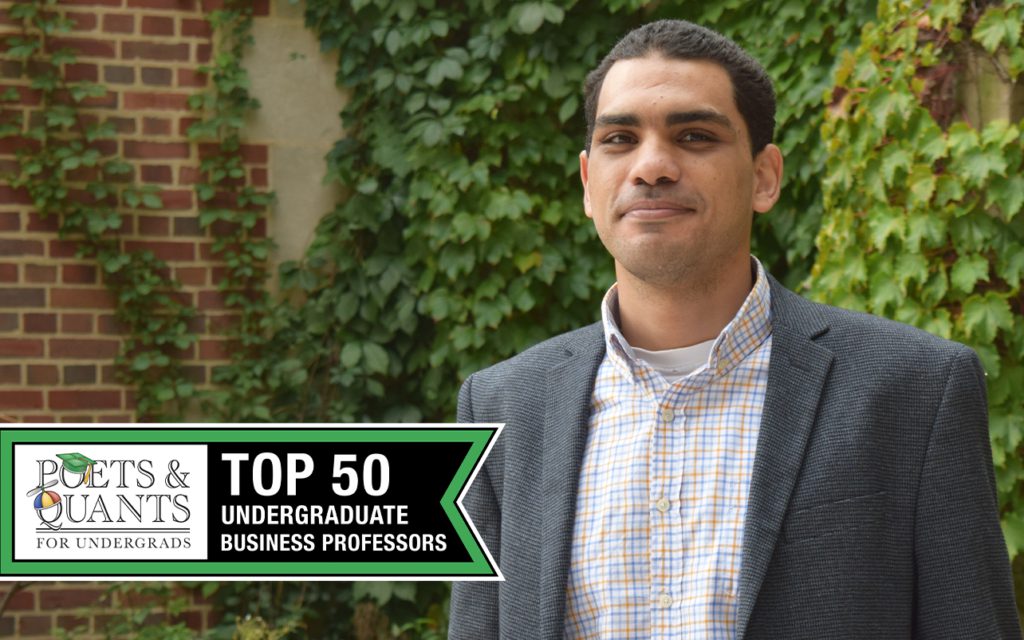
Ahmed Ahmed
Babson College
“Professor Ahmed Ahmed is renowned for his engaging and student-centered teaching. He has a talent for breaking down complex financial and economic concepts into clear, understandable lessons, while maintaining a rigorous and challenging classroom environment. Students consistently praise his clarity, approachability, and dedication, with many noting that he inspires confidence, intellectual curiosity, and a genuine love of learning. His work as a Senior Quantitative Analyst at Goldman Sachs and contributions to global policy organizations provide real-world insight, helping students connect theory to practice and preparing them for future careers.” – School nomination
Ahmed Ahmed is Assistant Professor of Finance at Babson College. He also serves as an Economic Advisor and International Expert with the United Nations Development Programme and as a Technical Advisor and Research Fellow at the Bank for International Settlements in Basel.
Ahmed holds a PhD in Economics from the University of Chicago, a Master’s in Finance from MIT, and a Master’s in Mathematics from the University of Waterloo. He earned the Fellow of the Society of Actuaries designation at the age of 22 and is also a Chartered Financial Analyst (CFA) charterholder.
His professional experience spans leading global institutions, including Goldman Sachs, BlackRock, the Norwegian Sovereign Wealth Fund, and the Bank of England. He has also advised several startups across sectors such as software technology, financial infrastructure, and commodity-backed digital currencies.
Ahmed’s research centers on intermediary asset pricing and international finance, with a focus on how institutional investors such as pension funds and insurance companies influence financial stability. His broader interests include development finance, particularly the ways political uncertainty, institutional design, and policy reforms shape firm behavior, credit access, and welfare outcomes.
Ahmed has been recognized with numerous academic, research, and teaching honors. At Babson College, he was named Professor of the Year, received the Deans’ Award for Excellence in Service, and was honored as a Career Champion by the Hoffman Family Undergraduate Center for Career Development.
His ongoing research on the economic and social costs of debtor prisons is supported by a €1,500,000 grant from the Fund for Innovation in Development hosted by the French Development Agency (AFD) and a pilot grant of $74,353 from the Abdul Latif Jameel Poverty Action Lab (J-PAL) and the Egypt Impact Lab. He also received the Research Fellowship at the Bank for International Settlements in Switzerland, supporting his work on global monetary policy transmission and financial markets. Earlier in his career, he was selected as a James C. Hickman Scholar by the Society of Actuaries, a distinction awarded to promising PhD researchers at the intersection of economics, finance, and actuarial science.
BACKGROUND
At current institution since what year? 2022
Education: PhD in Economics, The University of Chicago; Master of Arts in Economics, The University of Chicago; Master in Finance, Massachusetts Institute of Technology; Master of Mathematics in Actuarial Science, The University of Waterloo; Bachelor of Science in Actuarial Science, The American University in Cairo; CFA Charterholder ; Fellow of the Society of Actuaries (FSA); Associate of the Society of Actuaries (ASA)
List of Undergraduate courses you teach: Principles of Finance, Risk Management
TELL US ABOUT LIFE AS A BUSINESS SCHOOL PROFESSOR
I knew I wanted to be a business school professor when … I was a child. I grew up admiring my father, a professor of medicine, and my uncle, a professor of chemistry. I enjoyed watching them research fascinating topics in their respective fields and, most importantly, witnessing their generosity with their time and support for their students. My father’s kindness and devotion to his own patients also left a lasting impression on me, showing me the importance of empathy and integrity in both personal and professional life. These moments stayed with me and inspired me deeply. The spirit of teaching, care, and mentorship that I observed in them grew within me throughout middle school, high school, and college. I still fondly remember how my family used to call me “Dr. Ahmed” when I was a child, and that nickname still encourages me today.
What are you currently researching and what is the most significant discovery you’ve made from it? I am currently researching the intersection of intermediary asset pricing and international finance. My work examines how non-bank financial institutions, such as pension funds and investment funds, shape global capital flows and asset prices through their balance sheet constraints and hedging decisions. This area has become increasingly important as these institutions now play a central role in financial stability across both domestic and international markets. One significant insight that emerges from this work is that changes in institutional funding conditions meaningfully alter portfolio composition and risk-taking behavior, particularly in fixed income markets. This provides direct evidence that balance sheet dynamics influence market demand and pricing.
In addition to this, I also study development finance. This work focuses on how political uncertainty, institutional structures, and policy reforms shape firm behavior, credit access, and welfare outcomes. It combines large scale administrative data with survey methods and randomized controlled trials to understand how financial frictions operate in settings where institutional capacity and social constraints are especially salient.
Across both lines of research, my broader goal is to understand how financial systems transmit economic shocks and policy decisions into real outcomes. Whether in global capital markets or in local credit environments, my work seeks to provide evidence that can inform financial regulation and development policy in ways that promote stability, efficiency, and economic resilience.
If I weren’t a business school professor, I’d be … a soccer coach for an underdog team. I would hope to build a strong and united team from limited resources. I have a deep love for underdog teams and feel inspired by their stories of achieving great success despite humble beginnings. They usually make you cry most of the time, but I cannot help admiring them.
What do you think makes you stand out as a professor? I strongly believe that no one owns knowledge. This belief shapes my view that there is no hierarchy in the relationship between a professor and their students. I enter the classroom as one of the students, ready to share my understanding and perspectives on certain topics with my friends in the class. I am at my happiest when my “friends” challenge my views, because their questions and insights push everyone to think more deeply.
One word that describes my first time teaching: Memorable
Here’s what I wish someone would’ve told me about being a business school professor: You will learn just as much from your students as they learn from you. Be ready to be challenged, to laugh at unexpected moments, and to find joy in seeing others grow even when the journey is messy and unpredictable.
Professor I most admire and why: My PhD advisor, Professor Amir Sufi, Bruce Lindsay Distinguished Service Professor of Economics, Finance, and Public Policy at the University of Chicago Booth School of Business, and my undergraduate advisor, Professor Ali Hadi, emeritus professor of Statistics at Cornell University and Distinguished University Professor at the American University in Cairo. Both share a remarkable quality that I have not often seen in other professors: their support during difficult times far exceeds their guidance during peak times. This generosity and encouragement gave me the confidence to grow and develop, and their example continues to inspire the way I support and mentor my own students.
TEACHING BUSINESS SCHOOL STUDENTS
What do you enjoy most about teaching business students? Seeing them grow, especially those who initially struggle. Like a tree slowly reaching toward the sun, I find it deeply rewarding to watch their confidence and abilities develop over time. Guiding them through challenges and witnessing their transformation into capable, thoughtful, and independent thinkers is the part of teaching I cherish the most.
What is most challenging? Helping a diverse group of students, each with different abilities, experiences, and backgrounds reach their full potential at their own pace. I enjoy this challenge because it requires empathy, creativity, and adaptability to connect with every student. Turning this diversity into a dynamic and supportive learning experience is what makes teaching truly fulfilling.
In one word, describe your favorite type of student: Curious
In one word, describe your least favorite type of student: Disrespectful to their classmates
When it comes to grading, I think students would describe me as … Fair
LIFE OUTSIDE THE CLASSROOM
What are your hobbies? Outside the classroom, I enjoy activities that combine reflection, exploration, and connection. I love walking through the old parts of cities, strolling in parks, and along rivers, and meeting people with different stories and backgrounds along the way. I am also a passionate soccer fan and enjoy following underdog teams, celebrating their victories, and admiring their resilience. Reading widely, exploring new ideas, and spending quality time with family and friends are other sources of joy. These hobbies keep me energized, curious, and ready to bring the same enthusiasm into the classroom.
How will you spend your summer? I plan to spend my summer traveling internationally for research, exploring new ideas and collaborations, while also dedicating time to my family. At the same time, I hope to stay connected with my students and continue supporting their growth. Balancing family, research, teaching and mentorship responsibilities is something I always strive to maintain.
Favorite place(s) to vacation: Along the Mediterranean Sea. The scent of the salty air and the beauty of the sun rising and setting on the coast offer priceless moments for reflection and calm.
Favorite book(s): Capital in the Twenty-First Century by Thomas Piketty & The Only Game in Town by Mohamed El-Erian. Read together, they show that understanding inequality and understanding financial instability are inseparable: how societies distribute resources influences how they respond to shocks, and how they respond to shocks determines who ultimately benefits.
What is currently your favorite movie and/or show and what is it about the film or program that you enjoy so much? A movie I watched when I was seven years old is called “Al Nazer,” produced in 2000. The title translates roughly to “The School Principal.” What I enjoyed most about the movie is how it illustrates that building a strong and capable generation of students comes not through force, but through encouragement, motivation, and attention. The lessons it conveys resonate deeply with me as a professor: what can be achieved through inspiration and support can never be matched by pressure, no matter what the starting point. The humor is timeless as well, and many popular Arabic comedy memes today actually come from this film.
What is your favorite type of music or artist(s) and why? My favorite type of music is traditional older classical style Arabic oud music. I am drawn to it because it carries a deep sense of heritage and continuity. The oud, especially in its traditional compositions, expresses emotion with remarkable subtlety. The melodies unfold slowly and thoughtfully, encouraging the listener to be present and attentive to the small details in each note. It encourages slowing down, listening carefully, and appreciating the richness that comes from taking time to understand meaning, not just at the surface but in the layers beneath.
THOUGHTS AND REFLECTIONS
If I had my way, the business school of the future would have much more of this … Deep thinking while also equipping them to build with purpose, combining reflection, creativity, and impact.
In my opinion, companies and organizations today need to do a better job at … Elevating humanity, all humanity. They need to ensure that their actions, decisions, and policies respect, empower, and uplift every individual they touch.
I’m grateful for … everything we encounter, whether it appears good or bad on the surface, because in the end, every experience is a blessing.
DON’T MISS THE ENTIRE ROSTER OF 2025’s 50 BEST UNDERGRADUATE BUSINESS SCHOOL PROFESSORS.
© Copyright 2026 Poets & Quants. All rights reserved. This article may not be republished, rewritten or otherwise distributed without written permission. To reprint or license this article or any content from Poets & Quants, please submit your request HERE.


