






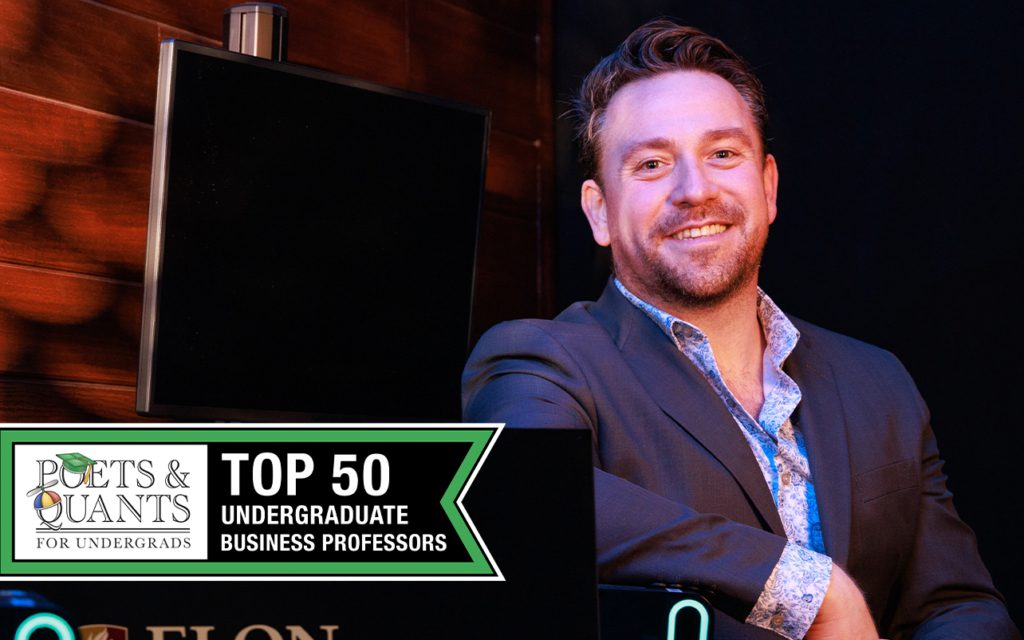
Mustafa Akben
Martha & Spencer Love School of Business
Elon University
“Dr. Mustafa Akben is redefining business education through his dual expertise in organizational behavior and applied artificial intelligence. In just three years at Elon University, he has become a nationally recognized leader in AI-enhanced pedagogy, a published scholar in Journal of Applied Psychology, and the university’s first Director of AI Integration. His combination of high-impact research, classroom innovation, and institutional leadership exemplifies the qualities Poets&Quants seeks to recognize.
“Dr. Akben has transformed the classroom with AI-enabled tools that deepen engagement and prepare students for the future of work. Examples include interactive platforms where students interview classical management thinkers, chatbots embedded in syllabi to guide learning, and AI-driven interview simulations. Beyond technology, students consistently highlight his energy, care, and mentorship as what makes him a “must-take” professor.
“He also created the AI Pedagogy Challenge, an event that funded cross-disciplinary faculty innovations and resulted in Elon’s AI Toolbox website. His work has been featured in Today at Elon for advancing experiential learning and preparing both faculty and students for an AI-transformed world.” – Haya Ajjan, Dean of the Love School of Business
Mustafa Akben, 37, is an Assistant Professor of Management and Director of Artificial Intelligence (AI) Integration at Elon University. He leads the university’s efforts to implement AI in both academic and administrative units, creating and executing ethical and responsible AI strategies.
Akben is a two-time recipient of awards at the Machine Learning Competition organized by the Society of Industrial and Organizational Psychology (SIOP) in 2023 and 2024, in which he designed innovative AI-based solutions to workplace problems.
He also received the Dean’s Award for Excellence in Teaching in 2024, recognizing his creativity and student impact.
His research focuses on applied deep learning and generative AI. He examines Gen AI’s impact on human cognition, creativity, and proactive behavior at work. He is published in the Journal of Applied Psychology, among other outlets. For his work on social networks and information sharing he earned the Best Paper Award from the Managerial and Organizational Cognition Division of the Academy of Management.
In the classroom, Dr. Akben is recognized for creating immersive learning experiences, from AI-driven simulations to escape-room exercises and Shark Tank competitions.
BACKGROUND
At current institution since what year? 2022
Education: Ph.D., Business Administration, Temple University; M.S., University of Pennsylvania; B.A., Marmara University
List of Undergraduate courses you teach: Principles of Management and Organizational Behavior, Human Resources for Competitive Advantage
TELL US ABOUT LIFE AS A BUSINESS SCHOOL PROFESSOR
I knew I wanted to be a business school professor when … My path to academia was not direct; after graduating in 2010, I worked as a general manager at a mid-sized company until mandatory military service in Turkey interrupted my career. There I saw the high price of failed leadership, met people the system had left behind, including people in their late twenties who could not read or write, and watched leaders’ malpractice devastate lives.
The irreversible turning point came when I learned that a fellow soldier lost his brother in a preventable fire at his civilian workplace, and he had to guard against the building where he lost his brother every night, a loss that shocked me into responsibility and left me asking how to help him and others and prevent this genuinely. I realized that a good manager in one company would have limited reach yet might be mighty, but I dreamed of doing more. I should become a business professor-researcher, teaching generations of students to inspire, motivate, and protect their teams, trust that they can make a positive difference, and help countless others become the best leaders they can be, honoring those lost and preventing the future malpractice of leadership.
What are you currently researching and what is the most significant discovery you’ve made from it? My research sits at the juncture of generative AI, managerial cognition, and organizational psychology, exploring how AI changes workplace creativity, proactivity, and decision-making.
I’m currently looking at whether collective human intelligence beats AI in emotion recognition (good news, yes it does), how creative self-efficacy paradoxically creates a “confidence cage” that hinders creativity with AI, and whether deep learning models (LSTM) can detect dishonest survey responses using mouse movements and biometrics.
Recently, I’ve even started leveraging neuroscience to map brain activity associated with one’s use of AI with an EEG study. One recent finding from my desk is the curvilinear relationship between job complexity and AI adoption. We’ve found that there’s a “cognitive sweet spot” in moderately complex jobs where human judgment and AI capabilities work best together. This suggests AI integration should be mindful, carefully calibrating the human-AI partnership to respect our cognitive limitations and collaborative potential at work, making sure AI enhances, rather than replaces, human ingenuity.
If I weren’t a business school professor, I’d be … Philosopher, or AI Developer, or Executive Director. A very weird combination of dreams.
What do you think makes you stand out as a professor? My dedication to experiential learning and self-discovery. I subscribe to belief that we learn best when we actively do something, and my classroom reflects that every single day. One day you might find us solving an escape-room challenge to test our teamwork. Another day we’re building, marketing, and selling small cardboard “houses” to understand how organizations work. Later in the semester, students pitch their final projects to real CEOs and community partners in a Shark Tank event. My classroom is, in a sense, a laboratory where students experiment, reflect, and grow, supported by psychological safety and the belief that every small learning moment matters.
One word that describes my first time teaching: Electrifying.
Here’s what I wish someone would’ve told me about being a business school professor: Your teaching and research might have an effect and impact on the future of leadership and workplace practices.
Professor I most admire and why: Herbert Simon. As someone doing AI research from a business school seat, I’m sometimes told my path looks unconventional. I smile and point them to the history of AI. Read it closely and Herbert Simon’s name keeps surfacing, almost like a gravitational force pulling fields together. He was a true Renaissance scholar, a Noble laureate, comfortable moving between organizational theory, psychology, economics, and computer science. His ideas quietly built the intellectual scaffolding for modern AI and organizational research. What I find most striking is how alive his writing feels. It is vivid, sharp, and deeply human. I remember reading his work and talking myself into learning to write like him and thinking like him. He had a rare ability to reach into the fundamental questions of what it means to think, to choose, and to act, whether in organizations or in life.
TEACHING BUSINESS SCHOOL STUDENTS
What do you enjoy most about teaching business students? I enjoy it most when my students surprise me with their own knowledge, creativity, enthusiasm, and entrepreneurial spirit. Put your faith in them, and they will put their faith in you. There is no textbook for life or work. You must improvise and use critical and creative thinking to find an answer. Timid at the beginning and brave at the end of the semester, my students come to embody those values and skills. And watching that transformation is one of the greatest joys of teaching.
What is most challenging? Reaching students who cannot find value in the content is challenging. The impact, significance, and importance of each concept should be communicated clearly so that students will hold teaching ideas dearly. I remind myself every day that my teaching should shift our class from a “just-in-case” mentality to a “just-in-time” mentality, so that I can equip and guide our students to see that every single concept we cover has something meaningful for them.
In one word, describe your favorite type of student: Inquisitive.
In one word, describe your least favorite type of student: Uninterested.
When it comes to grading, I think students would describe me as … Fair and Fast.
LIFE OUTSIDE THE CLASSROOM
What are your hobbies? Reading philosophy essays at night, building my own AI workflow for fun, and hiking with my wife
How will you spend your summer? As someone raised along the Mediterranean coast, summer to me means a particular rhythm. It is slow mornings, lively afternoons, spontaneous evening. I hope to recreate that feeling with my family (my wife and son) this summer. It will be a blend of rest, joy, and just enough busyness to keep life interesting.
Favorite place(s) to vacation: Florida. My parents-in-law live there, so we spend every holiday in Florida.
Favorite book(s): Homo Deus: A Brief History of Tomorrow, by Yuval Noah Harari.
What is currently your favorite movie and/or show and what is it about the film or program that you enjoy so much? My current favorite movie is the Dune series. The story takes us unimaginably far into the future. Indeed some say farther than any major novel has ever dared. Yet despite that distant setting, the characters still carry the same fears, ambitions, loyalties, and flaws we’ve had since ancient times. I find that contrast beautiful. It’s an oxymoron in the best sense. The farther we go into the future, the more we see ourselves.
What is your favorite type of music or artist(s) and why? Led Zeppelin. I played electric guitar during my undergraduate years, and their music still brings me back to that time. Their riffs have a kind of raw elegance, the solos feel alive, almost conversational. Whenever I listen to their music, I’m reminded of late nights practicing, and feeling that electric sense of possibility only college can give.
THOUGHTS AND REFLECTIONS
If I had my way, the business school of the future would have much more of this … If it were up to me, future business schools would look more like creative workshops, in which students and learners of all ages work with ideas the way artists work with materials. Hands-on learning gives students a deeper understanding of their craft and the confidence that comes from practicing, failing, adjusting, and succeeding. That is where real growth happens.
In my opinion, companies and organizations today need to do a better job at … In my view, companies must improve how they identify and empower true leaders while also holding them accountable to communities at large as well as shareholders. In the future, I hope organizations will focus on sustainability, ethical choice, and long-term responsibility rather than prioritize short-term goals. Leadership should be measured by the positive impact it creates.
I’m grateful for … the people who shaped my journey, including my colleagues, friends, and my mentors. They all recognized something in me and encouraged me to rise to it. Above all, I’m grateful for my wife, Rebecca, and my son, Augustus Rumi. They believed in me not just as a professor but as a person, and they lovingly pushed me to grow into the best version of myself.
DON’T MISS THE ENTIRE ROSTER OF 2025’s 50 BEST UNDERGRADUATE BUSINESS SCHOOL PROFESSORS.
© Copyright 2025 Poets & Quants. All rights reserved. This article may not be republished, rewritten or otherwise distributed without written permission. To reprint or license this article or any content from Poets & Quants, please submit your request HERE.


