






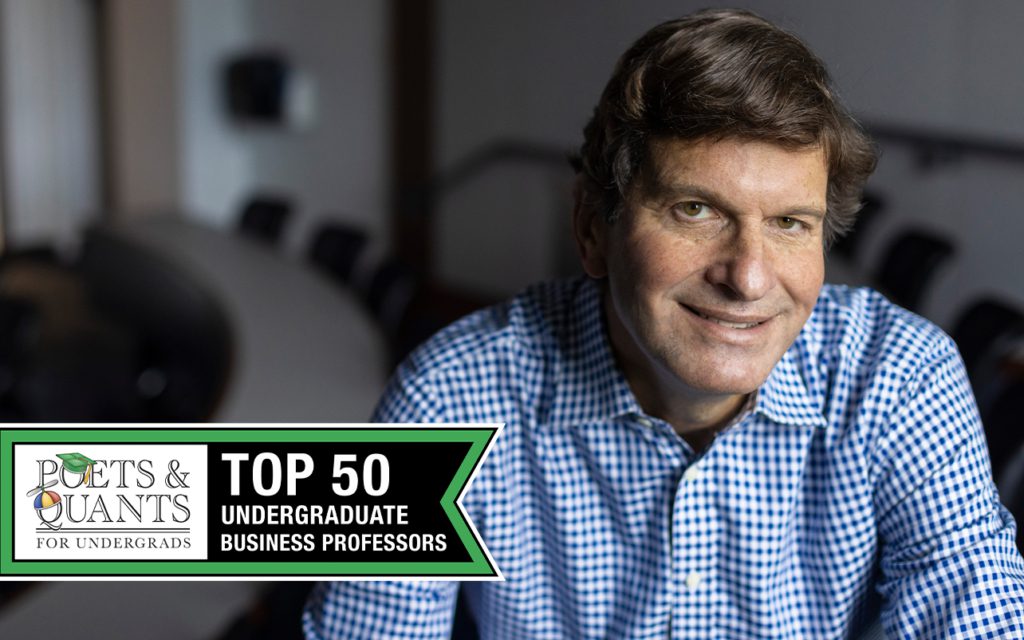
Jeff Rosensweig
Goizueta Business School
Emory University
“Professor Rosensweig has been an instrumental mentor in my experience as a student at Goizueta and as a fellow of the Robson Program for Business, Public Policy, and Government, which he chairs. He has completely shaped my Emory experience. Professor Rosensweig thrives on human connection, and the impact he has on his students extends far beyond the classroom. His unfailing support has provided me with happiness, courage, and confidence—teaching me that expressing gratitude daily is food for the soul. I am deeply grateful to him for helping me embrace the ambiguity of life and move forward with the knowledge that I am both worthy and capable.” – Grayson Culliford
Jeff Rosensweig, 68, is an Associate Professor of International Business and Finance and the founding Director of the John Robson Program for Business, Public Policy, and Government at Emory University’s Goizueta Business School.
Rosensweig launched the Robson Program to bring students into direct conversation with the world’s most influential leaders in business, government, and global affairs. Under his direction, the program has hosted speakers such as Dr. Jane Goodall; the Supreme Allied Commander of NATO; the CEOs of UPS, Delta, Yahoo, and The Home Depot; and the first woman president of Ireland.
Throughout his distinguished career, Rosensweig has earned numerous awards for excellence in and out of the classroom. He received the university’s Thomas Jefferson Award, the highest honor given annually among its 25,000 employees. Past recipients include prominent scientists, physicians, deans, and university leaders. The Wall Street Journal once named him among its twelve favorite executive MBA professors worldwide.
“I still teach executive MBAs, but my interest in teaching and mentoring BBAs has grown. Thus, this P&Q honor is deeply meaningful to me,” he says.
He is the author of Winning the Global Game: A Strategy for Linking People and Profits and has published additional works with leading academic and trade publishers. His expertise in global economics and international business has made him a frequent commentator on CNN and a sought-after keynote speaker for C-suite audiences around the world.
Beyond the classroom, Rosensweig is a lifetime member of the U.S. Council on Foreign Relations and a dedicated mentor to many of Emory’s most successful graduates. His mentees include a prime minister, several CEOs, and the CEO of UNICEF.
BACKGROUND
At current institution since what year? 1988
Education: Yale, M.A. and B.A. in Economics; Oxford University, M.A. as a Marshall Scholar. Philosophy, Politics, and Economics; M.I.T. Ph.D. in Economics, MIT Fellowship
List of Undergraduate courses you teach: Global Macroeconomic Perspectives
TELL US ABOUT LIFE AS A BUSINESS SCHOOL PROFESSOR
I knew I wanted to be a business school professor when … I was working at the Federal Reserve when my alma mater, Yale, asked me to be a visiting professor. I taught Money and Banking in Yale’s undergraduate college and international finance in Yale’s business school. I found that I love teaching and the business school environment, especially the talent, drive, and urge to develop shown by business students.
What are you currently researching and what is the most significant discovery you’ve made from it? I have been researching the economics of competition in the travel and tourism industry for a long time. My most recent interest is in the potential for “medical tourism” to be a major growth source for international trade in services.
If I weren’t a business school professor, I’d be … A TV sports commentator. I love attending or viewing sports competitions, and I have always been a public speaker, so this would be a fun and fulfilling way to combine them.
What do you think makes you stand out as a professor? Always trying to inspire and engage as well as inform. Creating highly relevant and timely original material.
One word that describes my first time teaching: Enthusiastic. The summer right after graduating college I got a job teaching some college courses. I was able to talk my way into this because Yale gave me a master’s degree simultaneously with my bachelor’s degree. I was 22 and many of the students had been in the working world; I was one of the youngest in the room. My enthusiasm kept me from being nervous.
Here’s what I wish someone would’ve told me about being a business school professor: Frankly, nothing. I envisioned it as the most fulfilling profession, and it has been.
Professor I most admire and why: James Tobin. He showed me the importance of teaching and mentoring undergraduates. It was clear that he would win the Nobel Prize and he did a few years later. He could have just taught Ph.D. students. Yet he taught a senior seminar for 24 students. I persuaded him to let me take it as a sophomore. He kept the class small so that he could help mentor us as well as share his vast knowledge.
TEACHING BUSINESS SCHOOL STUDENTS
What do you enjoy most about teaching business students? The students know what is happening in the world across its many dimensions. They are attuned to the US and global economy, geopolitics, cultural shifts, financial markets, and trends and current events in business. They are often the best students at universities in blending the theoretical with the “street-level” practical.
What is most challenging? Holding students’ interest. Business students are so busy networking, involved in activities such as sports, have social lives (a good thing!), working part-time, etc. that making their studies “job one” can be a challenge.
In one word, describe your favorite type of student: Inquisitive. Truly wants to learn, not just get a great grade or job. However, I do recognize that grades and jobs do count.
In one word, describe your least favorite type of student: Disengaged. Only gets interested right before the midterm and the final exam.
When it comes to grading, I think students would describe me as … Rigorous but fair. The professors that taught me had high standards, and I carry that forward. In over three decades of teaching many thousands of students, not one of my students has said that my grading is unfair. However, many have said: “your grading is fair, but you’d be my hero if you change it to an ‘A.’”
LIFE OUTSIDE THE CLASSROOM
What are your hobbies? Swimming and weightlifting are my preferred exercises. I try to get to the coast whenever possible. I am a sports fanatic and believe I spend too much time following sports. For example, college basketball/football.
Travel is a key hobby. I travelled to other nations each vacation during my years at Oxford and have been inspired by global travel ever since.
How will you spend your summer? I have the good fortune to give speeches at conferences for business leaders. I travel to them over the summer. My wife and I always take one big trip in the summer: 2023 – Africa; 2024 – Italy; 2025 – France.
2026: Please send in suggestions!
Favorite place(s) to vacation: Hands down, the beach! I have ridden the waves on a number of continents.
Favorite book(s): The Art of Fielding. Perhaps not widely-known, it is wonderfully written and combines things that I love: sports, college life, and students developing as people and forming meaningful friendships.
What is currently your favorite movie and/or show and what is it about the film or program that you enjoy so much? Castaway, starring Tom Hanks. It is an oldy but goody. It is so good that it is still constantly streaming. Why do I enjoy it so much? My wife, a CNN anchor, appears in it.
What is your favorite type of music or artist(s) and why? Reggae; I lived in Jamaica for parts of four years consulting on economic policy for the government. I admire Jamaicans and their culture, and reggae comprises masterful musicality and meaning.
THOUGHTS AND REFLECTIONs
If I had my way, the business school of the future would have … more interactions with other parts of the university. Goizueta’s Senior Associate Dean and BBA Director, Andrea Hershatter, was way ahead of the curve in creating pathways for Emory Arts and Sciences College students to collaborate with business students. For example, seeing how AI will replace routine tasks, she has enabled our students to focus on creativity, working with film and media studies, design programs, etc. We have many BBAs who double major in, for example, psychology or chemistry. I would like all business schools in the future to feature that.
In my opinion, companies and organizations today need to do a better job at … Providing role models, not just mentors –although wise and caring mentors are crucial. These role models would embody great interpersonal skill, the highest integrity, and communication ability that comprises superb listening as well as speaking skill. I am often asked: “What is most important to become a business leader, IQ or EQ?” I answer that someone needs both. We need to develop both hemispheres of our brain: the left or analytic side, and the right side which develops empathy and creativity.
I’m grateful for … Having a job which I would do even if I was not being paid. PLEASE do not tell my dean that! It keeps me learning every day, I get to work with great colleagues and superb students, and the benefit of teaching specifically in a business school is you can enjoy working with outstanding business executives and community leaders.
My job keeps me young. I’m 68, older than most faculty selected by P&Q here. Working with brilliant, dynamic, and idealistic BBAs vivifies me.
Most important, I’m grateful for my family. That includes three granddaugthers!
DON’T MISS THE ENTIRE ROSTER OF 2025’s 50 BEST UNDERGRADUATE BUSINESS SCHOOL PROFESSORS.
© Copyright 2026 Poets & Quants. All rights reserved. This article may not be republished, rewritten or otherwise distributed without written permission. To reprint or license this article or any content from Poets & Quants, please submit your request HERE.


