





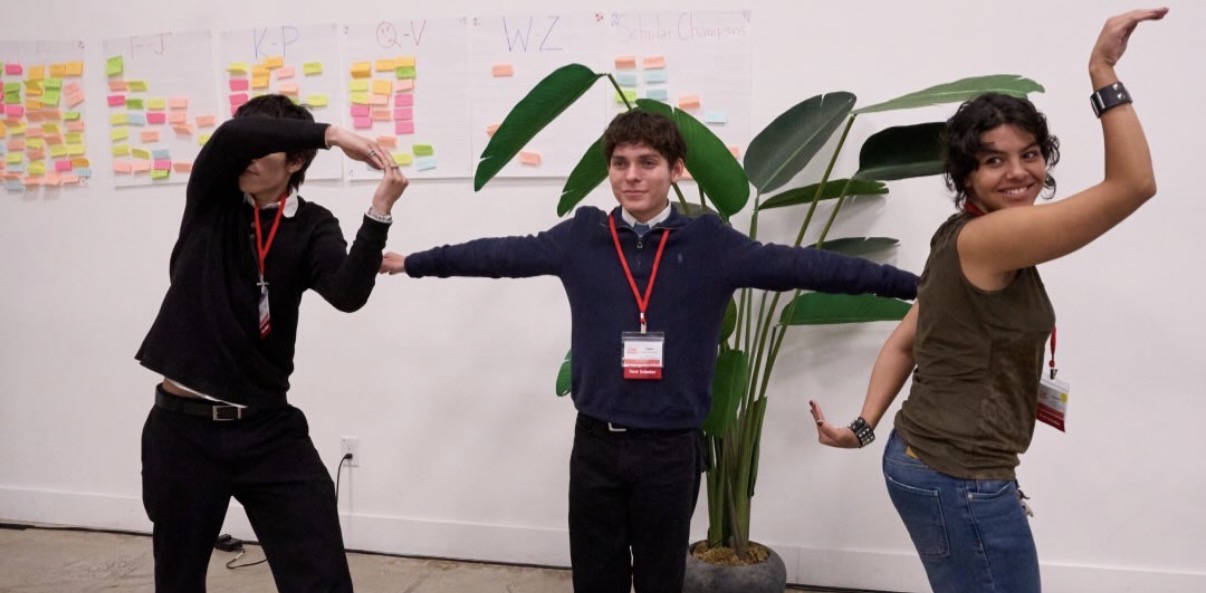
Carlos (Center) with other Ready to Succeed (RTS) participants.
I came to Haas to study business. I ended up studying who gets opportunity.
When I was admitted to Haas during my senior year of high school, I thought I had a good idea of what business school would teach me. I had already earned an associate degree in accounting and business administration alongside my high school business pathway. I knew bookkeeping, Excel, marketing, and the language of finance. I thought Berkeley would simply take that foundation further.
What I did not expect was for business school to make me think about something more personal: who actually gets to participate in the systems that move accessibility and opportunity?
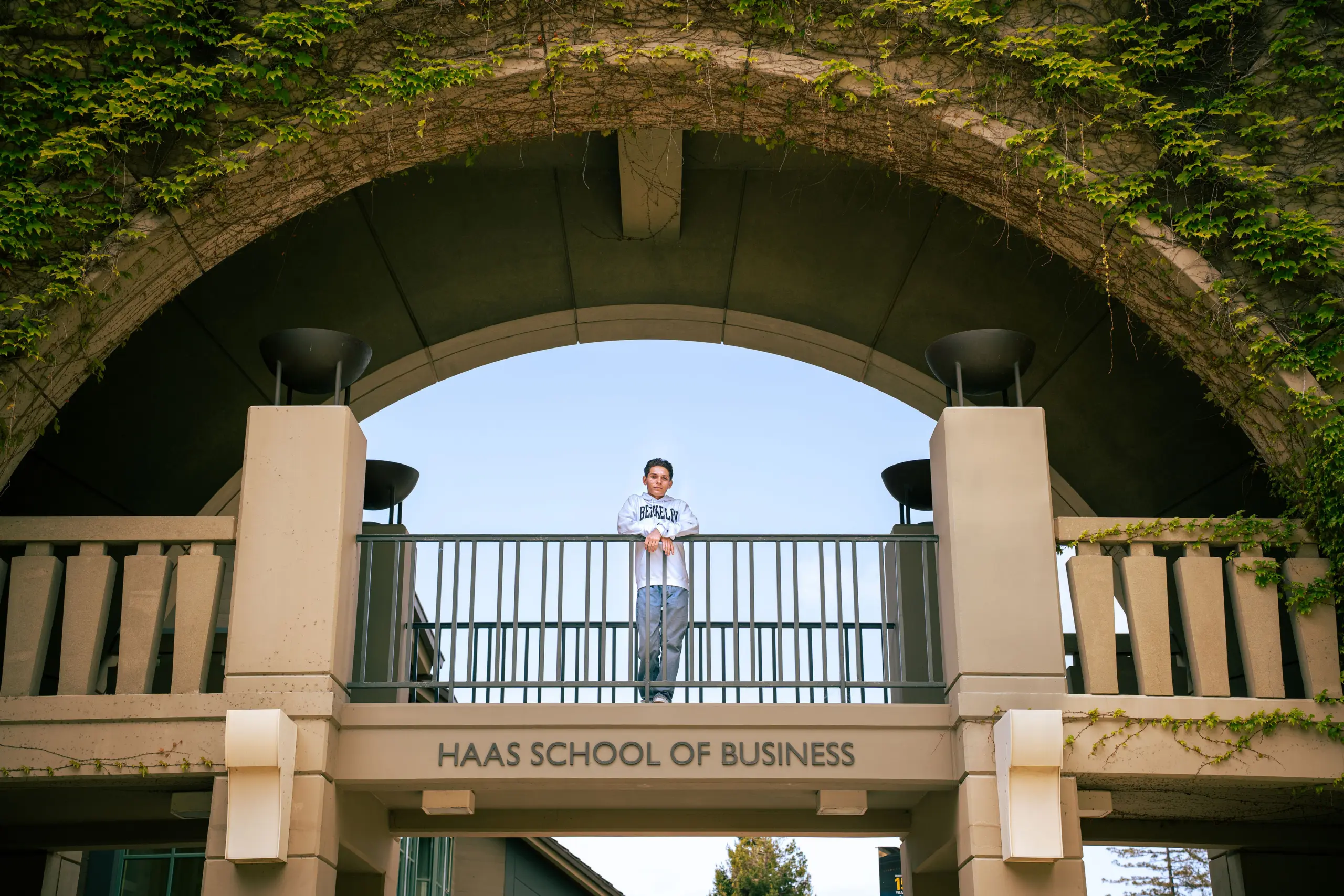
Carlos at Cal Day, posing near the Haas frame.
FINDING A MISSION
Since coming to Berkeley, I have started noticing opportunity everywhere. Sometimes, it is knowing about an internship before the deadline. Other times, it is understanding that a coffee chat is an informal networking conversation that can give you an edge in the recruiting or hiring process. Occasionally, it is a professor telling you, “Apply for this – you fit it” before you would have imagined yourself there.
I grew up in Long Beach in a low-income, single-parent household, where money meant stability long before it meant investment. At Haas, what felt new was hearing classmates talk casually about investing or putting money away while I was still thinking about how my own income could help support my family. We were all studying finance, but we were not necessarily experiencing money from the same starting point.
That contrast made me want to explore work that could have an impact beyond myself. I became increasingly interested in philanthropy and nonprofit work because I wanted to understand how resources could strengthen communities like the ones that shaped me.
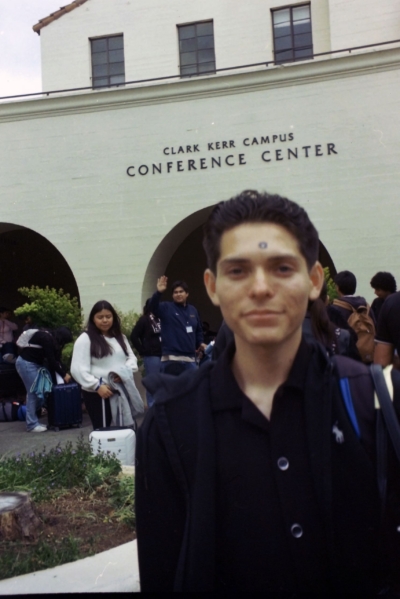
Berkeley’s Senior Weekend, a program that gives first-generation, low-income students of color the opportunity to spend three days exploring Berkeley before committing, so they can get a better sense of campus and student life.
FROM THEORY TO REALITY
During Spring 2026, I had the opportunity to help review grants with the Berkeley Public Schools Fund. On paper, I was evaluating whether projects aligned with funding priorities, how much support they should receive, and whether the case they presented was strong enough. But the experience felt much more complicated than that. Some projects I wanted to see funded did not make the strongest case for themselves. At the same time, organizations were not in the room to advocate for their ideas. Suddenly, I was helping make decisions about which opportunities received resources, how much they received, and why.
That made capital allocation feel much less theoretical.
It also changed how I understood the opportunities that brought me to Berkeley. Programs like The Achievement Award Program and Ready to Succeed, along with scholarships from my community, helped make attending Haas financially possible. They also gave me access to information and opportunities that are easier to find when someone already understands how these systems work.
I experienced the opportunity long before I understood the system behind it.
That may be the biggest change in how I think about business today. I still want to understand how organizations create value, but I am just as interested in who gets the resources, relationships, and trust needed to create it.
Eventually, many of us studying business will become the people making those decisions.
So the question I keep returning to is simple: when we say we want to create opportunity, who gets to receive it, who gets to decide, and why?
Bio: Carlos Guadamuz-Bielma is a student at UC Berkeley studying Business Administration through the Haas School of Business’s Spieker Undergraduate Program, with additional interests in rhetoric and public policy. A first-generation Latino student from Long Beach, California, Carlos grew up in a low-income, single-parent household and spent part of his childhood in foster care. He also identifies as LGBTQIA+, experiences that have shaped how he thinks about money, education, access, and opportunity.
At Berkeley, Carlos has become especially interested in the intersection of business and social impact. Through work in philanthropy, donor analytics, fundraising, and grant strategy, he has grown increasingly curious about how institutions decide where resources go, whose ideas receive support, and what creates opportunity in the first place.
Carlos is still exploring where his interests in business, education, philanthropy, public policy, and law will ultimately take him. Through Poets&Quants, he hopes to share an honest perspective on navigating Haas and Berkeley while reflecting on how his background continues to shape the way he understands business, opportunity, and the institutions behind both.
© Copyright 2026 Poets & Quants. All rights reserved. This article may not be republished, rewritten or otherwise distributed without written permission. To reprint or license this article or any content from Poets & Quants, please submit your request HERE.


