





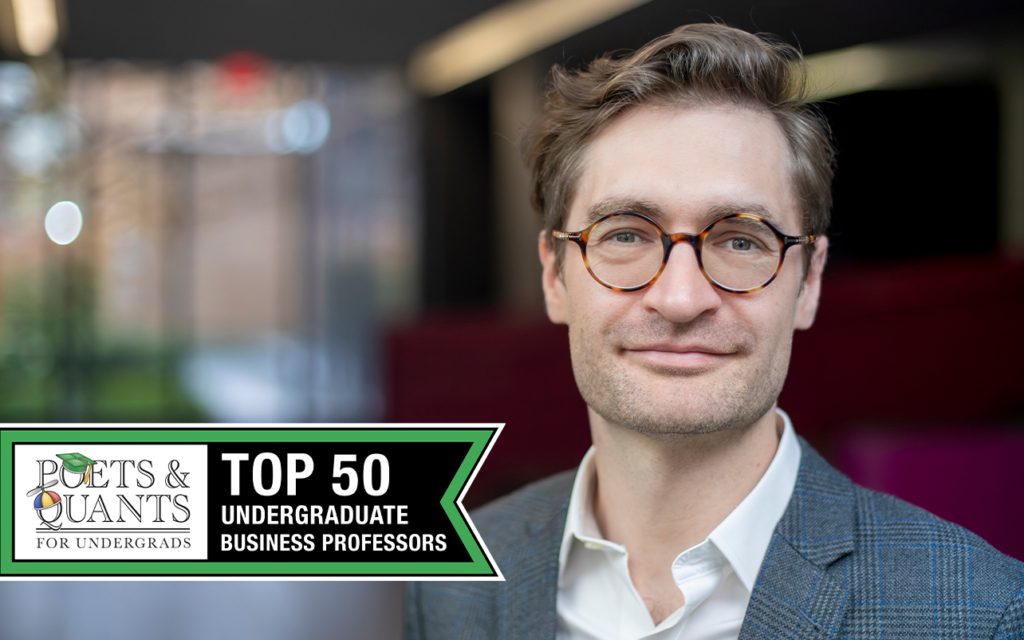
Alexandre Corhay
Rotman School of Management
University of Toronto
“Professor Corhay’s impact on the undergraduate students is both unusually large and unusually personal. He teaches and coordinates 15+ sections annually of our core introductory undergraduate finance course, recognized with a Rotman teaching award every single year since joining the University: that’s nine years and counting … He is known for his calm, step-by-step coaching, guiding students to discover answers rather than handing them over. This mentorship is incredibly valuable and goes above and beyond expectations.” – Mike Simutin, Professor of Finance, CIT Chair in Structured Finance, Rotman School of Management
Alexandre Corhay, 38, is an Assistant Professor of Finance at the Rotman School of Management, University of Toronto, where he has taught since 2016. He holds a PhD in Finance from the University of British Columbia, an MSc in Finance from HEC Montréal, and a BCom from the Université de Liège in Belgium.
Professor Corhay’s research sits at the intersection of macroeconomics and finance. He examines how market power and competition shape firms’ innovation, risk, and valuations — and, by extension, aggregate growth and asset prices. He also studies how monetary policy transmits through firms and financial markets, emphasizing how credit risk, balance sheets, and market structure mediate policy’s broader effects on the economy. His work has been published in leading academic journals, including the Review of Economic Studies, the Journal of Finance, the Journal of Financial Economics, and the Review of Financial Studies. His research has received multiple competitive grants and awards.
At Rotman, Professor Corhay teaches Capital Market Theory and Portfolio Management across undergraduate and MBA programs. He is known for blending rigorous analytical frameworks with real-world application and mentorship. His clarity and enthusiasm in the classroom have earned him outstanding teaching evaluations, multiple teaching awards, and recognition for his contributions to curriculum design and student development. He also frequently collaborates with industry partners to create experiential learning opportunities that help students bridge theory and practice.
BACKGROUND
At current institution since what year? 2016
Education: Ph.D., Finance, Sauder School of Business, University of British Columbia; MSc, Finance, HEC Montréal; BA, Economics, Université de Liège
List of Undergraduate courses you teach: Capital Market Theory, Supervision of independent research projects for students
TELL US ABOUT LIFE AS A BUSINESS SCHOOL PROFESSOR
I knew I wanted to be a business school professor when …
… I realized that my ideal job was reading, thinking, and talking to curious people all day — and somehow they would let me do that as a career.
What are you currently researching and what is the most significant discovery you’ve made from it? Right now, I’m studying how inflation and monetary policy affect companies and financial markets. In a recent paper published in the Review of Economic Studies, we found that inflation doesn’t just make things more expensive—it also reshapes balance sheets across the economy. When prices rise, it actually helps indebted firms because they can repay their loans with “cheaper” dollars. In other words, inflation can inflate away their debts.
But the other side of the story is that banks and financial institutions, which hold a lot of long-term fixed-income assets, see their balance sheets weaken since those assets are now repaid in cheaper dollars. So, inflation creates winners and losers, and that tug-of-war really determines whether monetary policy stabilizes the economy or makes it more fragile.
I love this topic because it connects macroeconomics, finance, and real-world policy. And it ties directly to what I teach—when we discuss interest rates or central bank decisions in class, students can see exactly how these mechanisms play out in practice.
If I weren’t a business school professor, I’d be … an economist at a central bank—or some researcher who spends too much time building models just for fun. I’ve always loved connecting numbers to stories about how the world works.
What do you think makes you stand out as a professor? Probably the way I combine rigor with approachability. Finance can be intimidating, so I work hard to make it intuitive—breaking down complex ideas and showing how they connect to real-world decisions. I use hands-on projects and discussions so students see finance in action, and I connect them with upper-year peers interning at top banks to build mentorship and confidence. Above all, I try to create a space where students feel comfortable asking questions and taking risks. The best feedback I get is when they tell me they came in scared of finance and left excited about it—that’s when I know I’ve done my job.
One word that describes my first time teaching: Adrenaline.
Here’s what I wish someone would’ve told me about being a business school professor: When people think of professors, they often think only of teaching, but it’s a lot more work than most realize. Teaching is just one piece — research is time-intensive, grant applications are demanding, and there’s a constant cycle of presenting your work, discussing others’, and navigating meetings and administration. It’s fascinating and deeply rewarding intellectually, but definitely not a light workload.
Professor I most admire and why: I don’t have one professor I most admire, but I’ve always looked up to those who combine intellectual rigor with humility — the ones who make you think harder without making you feel smaller. I’ve also learned from the opposite kind: the professors who seemed disengaged or just going through the motions. They showed me, in their own way, the kind of teacher I never wanted to become.
TEACHING BUSINESS SCHOOL STUDENTS
What do you enjoy most about teaching business students? Their curiosity and drive to connect ideas to the real world. They’re not satisfied with theory for theory’s sake—they want to know how it applies, how it works in practice. That makes every class dynamic and interactive.
What is most challenging? The hardest part is helping students overcome the initial fear that finance is “too technical” or “not for them.” Many come in a bit intimidated, and it takes time to build their confidence. But that challenge is also what makes the job so rewarding—seeing those same students later solving problems, debating ideas, and realizing they can do this after all.
In one word, describe your favorite type of student: Curious.
In one word, describe your least favorite type of student: Passive
When it comes to grading, I think students would describe me as … Students would probably say I’m fair but firm. I hold them to a high standard, but I’m also very clear about what’s expected and always open to explaining feedback.
LIFE OUTSIDE THE CLASSROOM
What are your hobbies? Outside of work, I love to travel, hike, and spend time with my family—especially my two kids, who make sure I stay very up to date on what’s cool and what’s not in the world of memes. They’ve also given me the perfect excuse to re-live some of my own childhood fun—building endless Lego sets, having Star Wars movie nights, or even playing Fortnite together. It’s a great way to unwind, laugh, and remind myself not to take life too seriously.
How will you spend your summer? This summer I’ll be traveling quite a bit—some for conferences, and some to visit family abroad (Asia and Europe). In between, I’m hoping to enjoy the quiet stretch without teaching to focus on my many research projects.
Favorite place(s) to vacation: Anywhere with a good mix of history, beautiful nature, delicious food, and great company—whether it’s family or close friends.
Favorite book(s): Tintin (Hergé) — a childhood classic and part of my DNA as a Belgian. As for literature, The Brothers Karamazov (Dostoevsky) is currently on my nightstand.
What is currently your favorite movie and/or show and what is it about the film or program that you enjoy so much? I really enjoyed Oppenheimer — not just for its academic dimension, but for how it portrays the uneasy mix of science, politics, and responsibility. It’s a powerful reminder of how research never happens in a vacuum, for better or for worse.
What is your favorite type of music or artist(s) and why? I often have music on when I work, but lyrics distract me — so I stick to instrumentals. I grew up on electronic beats (the Daft Punk generation!) but have also developed a soft spot for jazz and classical.
THOUGHTS AND REFLECTIONS
If I had my way, the business school of the future would have much more of this … genuine curiosity — less focus on perfect answers, more on asking better questions. The real value of a business education isn’t in teaching what machines can already do faster, but in cultivating the kind of curiosity and judgment that machines can’t replicate.
In my opinion, companies and organizations today need to do a better job at … valuing intellectual honesty over convenient narratives. It’s easy to tell stories that fit the data; it’s harder (and far more valuable) to let the data challenge the story.
I’m grateful for … my students, who keep me curious; my colleagues, who keep me sharp; and my family, who keep me humble. I’m also deeply thankful to the Rotman School of Management for taking a chance on me when I was still a freshly minted PhD and for giving me the support and resources to grow into this career. Not everyone gets to turn their passion into a profession, and I try not to take that for granted.
DON’T MISS THE ENTIRE ROSTER OF 2025’s 50 BEST UNDERGRADUATE BUSINESS SCHOOL PROFESSORS.
© Copyright 2026 Poets & Quants. All rights reserved. This article may not be republished, rewritten or otherwise distributed without written permission. To reprint or license this article or any content from Poets & Quants, please submit your request HERE.


