






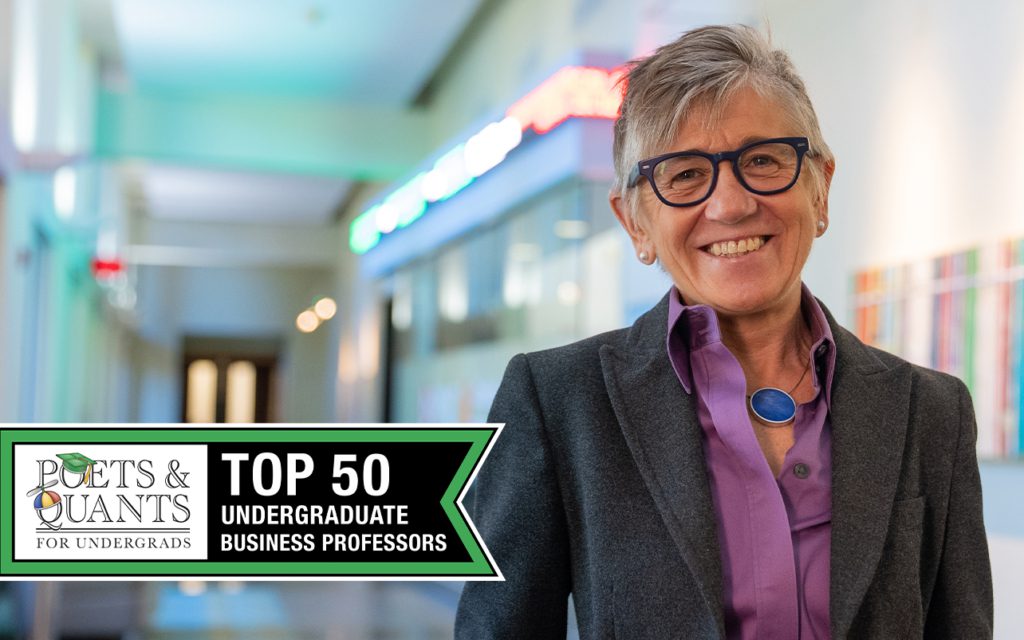
Arzu Ozoguz
Kenan-Flagler Business School
University of North Carolina
“What makes Dr. Arzu Ozoguz so deserving of this award is not just the number of students she reaches, but the way she transforms how they think about business and economics. She teaches more undergraduates than almost any other faculty member at UNC Kenan-Flagler, and yet she never allows scale to dilute quality. Students consistently describe her classes as rigorous, inspiring, and career-shaping.
Her most significant contribution is the creation of Applied Micro Economics (BUSI 402), a required course she designed and delivers from scratch in a large lecture format of 200 students per section. Applied Economics is now a cornerstone of the curriculum, providing every business major with a foundation for decision-making that is both theoretically sound and immediately practical. Students rave about the way she takes abstract economic models and translates them into tools for solving real-world problems.
Arzu does not let her students hide behind formulas or memorize frameworks. Instead, she pushes them to apply ideas to current events, company decisions, and policy debates. She draws them into discussions, challenges them to defend their reasoning, and gives them the confidence to wrestle with ambiguity. At the same time, she is approachable, generous with her time, and unfailingly invested in her students’ success. Students know she cares about them not just as learners, but as people—and they respond with admiration and gratitude.” – Shimul Melwani, Associate Dean, Undergraduate Business Program, Kenan-Flagler Business School
Arzu Ozoguz, 55, is a Clinical Professor of Finance at UNC Kenan-Flagler Business School teaching undergraduate and MBA Corporate Finance and Entrepreneurial Finance courses.
Her research explores the intersection of information in financial markets and real investment decisions with an agenda that crosses over both asset pricing and corporate finance fields.
Her work has been published in several journals such as the Review of Financial Studies and Journal of Financial Economics and won Best Paper Awards from the Western Finance Association and Financial Management Association.
BACKGROUND
At current institution since what year? Since 2006, but I went away for nearly a decade and came back in 2019
Education: BA, Oberlin College; MBA, Koç University; PhD, INSEAD
List of Undergraduate courses you teach: Applied Microeconomics, Advanced Corporate Finance, Entrepreneurial Finance
TELL US ABOUT LIFE AS A BUSINESS SCHOOL PROFESSOR
I knew I wanted to be a business school professor when … I was an MBA student and I started going to finance area research seminars – admittedly, most of it probably went over my head at the time, but it gave me a glimpse of this world where your job is to do research to create knowledge, answering interesting (economics) questions with significant business or policy implications and then disseminate that knowledge to others through teaching. Perfect for a life-long learner.
What are you currently researching and what is the most significant discovery you’ve made from it? This is a little different from my typical research area and what I’ve done in the past, but recently, I am really interested – probably because of what I teach – in private capital funds, equity and credit, how private capital investments affect financial results and economic outcomes. Specifically, I am interested in understanding how its “retailization” – increased access to retail investors – affect private markets, what are benefits and risks to retail investors, what about equilibrium returns and allocations. I do not yet know the answers. These are really important questions with great policy implications. It is exciting.
If I weren’t a business school professor, I’d be … in some life I’d want to be a chef, but more realistically, probably I’d be working as an economist at a policy think-tank, trying to shape policy through research
What do you think makes you stand out as a professor? I imagine that my classes are pretty engaging. First, I am naturally loud. But, more importantly, I try to create a lively interactive environment that is also occasionally somewhat humorous. I know this sounds a bit cliché: I value being able to connect with my students on a personal level. I would like my students to feel a sense of community in the classroom and know that I see them as a person with ups and downs, beyond just the grades. Each class, and, of course, each student is a little different; however, I would say we usually build a connection.
One word that describes my first time teaching: I’ve got two words: ambitious rookie
Here’s what I wish someone would’ve told me about being a business school professor: (a) You will never stop learning. (b) Teaching is the most impactful thing you will do.
Professor I most admire and why: This is hard as I am surrounded by really impressive colleagues at UNC Kenan-Flagler, but Jennifer Conrad is who I admire most. She is a colleague and mentor, who just recently retired. A leading researcher, excellent teacher, invaluable colleague and all that with humility and humor. I am so grateful I got to know her and have her as a colleague.
TEACHING BUSINESS SCHOOL STUDENTS
What do you enjoy most about teaching business students? I am extremely lucky that I get to teach amazing students at UNC Kenan-Flagler. Our students are smart, motivated, curious, genuinely nice and caring. I am always amazed how much they juggle at all times and accomplish. It makes me hopeful about the future of the world when I think of them as future business leaders. Also, it is deeply gratifying when my students can relate an insight they learned in my class to a current real-world business or economic situation and can form an opinion on why it matters, and how it matters, and what possible consequences are.
What is most challenging? Attention has become the most scarce resource. We are tied to our devices, and students are understandably no different. I feel like we could all benefit from putting our devices away a little, especially in the classroom.
In one word, describe your favorite type of student: Curious
In one word, describe your least favorite type of student: Dishonest
When it comes to grading, I think students would describe me as … fair. I think my students know they will be challenged and the work will be rigorous, but it will be rewarding and the grading will be fair.
LIFE OUTSIDE THE CLASSROOM
What are your hobbies? Running, running, running (seems like that’s all I do), hiking, reading, cooking and entertaining
How will you spend your summer? I am involved with a non-profit organization called Girls Who Invest whose mission is to increase the number of women in asset management. I usually teach some days in their summer intensive program in early summer, followed by hopefully a bit of travel with my partner to a place that has a beach and possibly squeezing some time with family and friends in Turkey.
Favorite place(s) to vacation: The Aegean Coast of Turkey
Favorite book(s): I seem to have favorite authors: anything written by Haruki Marukami, Emily St. John Mandel, Patricia Highsmith and Orhan Pamuk.
What is currently your favorite movie and/or show and what is it about the film or program that you enjoy so much?
We just finished watching the show “The Bear.” It was so good, but at the same time very stressful. It definitely kills any romantic fantasies one may have about being a chef at a restaurant.
What is your favorite type of music or artist(s) and why? I have a really wide range of music likes. Recently I’ve been into bluegrass, probably because in my mind, it is similar to jazz with fiddle and banjo. I like how the instruments talk to each other.
THOUGHTS AND REFLECTIONS
If I had my way, the business school of the future would have much more of this … A much more interdisciplinary curriculum than one that is structured around functional areas with an emphasis on experiential learning, leveraging AI for tools with greater student focus on critical thinking, and the ability to apply judgment and navigate nuances.
In my opinion, companies and organizations today need to do a better job at … treating climate risk as a serious, core, existential, operational issue.
I’m grateful for … my family and friends.
DON’T MISS THE ENTIRE ROSTER OF 2025’s 50 BEST UNDERGRADUATE BUSINESS SCHOOL PROFESSORS.
© Copyright 2026 Poets & Quants. All rights reserved. This article may not be republished, rewritten or otherwise distributed without written permission. To reprint or license this article or any content from Poets & Quants, please submit your request HERE.


