





Tiantian Yang
The Wharton School
University of Pennsylvania
“She is one of the most dedicated and genuine professors I have worked with. I was both her student and her teaching assistant, and I was struck by how she was constantly trying to better the experience of students; consistently asking for the TA’s and students’ thoughts on curriculum, discussions, classroom practices, methods of assessment, total workload, etc.
“Especially because the field of management has lots of gray areas where there is no one solution, Yang emphasizes the importance of open discourse. She gives ample opportunity for students to question and debate existing beliefs and viewpoints. Her class ‘People Analytics’ focuses on how we can quantify the very qualitative aspects of management like communication quality, relationships, and organizational effectiveness, using R software. For many students this is their first time using R or trying to convert qualitative qualities into quantitative data that can then be analyzed. This skill is increasingly valuable in the private sector, and Yang makes sure she teaches it in a way that prioritizes students familiarizing themselves with solving a variety of problems in R over just getting one answer correct.
“As a researcher, she studies inequalities in career attainment, especially in entrepreneurship, across gender and racial lines, as well as how entrepreneurial organizations succeed. This research is not only incredibly influential on the field as a whole, as it attempts to close long-held career opportunity gaps to ensure that organizations can truly hire and operate with the best possible candidates, but also helps her prowess as an educator, as this work studying career mobility is very relevant for her students following graduation.” – Carina Li
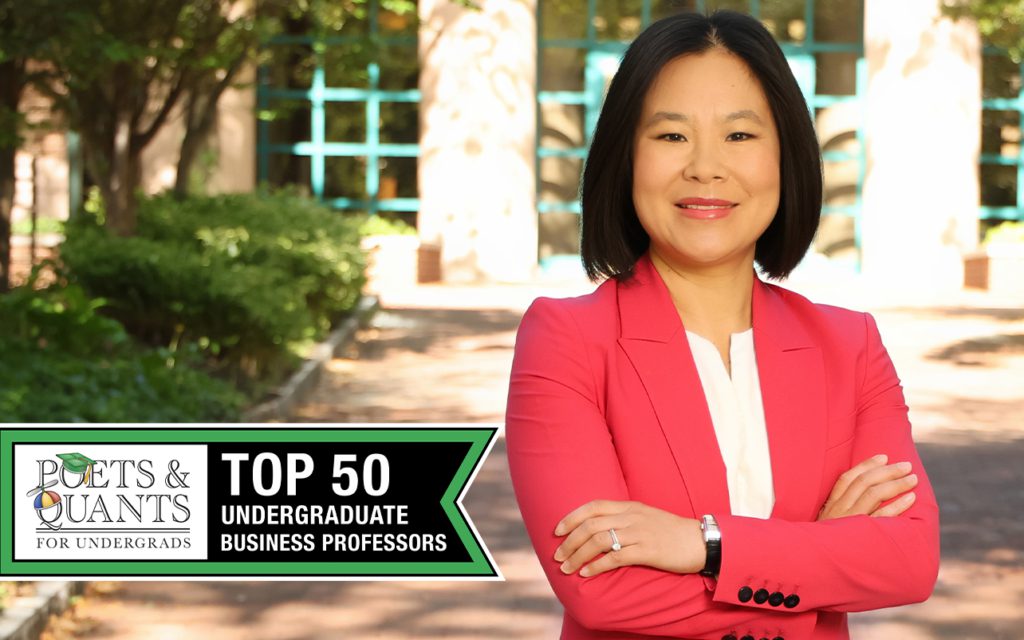
Tiantian Yang, 41, is a management professor at University of Pennsylvania’s The Wharton School.
Her research examines the strategies individuals use to advance their careers, with a particular focus on how they navigate and shape career opportunities—and why some succeed while others fall short.
Her work has been published in top management and sociology journals, including American Sociological Review, Organization Science, Strategic Management Journal, Academy of Management Journal, MIS Quarterly, and Journal of Management. She is a winner of the Kauffman Dissertation Fellowship and the Kauffman Junior Faculty Fellowship.
At Wharton, she teaches two courses: Managing Careers and People Analytics. In Managing Careers, she helps students learn to navigate their professional paths and develop into organizational leaders—students describe the class as providing a valuable roadmap for their careers. In People Analytics, she equips students with data-driven tools to guide management decisions and helps them recognize the strategic value of data in managing people.
She has won the Wharton Teaching Excellence Award in Undergraduate Teaching three times.
Beyond academia, Yang advises organizations on talent and career management, integrating her expertise in how individuals make career decisions with how organizations make personnel decisions.
BACKGROUND
At current institution since what year? 2020
Education: PhD Sociology, The University of North Carolina-Chapel Hill
List of Undergraduate courses you teach: People Analytics, Managing Careers
TELL US ABOUT LIFE AS A BUSINESS SCHOOL PROFESSOR
I knew I wanted to be a business school professor when … I was working on my dissertation about entrepreneurship as a career path in the Sociology department at the University of North Carolina-Chapel Hill. My perspectives on entrepreneurship were shaped by sociological work on occupations, collective action, and labor markets. I attended many conferences for management scholars in business schools. I realized that business schools would allow me to do research as a sociologist while providing a platform to teach students and make a practical impact on businesses.
What are you currently researching and what is the most significant discovery you’ve made from it? I study how individuals cope with career challenges (e.g., employer rejections of job applications), career disruptions (e.g., labor force exits due to childbearing), and organizational disruptions (e.g., mergers and acquisitions). I found that identity, such as gender, race, and motherhood, plays a major role in shaping how individuals react to career challenges. Sometimes identity can be helpful because members of underrepresented groups may seek and receive help from those who are similar with them; other times, identity creates challenges for help-seeking especially when an identity-based lens negatively influences how individuals perceive their own ability and career fit.
If I weren’t a business school professor, I’d be … A writer. I’ve been drawn to storytelling since I was a kid—crafting fictional essays that won awards in secondary school and high school. I loved inventing worlds and characters, then watching readers get lost in the stories I’d created.
But somewhere along the way, I became fascinated with a different kind of truth. When I was choosing my college major, I pivoted toward journalism. I wanted to uncover real stories, not invent them. The problem? Journalism faced significant constraints where I attended college.
That’s when I had a realization: research is journalism with rigor. Instead of chasing stories on a deadline, I could investigate questions systematically, using data to reveal patterns others might miss. The core impulse remained the same—finding compelling narratives and sharing discoveries—but now the stories were grounded in evidence rather than imagination.
In some ways, I’m still that kid who loves telling stories. I’ve just switched from fiction to finding the truth hidden in the data😊
What do you think makes you stand out as a professor? I am deeply knowledgeable about the topics I teach, and I am a passionate teacher. I care deeply about teaching my students something valuable, and I continually work to improve as a communicator and speaker. I read extensively about college education and pedagogy, and I am constantly learning and refining my teaching skills. Because I bring my own curiosity and enthusiasm to each class, my students become inspired and want to learn more.
One word that describes my first time teaching: Nervous.
Here’s what I wish someone would’ve told me about being a business school professor: How exciting it could be. People tend to emphasize the challenges and difficulty of being a business school professor. I won’t deny the challenges, but I enjoy learning to overcome them. The process of pursuing self-growth is genuinely fulfilling. It brings me so much joy when students enjoy and learn from my teaching.
Professor I most admire and why: My doctoral advisor, because he’s a guru who loves teaching and mentoring.
He loves teaching students how to write papers. He is a great writer himself and enjoys sharing his expertise with others. He’s also very patient, knowing that research and writing are not skills learned overnight. He was always encouraging but also found ways to challenge me and help me make progress. He led me one step at a time and taught me valuable skills throughout my six years in graduate school.
The high standards he holds for teaching, writing, and research are deeply inspiring.
TEACHING BUSINESS SCHOOL STUDENTS
What do you enjoy most about teaching business students? They are exceptionally bright and driven. They come to class intellectually curious and eager to engage deeply with ideas. They ask questions that challenge me to think in new ways. They contribute insights that transform our discussions from lectures into genuine intellectual exchanges.
The classroom becomes a kind of theater where I’m the conductor and the students form the orchestra. I set the tempo and introduce the themes, but they bring the music to life—sometimes improvising, sometimes harmonizing, always creating something that didn’t exist before we came together. Each class session becomes a creative act, where students inspire one another to generate ideas I could never have produced alone.
That’s what keeps teaching fresh for me. I may teach the same course every year, but my students ensure I never teach the same class twice. Every semester brings new voices, new perspectives, and new discoveries that remind me why I fell in love with this work in the first place.
What is most challenging? Engaging everyone and fully understanding each student’s interests. This is especially true in large classrooms with more than 70 students. I prepare for my classes diligently. I try to memorize every student’s name before our first class. I also arrive at the classroom 15-30 minutes early so I can talk to students before class. These actions send a message to students—you’re a person I’m invested in knowing and connecting with. It transforms the dynamic immediately. Students lean in. They participate more. They take risks in discussion because they feel seen.
In one word, describe your favorite type of student: Curious
In one word, describe your least favorite type of student: Distracted
When it comes to grading, I think students would describe me as … Fair
LIFE OUTSIDE THE CLASSROOM
What are your hobbies? Reading, traveling, running, visiting art museums
How will you spend your summer? Spending more time with family; traveling to Europe both for work and for some leisure time; training for a marathon.
Favorite place(s) to vacation: Italy — for the art, food, and slow pace of life.
Sweden — for research projects and spending time with some old friends.
Favorite book(s):
Into the Magic Shop by James Doty
The Gifts of Imperfection by Brene Brown
Outliers: The Story of Success by Malcolm Gladwell
Why Nations Fail by Daron Acemoglu and James A. Robinson
What is currently your favorite movie and/or show and what is it about the film or program that you enjoy so much? I enjoy Fresh Air for its thoughtful interviews and the joy of discovering new ideas, and The Mel Robbins Podcast for its conversations with experts who translate research into real-world wisdom.
What is your favorite type of music or artist(s) and why? I’m drawn to artists who are original and fearless — those who create something new and stay dedicated to their craft long before it’s recognized.
THOUGHTS AND REFLECTIONS
If I had my way, the business school of the future would have much more of this … Device-free classroom learning that fosters genuine human connection and reflection.
In my opinion, companies and organizations today need to do a better job at … Creating meaningful opportunities for young people and cultivating the next generation of global leaders.
I’m grateful for … My family — my husband, my two kids, and my parents — whose love and support inspire me to live my life wholeheartedly.
Every student I’ve had the privilege to teach — their curiosity, courage, and kindness remind me why I love what I do.
DON’T MISS THE ENTIRE ROSTER OF 2025’s 50 BEST UNDERGRADUATE BUSINESS SCHOOL PROFESSORS.
© Copyright 2026 Poets & Quants. All rights reserved. This article may not be republished, rewritten or otherwise distributed without written permission. To reprint or license this article or any content from Poets & Quants, please submit your request HERE.


