






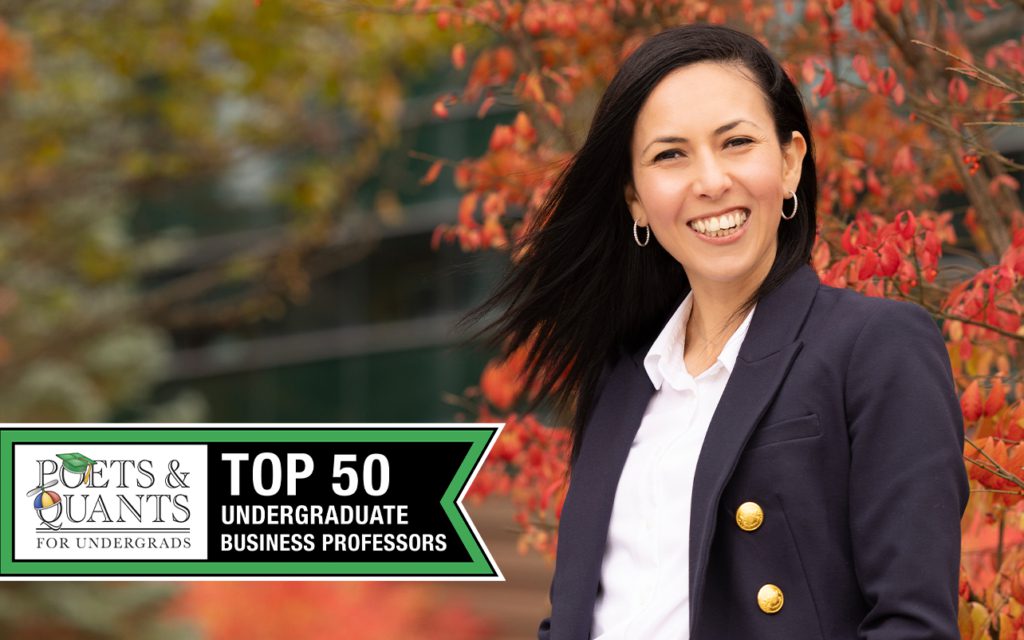
Shiran Froymovich
Binghamton University School of Management
“Professor Froymovich is a one of a kind teacher who makes a real difference in students’ lives. Binghamton is known for its accounting program. To be honest it is prestigious, intimidating, and harder as you get through the courses. Walking into a 300 level accounting class, students feel worried. What am I getting myself into? But very quickly, Dr. Froymovich puts you at ease. Everything is made clear, assignments are manageable, and you walk away learning so much more than Cost Accounting. What students love most about Dr. Froymovich is her relatability. She truly cares about us, our understanding, even how stressed we are. Taking her class allows us to connect to the real world in a tangible way. We know that what we’re learning will be used in the work force and for that we are grateful to Dr. Froymovich. Her impact goes beyond grades or one semester and it’s why I believe she deserves this recognition.” – Ashley Upeslacis
Shiran Froymovich, 39, is Assistant Professor of Accounting at Binghamton University School of Management.
From her first college class, Froymovich was captivated by the power of accounting to tell the story of how a business influences decisions that shape economies and societies. That early curiosity evolved into a career dedicated to making complex financial concepts accessible and meaningful for students while advancing research that addresses some of today’s most pressing challenges.
An award-winning educator and researcher, Froymovich has earned exceptional teaching evaluations (4.9/5) and received the Patty Bloomer SOM Faculty Grant for her innovative use of artificial intelligence in accounting education.
Her research explores how accounting information interacts with macroeconomic forces and sustainability practices. She has published in the Journal of Accounting Research and has additional work under review at other leading accounting journals, including Contemporary Accounting Research, Journal of Accounting and Economics, and Review of Accounting Studies. Her research explores topics including the impact of competition on ESG rating quality, the influence of ESG ratings on corporate behavior, the effects of tariffs on U.S. firms, and the macro-level predictive power of deferred tax asset valuation allowance.
Froymovich is also deeply committed to student success, known for her ability to simplify complex concepts and foster an inclusive, engaging classroom environment. She regularly presents at leading conferences worldwide and serves on academic committees that advance diversity and innovation in business education.
BACKGROUND
At current institution since what year? 2022
Education: Duke University, PhD, Business Administration (Accounting); Ben-Gurion University of the Negev, Master of Arts (MA) in Economics; Open University of Israel, Bachelor of Arts (BA) in Economics & Management
TELL US ABOUT LIFE AS A BUSINESS SCHOOL PROFESSOR
I knew I wanted to be a business school professor when … I discovered how transformative great teaching can be. As a college student, I was fascinated by how accounting connects business decisions to real-world outcomes. That curiosity evolved into a passion for research and a commitment to helping students see the bigger picture behind the numbers.
What are you currently researching and what is the most significant discovery you’ve made from it? My research explores how accounting information interacts with macroeconomic forces and sustainability practices. I am particularly interested in how firm-level financial disclosures can reveal broader economic patterns. One of my most significant findings is that deferred tax asset valuation allowance, often overlooked in traditional analyses, can serve as a leading indicator of GDP growth.
This insight suggests that accounting data, typically viewed as backward-looking, can actually offer forward-looking signals about macroeconomic trends. It bridges the gap between micro-level reporting and macro-level policy, showing how granular financial decisions aggregate into meaningful economic information. This kind of research excites me because it highlights the untapped potential of accounting information to inform not only corporate strategy but also public policy and economic forecasting.
If I weren’t a business school professor, I’d be … A fashion entrepreneur. Ever since I was young, I have been captivated by the creativity, storytelling, and cultural influence of fashion. I see it as more than style – it is a reflection of identity, innovation, and global trends. I would love to build a brand that merges aesthetic vision with data-driven strategy, perhaps focusing on sustainability or consumer psychology. Just as in accounting, fashion tells a story through choices, patterns and purpose. I would find deep fulfillment in shaping that narrative.
What do you think makes you stand out as a professor? I prioritize empathy and inclusivity, creating a classroom where every student feels supported and challenged. I strive to make complex concepts not only accessible but meaningful, connecting rigorous technical content to real-world decisions. My goal is for students to walk away not just understanding accounting, but appreciating its strategic relevance and its power to shape business outcomes.
One word that describes my first time teaching: Exciting. I stepped into the classroom with anticipation and left with a sense of purpose. That first class affirmed my passion for teaching and showed me how powerful education can be in shaping not just knowledge, but confidence and curiosity.
Here’s what I wish someone would’ve told me about being a business school professor Teaching is as much about empowering students as it is about sharing knowledge. Students remember how you made them feel capable of tackling challenges. Building trust, enthusiasm and a sense of empowerment is just as important as explaining the technical details.
Professor I most admire and why: I deeply admire Shelley Dionne, dean of the School of Management at Binghamton University. Her leadership blends intellectual rigor with genuine care for students and faculty. She fosters collaboration, champions innovation and builds a community grounded in trust and inclusivity. Watching her lead with both vision and empathy has shaped my perspective on academic excellence.
TEACHING BUSINESS SCHOOL STUDENTS
What do you enjoy most about teaching business students? Their curiosity and ambition. Business students want to understand how theory translates into practice, and I love showing them how accounting insights drive strategic decisions. Watching them connect classroom concepts to real-world challenges is incredibly rewarding.
What is most challenging? Keeping students engaged in technical material during early morning classes. I tackle this by using interactive exercises and real-world examples that make the content come alive.
In one word, describe your favorite type of student: Curious. Curiosity drives engagement, deepens understanding and sparks the kind of questions that lead to meaningful learning. When students are curious, the classroom becomes a space for exploration and discovery — for them and for me.
In one word, describe your least favorite type of student: Unengaged. When students disengage, they miss out on the opportunity to grow, challenge themselves and contribute to the learning environment. I strive to reignite that spark by connecting the material to their interests and showing them the real-world impact of what they are learning.
When it comes to grading, I think students would describe me as … Fair and transparent. I set clear expectations from the start and provide detailed feedback to help students learn and grow. My goal is to ensure that grading reflects both effort and understanding, while fostering a sense of trust and accountability in the classroom.
LIFE OUTSIDE THE CLASSROOM
What are your hobbies? Traveling and exploring new cultures, hiking scenic trails and discovering unique cuisines. I also enjoy photography and reading books that blend economics, psychology, and storytelling — anything that sparks curiosity and creativity. For an adrenaline rush, I love skydiving, paragliding, and bungee jumping, which challenge me to push boundaries and embrace adventure.
How will you spend your summer? Presenting research at conferences, working on research projects, and spending time outdoors with my family, preferably near the ocean.
Favorite place(s) to vacation: Hawaii for its breathtaking landscapes and sense of tranquility, and Thailand for its vibrant culture, rich history and incredible food.
Favorite book(s): “Thinking, Fast and Slow” by Daniel Kahneman – This book offers profound insights into how people make decisions, blending psychology and economics in a way that is deeply
relevant to accounting and business strategy. It is a reminder that data and judgment must go hand in hand.
Favorite movie/show and why: “The Big Short” because it brilliantly combines storytelling with financial insight, showing how complex systems can unravel when incentives misalign. It is both entertaining and intellectually stimulating.
“Friends” is my comfort show because it reminds me of the power of humor, friendship and finding joy in everyday moments. It is a great balance to the intensity of academic life and a reminder that connection matters just as much as content.
Favorite type of music or artist(s) and why: Billy Joel for his timeless storytelling and versatility. His music reminds me that creativity and structure can coexist beautifully. I also love Hatikva 6, an Israeli band whose lyrics blend social commentary with optimism and cultural pride. Their music brings together reggae, pop and Middle Eastern influences in a way that is both energizing and meaningful.
THOUGHTS AND REFLECTIONS
If I had my way, the business school of the future would have much more of this: Immersive, technology-driven learning environments that prepare students not just to understand business, but to shape it. I envision classrooms where students engage with AI powered tools, advanced data analytics platforms, and interactive simulations that mirror the complexity of real-world decision-making.
These experiences foster more than technical proficiency; they cultivate adaptability, strategic thinking, and collaborative problem-solving. In a world where business challenges are increasingly interdisciplinary and fast-moving, our students need to learn how to navigate ambiguity, leverage emerging technologies, and work across boundaries. The future of business education lies in bridging theory with practice, and innovation with impact.
In my opinion, companies and organizations today need to do a better job at .. Investing in continuous learning and adaptability. The pace of technological and economic change means that organizations cannot rely on static skill sets or outdated processes. Companies should create cultures that embrace innovation, encourage upskilling, and empower employees to experiment and learn. This not only drives resilience but also positions businesses to lead in an era of constant transformation.
I’m grateful for … My family, especially my husband and children, my friends, my students and the opportunity to contribute to knowledge through research and teaching that shapes both business and society. I am especially thankful for the moments of connection and curiosity in the classroom, where learning becomes a shared journey and ideas come to life. I am deeply grateful for my father’s unwavering support throughout my life. His belief in me continues to guide and inspire me, even after his passing in December 2024.
DON’T MISS THE ENTIRE ROSTER OF 2025’s 50 BEST UNDERGRADUATE BUSINESS SCHOOL PROFESSORS.
© Copyright 2026 Poets & Quants. All rights reserved. This article may not be republished, rewritten or otherwise distributed without written permission. To reprint or license this article or any content from Poets & Quants, please submit your request HERE.


