




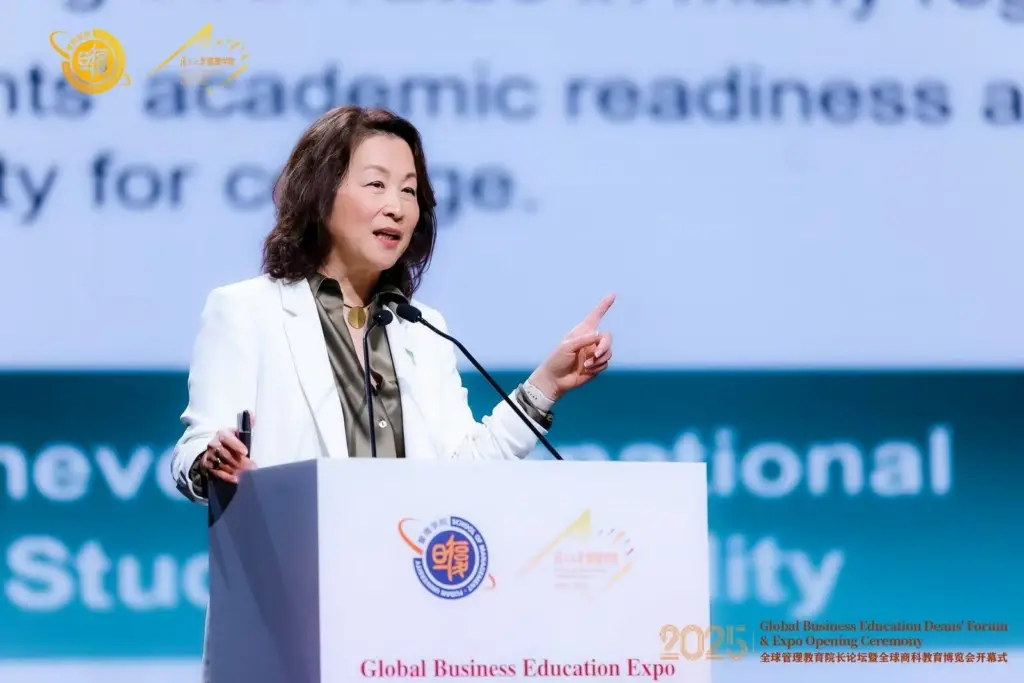
Lily Bi, president and CEO of AACSB International, delivers a keynote address at Fudan University in Shanghai, China.
For 110 years, the Association to Advance Collegiate Schools of Business has been the gold standard of business school accreditation around the world. But the organization that once defined the rules of management education now faces the same factors disrupting the sector itself.
Artificial intelligence is reshaping jobs faster than curricula can keep up while demographic declines threaten traditional enrollment pipelines. Political and visa pressures for international students continue in the U.S. and elsewhere, while a growing share of business education is happening outside traditional degree programs altogether.
In this climate, Lily Bi, president and CEO of AACSB International since June 2023, tells Poets&Quants that accreditation alone will not prepare schools for the disruptions ahead.
FROM ELITE ACCREDITOR TO GLOBAL STANDARD-SETTER IN A CHANGING MARKET
Fewer than 10% of the world’s roughly 17,000 business schools hold AACSB accreditation. If the organization’s mission is truly global, she says, focusing only on that slice is not sufficient. Instead, AACSB is working to reposition its standards as a broader guide for quality business education, not just a gatekeeping accreditor for elite institutions.
While about 55% of AACSB-accredited schools are still American, most future growth is expected in Asia, the Middle East, and parts of Europe and Africa, where expanding economies and large populations are fueling demand.
Even as undergraduate enrollments in some regions flatten or decline, demand for management skills is spreading across industries and age groups. Professionals are returning to school mid-career, companies are seeking customized training, and lifelong learning is becoming a workforce imperative. Schools that rely solely on traditional pipelines of 18- to 22-year-olds risk falling behind those that rethink who their students are and when they show up.
Artificial intelligence amplifies all of this. While some critics predict online platforms and AI tutors will erode the value of formal degrees, Bi believes the opposite may occur. As machines take over routine tasks, she argues, the human skills business schools teach become more essential.
P&Q recently spoke with Bi to discuss how AACSB is redefining itself, where business education is growing fastest, and why global student mobility still matters even as many countries look inward. Our conversation has been edited for length and clarity.
If we start with the landscape of business education in March 2026, how would you describe it right now? What are the biggest challenges and opportunities?
We are just about ready to celebrate 110 years of AACSB. As I reflect on the past 110 years and focus on today, everyone says we are at an inflection point. So what does that mean? What kind of pressures are we facing?
One is technological disruption. Obviously, AI is key. Everybody is talking about AI, and some people think we have already talked a lot about it. Honestly, I feel we have not talked enough.
AI is transforming the world of work, and when work changes, management will change as well. In the past, management was about managing people, performance, efficiency, and processes. Soon, it will be about managing both humans and intelligent agents, and the whole process will change significantly, maybe within just a few years.
So, management education has to change. That has been our message. We recently interviewed about 50 schools and in January published a paper on adopting AI and highlighting good practices at business schools. What counts as good practice today will likely need to be updated next year, but this is clearly one major issue.
Another challenge is how to bridge the gap between practice and academia. I mean both teaching and research. Business schools originally grew out of practice—especially in the United States, where they emerged from chambers of commerce and vocational training. Now they are part of universities, and we have become very academically driven, with a strong focus on scientific rigor. Rigor is important, but business schools are unique. We must also ensure that what we teach and research is relevant.
We want teaching to emphasize real-world problem solving and experience. On the research side, impact begins with choosing relevant questions. Before we talk about impact, we have to start with relevant topics.
A third issue is interdisciplinarity. This is not new, but we need to rethink it. Business schools and universities are organized by disciplines, but the real world is not organized that way—it is organized by industries and problems. A student may graduate with an accounting degree and begin as an accountant, but as they move into leadership roles, disciplinary expertise becomes less important than managerial capability.
We still need to teach content so graduates can get jobs, but we must also develop capabilities for long-term success. Knowledge and skills now expire faster—maybe within two or three years. Not every student will return to school that often, so we must cultivate the ability to keep learning independently. Lifelong learning is truly a reality now.
We could also talk about geopolitics, policy issues, and many other pressures, but these are some of the major forces shaping business education today.
Geopolitics is obviously a major issue in our reporting, especially in the United States with debates around DEI. What challenges or discussions around geopolitics are you having internally and with deans?
Like business schools themselves, AACSB must stay agile and adaptive. We closely monitor the situation in the United States, but we serve 112 countries. About 60% of our membership is outside the United States, so we have to pay attention to developments across major countries and continents. Our approach is to remain flexible and focused on our mission despite changing circumstances.
Last spring, AACSB reframed its diversity and inclusion principles to “community and connectedness” during the heightened DEI backlash, particularly in the U.S. You also faced some backlash of your own for the changes, particularly in Europe. Where does that discussion stand now? Are these changes long-term or situational?
It is important to distinguish between what is temporary and what is long-lasting. Political situations can change over time, but AACSB has existed for 110 years and we hope to continue indefinitely, just as business schools aim to endure. In any circumstance, I return to our mission: we exist to advance the quality and impact of business schools globally.
Whether we are adapting to current conditions or continuing long-term initiatives, our focus remains on advancing quality and impact for AACSB and our member schools. We are also in the process of updating our standards. We have received thousands of inputs, which we are incorporating as we reposition the accreditation standards into broader global standards for business education.

Lily Bi speaks on an artificial intelligence panel at the World Economic Forum in Davos, Switzerland, in 2026.
Let’s talk about the big opportunities for AACSB and management education. Where do you see the strongest opportunities in terms of content, disciplines, or direction?
There are definitely many challenges, but also many opportunities—they are always two sides of the same coin. The first—and perhaps the greatest—is repositioning our standards. Our mission is to advance the quality and impact of business schools globally, and inclusivity is a core value. Currently, only about 6% of business schools worldwide hold AACSB accreditation. Even including those in process, it is around 10%. That leaves roughly 90% of schools outside the accreditation system. If our mission is truly global, we cannot focus only on that small percentage.
That is why we are repositioning our accreditation standards into global standards for business education. Accredited schools can continue using them for quality improvement, innovation, and impact, but the other 90% of schools can also use them as guidance—even if they are not pursuing accreditation in the near future. This is our way of being inclusive rather than acting as an elite club. Our membership will vote on these standards at an upcoming conference, because AACSB standards are created by members, not imposed by AACSB itself.
The second opportunity relates to thought leadership. Historically, AACSB was not created as an accrediting body but as a membership and standards-setting organization. Accreditation came later, in the late 1940s. Today, we can go beyond accreditation by helping shape the future of business education.
Many important ideas should begin with exploration, not regulation. We want to move from providing insight to offering foresight—testing ideas about what the future may require. This means allowing schools room to experiment and go beyond minimum standards. One example is our research impact framework. We have discussed research impact for at least a decade, but implementation has been uneven. We are now collaborating with about ten other organizations worldwide to define research impact more clearly, especially impact beyond academic publications. That work is very exciting.
The third area is governance. My doctoral work focused on corporate governance, so I pay close attention to this. AACSB is now truly global, with most members outside the United States. Our governance structure must reflect that reality. After an 18-month process with our board and regional representatives, we approved a new governance model last October.
Governance involves both structure—who serves on the board and whom they represent—and process—how decisions are made. We are now implementing the new model. For the first time, we will hold a Global Summit in Seattle, bringing together five regional advisory councils along with a Business Influencer Council representing industry perspectives. Together with the board, we will spend a full day discussing the most important challenges facing business education and how to define its future.
There are many initiatives underway, and it is an exciting time for AACSB—even if my team sometimes jokes that every new idea means more work for them.
Where are you seeing the most growth globally for accredited business schools? Which regions are especially dynamic right now?
In terms of accreditation, we definitely see the Asia-Pacific and EMEA regions as major areas of growth. Among roughly 1,000 accredited schools worldwide, about 55% are in the United States, with the remainder outside. That means the future growth of accreditation will largely be outside the United States.
At the same time, as we shift toward being a more inclusive membership organization beyond accreditation, capacity building is also critical. Many schools in Africa and other parts of the world need support to strengthen their capabilities before they can even pursue accreditation. Helping them develop is another important growth area—not necessarily growth in the number of accredited schools, but growth in impact and influence.
We estimate there are about 17,000 business schools worldwide. For example, India alone has roughly 4,000 business schools, but only about 27 of them are accredited. When you look at those numbers, it is clear that there is enormous potential, even though not all of those schools will seek accreditation anytime soon.
We monitor trends not only in terms of numbers but also economic development. Countries like India and China rank among the largest economies, and both have significant higher education systems. China has roughly 1,000 to 1,500 business schools, while India has around 4,000. Indonesia, another highly populous country, also represents strong potential.
So the growth is driven by a combination of factors: the sheer number of institutions, demographic scale, economic growth, and government support for higher education. In countries such as India, government backing for business education has been particularly strong, which further contributes to the expansion.
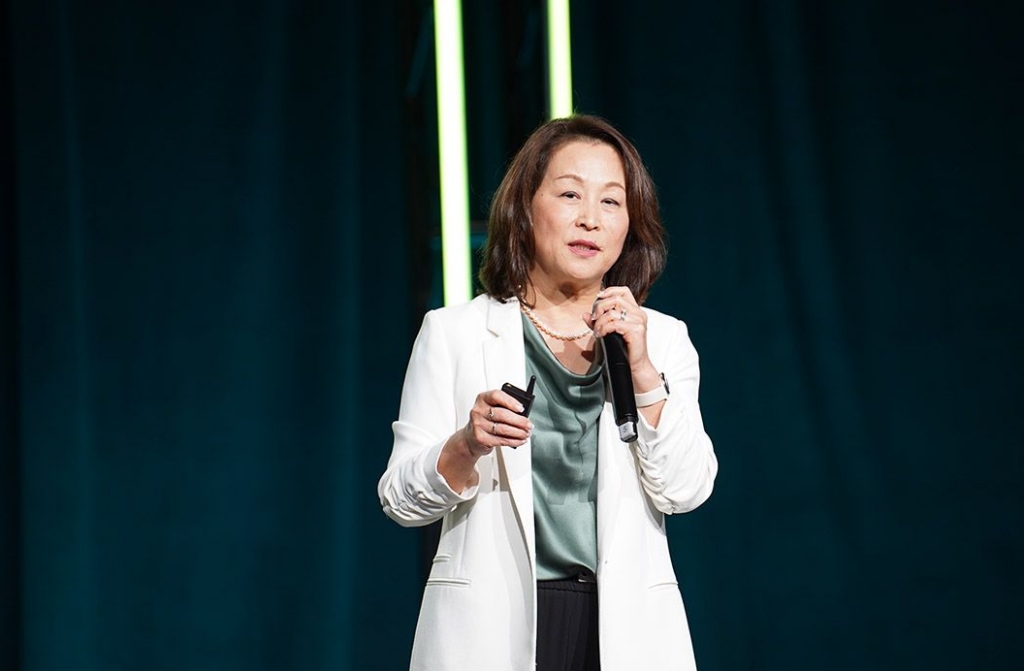
Lily Bi speaks at the AACSB Deans Conference in Toronto, Canada, in 2025.
For schools in places like China, is AACSB accreditation still necessary? Do they feel they need it, or do they rely on their own accrediting bodies as Asian business schools rise in global rankings?
AACSB accreditation is voluntary. When schools vote on our standards, that vote represents two commitments: they agree with the content and requirements, and they are willing to follow those standards.
In China, we have roughly 130 member schools, about 52 of which are accredited by AACSB. When I visited them last year, they were highly motivated to maintain and advance their accreditation. We see the same strong commitment in India.
Education holds very high importance in many Asian societies. Regardless of whether countries have their own local regulations or accreditation systems, many schools aspire to be recognized as world-class institutions. For many of them, AACSB accreditation is viewed as a global benchmark of quality.
For many years, international students—especially from India and Asia—sought U.S. business education partly for its global recognition and to work outside their home countries. If globalization is slowing or shifting, is AACSB accreditation still important if more students plan to study and work in their home countries?
I would answer that from two perspectives. First, we have seen changes in international student flows—not only to the United States but to other countries as well. Some countries are actively attracting more students, while others are becoming more restrictive.
There is also a common misunderstanding that international students are the same as immigrants. They are not. When you apply for a student visa, one of the first requirements is to demonstrate that you do not intend to immigrate permanently. These are very different concepts. Sometimes public discussions blur that distinction.
AACSB published a position paper last year showing that international students bring significant benefits. They contribute expertise and diverse perspectives that enrich domestic students’ learning. They also provide substantial financial support to universities, since many pay full tuition. In economic terms, international education is an export—U.S. education delivered to students from abroad. It is one of the country’s major export sectors. From our perspective, international students create a win-win situation.
Second, regarding globalization, I would distinguish between free trade and globalization. Free trade may be under pressure, but globalization itself is not disappearing. At international forums like Davos, there is still a strong desire for global engagement.
If studying abroad becomes more difficult for some students, that does not mean they no longer want a world-class education. AACSB accreditation helps signal that quality. For example, if an Indian student enrolls at an accredited university in India, that accreditation indicates the institution meets global standards comparable to schools elsewhere. Ideally, students should be able to move freely across borders for education, because business itself operates globally, and educated graduates support economies everywhere.
Let’s go deeper into AI. Are there particular skills or standards you are emphasizing in accreditation or support? How are you thinking about AI and what it means for business education and AACSB?
AI has many implications. No one can predict the future with certainty—people envision different scenarios—but business education must incorporate AI as an integral part, not an add-on. It needs to be embedded throughout the curriculum.
In many ways, AI makes critical thinking and judgment even more important. The first step in using AI is prompting—formulating the right question. That comes from humans. I have always believed that asking the right question is half the solution. With AI, two people can have the same problem but receive different answers because they asked different questions. So business schools must emphasize the ability to frame problems and ask the right questions.
The processing stage of AI is largely a black box for most users. Business education typically focuses on the application layer—the user side—rather than the technical internals. We are moving toward a world where humans and intelligent agents work together, and possibly one day agents may outnumber humans in certain tasks.
Then comes the output. How do we know the answer is correct? How do we identify bias or errors? Judgment is critical. Students need foundational knowledge and analytical skills to evaluate AI-generated results. So the key capabilities are asking the right questions at the beginning and exercising sound judgment at the end.
AI also raises issues of accountability. Even if AI produces an answer, humans remain responsible for the outcome. AI cannot be accountable to itself. That is why governance of AI is essential. Business schools are increasingly moving in this direction, and we are highlighting these issues in our standards.
We do not necessarily need to use the word “AI” explicitly in standards because technologies evolve. A few years ago, the focus was blockchain. What matters is that curricula incorporate the most current advanced technologies and prepare students to use them responsibly.
Can you highlight any schools or regions doing particularly innovative work with AI that stand out to you?
There are many schools doing innovative work with AI. For example, when I visited India in November, I saw an interesting approach at SP Jain. They organized a real-life interdisciplinary discussion involving four professors—from product management, supply chain, marketing, and finance—along with students from those same fields.
The conversation explored how each discipline looked before AI and how it is changing after AI. It demonstrated how AI blurs the boundaries between traditional disciplines. For instance, they examined how AI reshapes the entire value chain, from supply chain operations to financial decision-making, and how these areas must now integrate more closely. It was not just a theoretical exercise; it reflected how business functions are evolving in practice.
Many other schools are also embedding AI into real-world applications. In marketing, for example, students might analyze tools like virtual try-on technology used by companies such as Sephora. These AI systems allow customers to see how products like lipstick will look on their faces before purchasing. Teaching students how such tools work—and how they affect consumer behavior—helps them understand that AI is not an isolated technology but something embedded directly in business practice.
Similar examples exist in supply chain management and other fields. Across disciplines, schools are increasingly integrating AI into coursework in ways that reflect how it is actually used in industry.
Some critics say automation and AI could reduce the need for management education, since people can learn independently through online courses or AI tools. Do you see AI as a threat to management education or to AACSB’s role?
There are many narratives suggesting AI will replace humans, disrupt the labor market, or threaten management education. I believe AI will change management education, not destroy it. As we discussed earlier, AI is changing jobs and management practices, so education must evolve accordingly.
Humans are still needed to define problems and ask the right questions. For any real-world challenge, someone must determine what needs to be solved. Based on current AI capabilities, the processing stage may become more automated, but humans remain essential at the input stage, the output evaluation stage, governance, and accountability. Ultimately, humans are responsible for outcomes, and that entire process is what management education addresses.
I also like the idea that business education is becoming a new form of liberal arts. Management skills are needed across all industries. If you work in healthcare, technology, energy, or any other field, you still need management capabilities. For example, one university partners with hospitals and energy companies to provide a full semester of management training for professionals who are not business students.
Specialized technical knowledge may increasingly be enhanced by AI, but management is fundamentally a social science centered on human interaction. Because of that, the need for management education will likely grow stronger, not weaker, even as technology advances.
With AI disruption, geopolitics, and demographic declines in some countries, which business schools are most vulnerable—and which are best positioned to thrive in this transformative era?
We hear a lot about the so-called enrollment cliff. Demographic change is real, even if the impact varies. It begins at the university level overall. Business education has remained popular—roughly one in five students chooses a business major—so business schools have not yet been hit as hard as some other fields. But that does not guarantee long-term security.
Schools need to stay agile and innovative. I often tell deans that they should look beyond the traditional pipeline of 18- to 22-year-old students. Learning is lifelong. I am an example myself: I completed two master’s degrees earlier in life, then earned my MBA at age 40 and my doctorate at age 50.
Business schools should consider learners of all ages as potential students. Whether or not someone already has a degree is less important than whether they need updated knowledge and skills. As technology and industries change, people will need to return to education repeatedly throughout their careers.
In other words, schools that broaden their focus beyond recent high school graduates—and embrace lifelong learning—are better positioned to thrive. The future student population includes working professionals, mid-career learners, and others seeking reskilling, not just traditional undergraduates.
Given all these transitions, do you expect closures, mergers, or acquisitions among business schools? Do you see the number of schools declining or growing?
If we look at the broader U.S. university landscape, there have been mergers and consolidations over the past decade. I do not have exact figures, but the trend is real.
Within AACSB’s network, however, we have nearly 700 member schools, including accredited institutions, and we have not seen significant closures or mergers among them so far. That does not mean it will never happen. Future outcomes will depend on how individual schools adapt and on regional demographic trends.
Population shifts vary by region, and we monitor those closely. Overall, business schools appear less affected than universities as a whole. In terms of closures or consolidation, the impact on business schools has been much smaller compared to the broader higher education sector.
Anything else you’d like to add?
We are living in an interesting world, but every generation faces its own set of challenges—today it is technology, geopolitics, and economic change. Adaptability is essential. You have to disrupt yourself before others disrupt you. As some people say, you are either at the table or on the menu. That mindset is very important. AACSB is working to be proactive and innovative in that way.
My second point is that AACSB intends to take a stronger leadership role in shaping the next model of business education. The current model has been very successful, but it must continue to evolve. We will be discussing what that future model should look like at our upcoming gathering in Seattle, where we will focus on defining the future of business education.
DON’T MISS: 2026 FINANCIAL TIMES ONLINE MBA RANKING: EUROPE CONTINUES TO SET THE BAR AND THE TOP ONE-YEAR MBA PROGRAMS IN THE UNITED STATES
© Copyright 2026 Poets & Quants. All rights reserved. This article may not be republished, rewritten or otherwise distributed without written permission. To reprint or license this article or any content from Poets & Quants, please submit your request HERE.


