




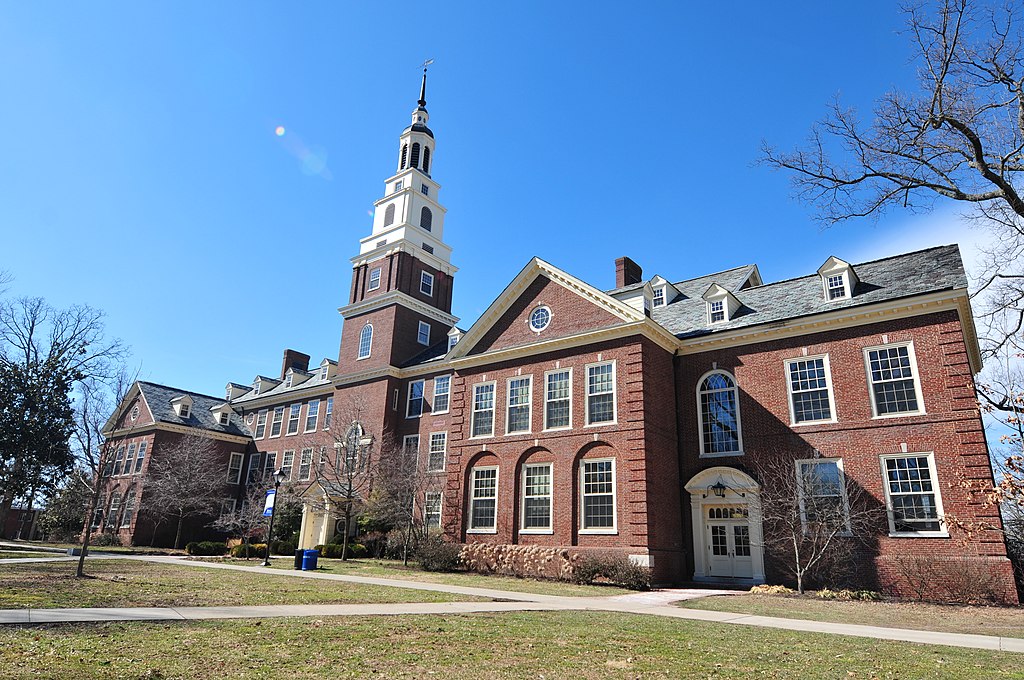
Berea College in Kentucky ranked No. 1 in Washington Monthly’s 2025 College Guide, recognized for its tuition-free model and commitment to low-income students.
University ranking season has come, and with it a flood of lists and data promising to help students make sense of the already nerve-racking question: Which college is right for me?
Two rankings dropped last week: Forbes 2025-2026 Top Colleges in America and Niche’s Best Colleges for Business. Princeton Review’s Best Colleges Guide for 2026 arrived earlier this month. In September, we expect the big dog: U.S. News & World Report’s university and business school rankings as well as Wall Street Journal’s Best Colleges in America.
While all have their own favored metrics and methodologies, the top of their lists typically look all too familiar: A handful of private, expensive, and increasingly selective Ivies jockeying about for the top few slots.
Not in Washington Monthly’s annual College Guide and Ranking.
Its 20th anniversary ranking, Best Colleges for Your Tuition (and Tax) Dollars, released this week, names a small college in rural Kentucky the best school in the country. The highest Ivy (Princeton University) ranks No. 5 while University of Texas Rio Grande (No. 21) comes in seven spots above Harvard (No. 28).
Washington Monthly – a small, independent magazine focusing on public service, accountability, and policy – positions its ranking as its “answer to U.S. News & World Report.”
U.S. News has long dominated the college conversation, shaping how families, policymakers, and even colleges themselves define excellence. But, instead of measuring how exclusive or wealthy a college is, Washington Monthly strives to rank schools not only on the return on investment a college provides, but on the good they return on society.
“Our argument was not rankings are bad,” Editor-in-Chief Paul Glastris tells Poets&Quants. “Our argument was their rankings are bad, their methodology was bad.”
A VERY DIFFERENT TOP 10
The No. 1 school in Washington Monthly’s 2025 ranking is Berea College, a liberal arts college with less than 1,500 students about an hour from Lexington, Kentucky.

Paul Glastris
Founded by abolitionists in the 1850s, Berea was the first college in the South to educate both Black and white students, and to recruit women, Glastris says. It has remained tuition-free for more than a century. (Students pay for living expenses and books.)
Today, 99% of its students are Pell-eligible. Berea is also one of just a dozen federally designated work colleges, meaning every student works a campus job, and much of their earnings go toward tuition. Over decades, Berea has built a $1.5 billion endowment.
“Instead of using that money to build fancy buildings, they use it to keep costs low for the students,” says Glastris, who is a former U.S. News correspondent, though he didn’t work in rankings then. He also was a speech writer for President Bill Clinton, working on education policy for State of Union addresses and the 1998 Higher Education Act reauthorization.
On average, Berea students earn $5,000 more nine years after entering college than students of similar demographics at other schools, and they graduate with the lowest debt load in the country.
On the other hand, it has the fourth worst outcomes ranking of any other school in the top 10, including the lowest 9-year median salary at $36,974. (Washington Monthly’s outcomes category ranks colleges metrics like graduation rates within eight years compared to predictions, graduation gaps between wealthy and low-income students, early-career earnings compared to peers, and the number of graduates who earn PhDs.)
Three California State University campuses follow Berea on the list. Only then does the first Ivy, Princeton University, appear.
Washington Monthly’s Top 10 For 2025 |
|||||||||
Rank |
Name |
Net Price |
Median Earnings (9 yrs) |
Student Loan Debt |
8-yr Grad Rate |
Access Rank |
Affordability Rank |
Outcomes Rank |
Service Rank |
| 1 | Berea College (KY) | $3,395 | $36,974 | $4,041 | 68% | 25 | 2 | 233 | 84 |
| 2 | CA State University–Fresno (CA)* | $5,171 | $50,337 | $14,715 | 70% | 17 | 42 | 287 | 41 |
| 3 | CA State University–Northridge (CA)* | $6,645 | $49,449 | $14,124 | 70% | 2 | 50 | 220 | 362 |
| 4 | CA State University–Los Angeles (CA)* | $3,139 | $49,310 | $13,323 | 69% | 5 | 21 | 167 | 580 |
| 5 | Princeton University (NJ) | $4,838 | $92,563 | $10,507 | 98% | 443 | 13 | 3 | 379 |
| 6 | CA State University–Sacramento (CA)* | $7,665 | $54,997 | $15,107 | 70% | 18 | 69 | 194 | 224 |
| 7 | Univ. of TX–Rio Grande Valley (TX)* | $5,583 | $42,745 | $12,894 | 57% | 4 | 27 | 522 | 452 |
| 8 | Florida International University (FL)* | $6,784 | $51,935 | $17,139 | 69% | 7 | 92 | 145 | 572 |
| 9 | CA State University–Long Beach (CA)* | $6,598 | $54,096 | $14,724 | 83% | 8 | 57 | 387 | 380 |
| 10 | MA Institute of Technology (MA) | -$2,398 | $118,346 | $13,562 | 97% | 592 | 4 | 2 | 894 |
Washington Monthly ranks 1,421 colleges altogether. Glastris notes that half of the colleges that made it to the top 30 are considered elite institutions – highly selective, wealthy, and prestigious private universities that dominate traditional rankings. After Princeton, these include MIT at No. 10, University of Pennsylvania (No. 15), Cornell University (No. 21), Harvard (No. 28), and Brown (No. 29).
Compare that to U.S. News, where all of its top 10 colleges would be considered elite. That contrast is deliberate.
“U.S. News basically rewards three things: Colleges that are exclusive – how few people you admit, wealth – how much money you spend and raise, and prestige. U.S. News famously does a survey asking college leaders what they think of other colleges. So, they’re prestigious because people say they’re prestigious,” Glastris says.
“We come at it completely differently. Our rankings have nothing to do with SAT scores. We have never rewarded colleges for being exclusive. In fact, we reward colleges for not being exclusive.” (See P&Q’s Rankings Are Only Relevant to 20% of Students, Rankings Guru Says.)
ACCESS, AFFORDABILITY, OUTCOMES, SERVICE
Washington Monthly uses publicly available data mostly collected by the federal government. Its framework rests on four categories, each with a variety of different metrics:
- Access: How well a college provides opportunities to low- and middle-income students. One measure compares actual Pell Grant enrollments with what the school would be expected to enroll based on test scores and statewide demographics.
- Affordability: The net price for families earning under $75,000 and the amount of debt graduates carry.
- Outcomes: Eight-year graduation rates (overall and Pell vs. non-Pell), early-career earnings compared to peers, and the number of graduates who go on to earn PhDs.
- Service: Indicators of democratic participation, including Peace Corps and AmeriCorps enrollment, ROTC cadets, majors in fields like social work and nursing, and whether the institution encourages student voting.
While metrics in these categories are helpful for students and families, they’re also a measure of how much a university gives back to society – and to the people who really fund them.
“Government at all levels invests about a half a trillion dollars in the higher ed sector every year. If you break that down, that’s about $1,700 a year for every taxpayer. So, taxpayers have skin in the game,” Glastris says.
On democratic participation, Glastris points to colleges’ own mission statements: “If you look at the founding documents of almost every university, it says somewhere that their mission is preparing students to become fully engaged members of the democracy.
“So it’s not like we just invented this category. We’re saying what their mission statements say.”
See WM’s detailed methodology metrics here.
WHAT TRUMP HATH WROUGHT
The 20th anniversary issue of the rankings also takes a hard look at the state of higher education under the Trump administration.
“The administration has made a direct attack on primarily university research budgets in a whole bunch of ways, utilizing – constitutionally or not – government leverage to reorder internal processes and teaching to match the administration’s view,” Glastris says. “Nothing like this has ever happened.”
Washington Monthly’s September issue includes articles like Kevin Carey’s “What Trump Hath Wrought,” which argues that the administration’s policies are decimating higher education rather than reforming it.
The cuts have fallen hardest on research institutions, where federal grants drive everything from vaccine development to clean energy breakthroughs. Johns Hopkins, for example, has already lost $800 million in funding after USAID research programs were eliminated. For students interested in research careers, those cuts could alter entire fields of study.
“If vaccine research was your thing, you might want to rethink, unfortunately,” Glastris says.
Language in the so-called “Big Beautiful Bill” threatens to cut off aid for academic programs deemed unprofitable, often based on narrow salary outcomes. That provision puts many small liberal arts colleges at risk, particularly in rural communities where higher ed institutions serve as cultural and economic anchors.
“What this is going to mean is that a lot of small liberal arts colleges in out-of-the-way places that are already struggling – many of which do quite poorly on our rankings but some of them that do quite well – are going to have a tougher time,” Glastris says. “And that’s going to be devastating to those towns.”
Though Trump has directed his ire at elite schools in blue states, the effects ripple nationwide. Research universities in red states and rural regions – places that often vote for Trump – are facing the same squeeze.
For Glastris, these policies underscore why Washington Monthly’s rankings matter. U.S. News and others measure success in ways that mirror Trump’s ROI rules: narrow definitions based on prestige, exclusivity, or graduate salaries. Washington Monthly argues that higher education is not a “pure libertarian enterprise” funded solely by individuals but a system heavily subsidized by taxpayers.
“We need higher education to do more than one thing,” Glastris says. “We need it to prepare students to give back something for the opportunities that their country and government have offered them.”
ON THE PURPOSE OF RANKINGS
Glastris argues rankings aren’t just tools for students and parents to decide which schools to put on their target list, they are also a mirror for higher education itself.
Rankings are also tools for journalists, public policy decision makers, and university leaders to help define what excellence actually is.
“To expunge from their mind the idea that Harvard is the best university, and the closer you get to Harvard, the closer you are to excellence,” he says. “That’s BS. That’s crazy talk.”
Elite schools still have their place, if you can get in. Graduates will probably make more money, have fancier networks, and more impressive job titles. But, they simply aren’t accessible to most students, and they aren’t required to reap the rewards of a college degree.
“Open your minds to the possibility that there are great schools close by that would benefit your student hugely, and where you’re not going to spend an arm and a leg,” he says.
Over the last two decades, WM’s College Guide and Rankings have evolved – as other rankings have as new information, data, and best practice science becomes available. This year, for example, the magazine separated research into its own category after the Carnegie classification system was revamped.
But the mission has remained the same: to measure what colleges do for both the student and public good.
“Everybody should look at rankings. I think they all have some benefit,” Glastris says. “But you have to triangulate among them.”
NEXT PAGE: Washington Monthly’s 2025 Best Colleges for Your Tuition (and Tax) Dollars (1-100)
© Copyright 2026 Poets & Quants. All rights reserved. This article may not be republished, rewritten or otherwise distributed without written permission. To reprint or license this article or any content from Poets & Quants, please submit your request HERE.


