






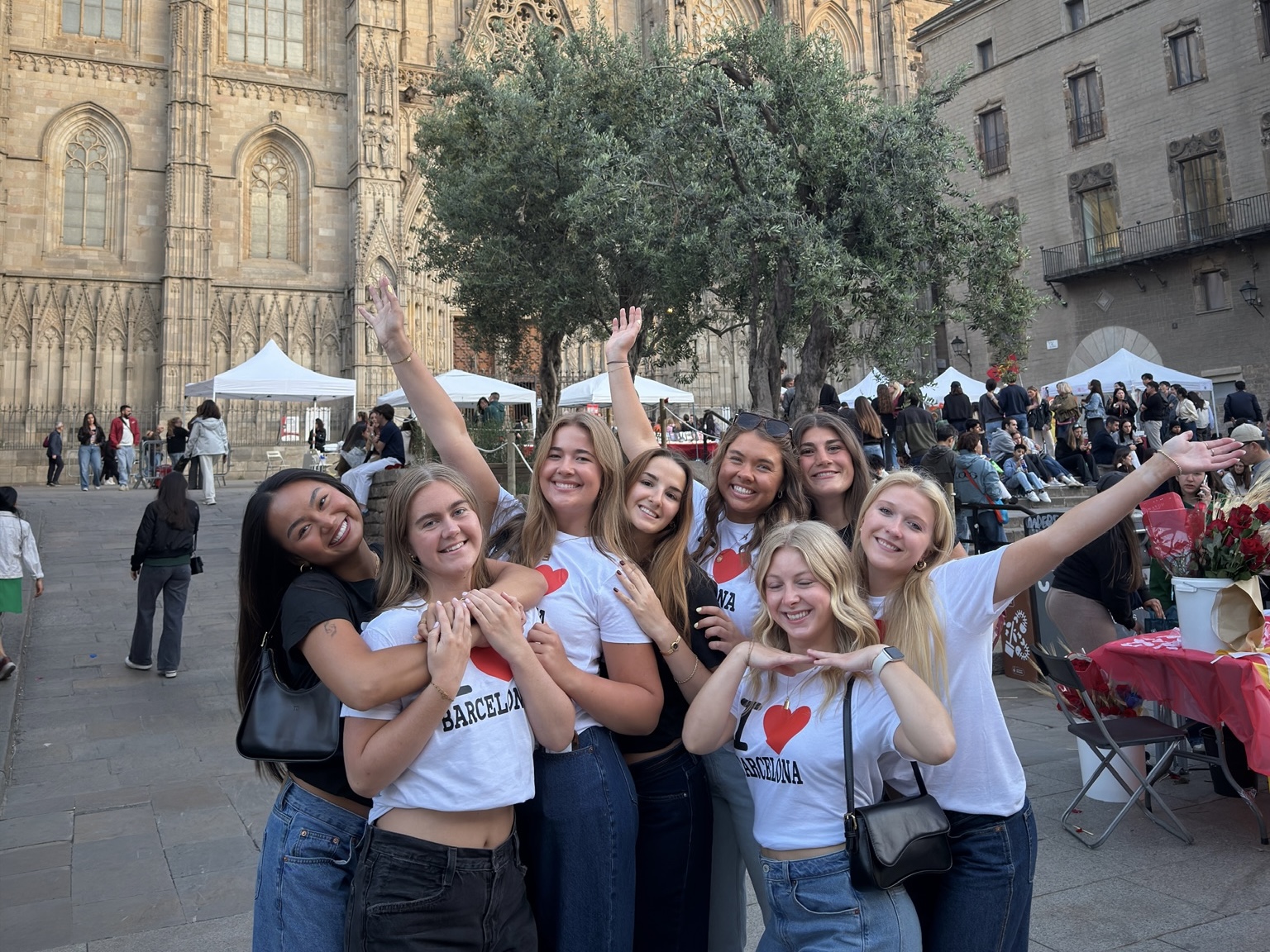
Emily (Third from left) and her friends celebrate their final weekend in Barcelona in front of the Cathedral of Barcelona, wearing “I ❤️ Barcelona” shirts.
When I first arrived in Barcelona, I thought I knew what studying abroad would look like. I expected to take classes, travel, meet new people, and explore a new city. What I didn’t expect was how much I would learn from the everyday experience of just living somewhere completely different.
Studying abroad taught me things I could not have learned in a classroom, from figuring out a new healthcare system to making friends from different countries and seeing everyday life from a perspective outside of the United States.
For business students especially, studying abroad can be much more than a semester of taking classes in another country. It can be an opportunity to challenge the assumptions you have built through your education, observe how people live and consume differently, and develop skills like independence, adaptability, and cultural awareness. But getting the most out of the experience requires being willing to step outside of what is comfortable and familiar.
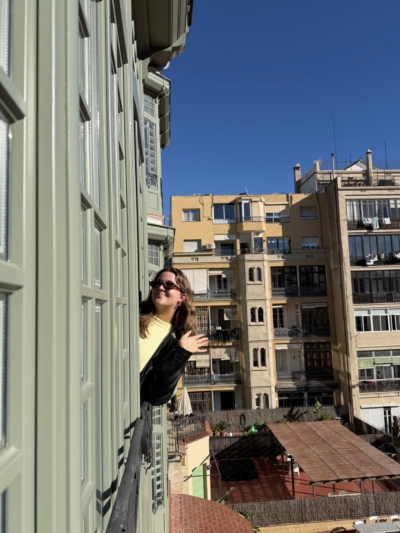
Emily stands outside the CET Academic Center on her first day of class in Barcelona.
LEARNING HOW TO ACTUALLY LIVE THERE
One of the first things I learned in Barcelona was that there is a big difference between visiting a city and actually living there. When you visit somewhere, you can rely on a hotel or tour guide to figure things out for you. When you live somewhere, you have to learn how to get to class, buy groceries, use public transportation, or find a pharmacy. That doesn’t count figuring out what to do when something goes wrong.
When I first arrived, I relied on the Council on International Educational Exchange (CET) staff to help me navigate those everyday situations. CET provided us with monthly metro cards as part of the program, which made getting around Barcelona much easier. The staff also helped us understand how to use the metro and showed us how to use Google Maps to navigate the city. At first, I would usually take the metro with friends because I was still getting comfortable with the system. Eventually, I became confident enough to maneuver around the city on my own. Something that initially felt intimidating became part of my normal routine.
I also had to learn how to navigate healthcare almost immediately. Shortly after arriving in Barcelona, I got influenza and had to visit a local health center. CET provided insurance and helped me understand where I needed to go. I ended up having a translator in the room with me, which was definitely an interesting experience compared with what I was used to in the United States. They helped me get the medication I needed, and I went to a nearby pharmacy to pick it up. Having that experience so early in the semester taught me how important it is to know what resources are available before you actually need them.
Safety was another part of learning to live in a new city. I always felt safe in Barcelona, but I still made an effort to be aware of my surroundings. I stayed close to friends and avoided walking anywhere alone at night. I was also conscious of pickpocketing and made sure I was paying attention to my belongings, especially when using public transportation or walking through busy areas.
Even something as simple as paying for things took some getting used to doing. Seeing a lower number in euros and then realizing what that purchase actually meant in U.S. dollars caught me off guard more than once. At first, I would use my calculator to figure out the conversion. Eventually, I became much more comfortable thinking about prices in euros. These small adjustments may not sound like major lessons, but they were a huge part of learning how to live independently in another country.
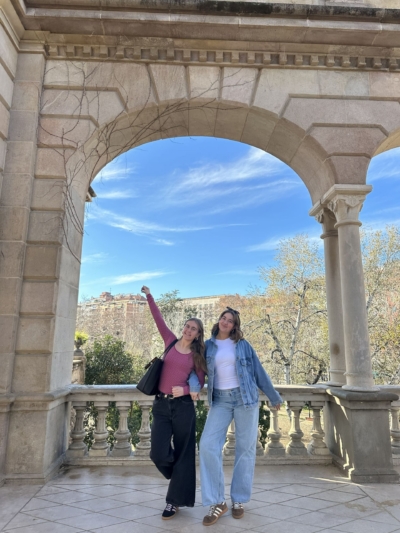
Emily and her friend and classmate, Brianne, explore Ciutadella Park on their first full day in Barcelona.
PREPARE, BUT BE READY TO LEARN ONCE YOU ARRIVE
If I could go back and give myself advice before arriving in Spain, I would tell myself to prepare for the cultural and language differences just as much as I prepared for the academic experience. I would recommend reading about the city, talking to people who have previously studied abroad there, and learning some basic language before arriving. With language, for example, I found it helpful to know how to order a coffee, especially since I often stopped at a coffee shop on my way to class and loved trying new places around the city. That preparation can make the first few weeks feel much less overwhelming.
At the same time, no amount of preparation can completely replicate actually being there. One of my biggest assumptions was that my four years of Spanish in high school had prepared me to communicate easily in Spain. I quickly realized that wasn’t necessarily the case. The Spanish I had learned in school was different from what I encountered in Spain. People often spoke faster than I was used to, so I found myself asking people to repeat themselves or overthinking which words I should use in response. Catalan is also spoken throughout the region, which was something I had not fully understood before arriving.
That experience taught me that knowing a language academically is very different from communicating in a new cultural environment. Even when I knew the words, there were moments when I wasn’t sure how to communicate naturally or understand exactly what someone was saying. I had to become comfortable making mistakes and figuring things out as I went. I also took Spanish through CET, used Google Translate when I needed extra help, and continued pushing myself to speak Spanish even when I wasn’t sure I was saying something correctly.
The same was true when something went wrong. I didn’t always know exactly what to do, but I knew who I could ask. My friends, professors, and the CET staff became my first resources. The CET staff lived in Barcelona and knew the resources available to students, which made a huge difference. Being independent abroad doesn’t mean knowing exactly what to do in every situation. It means knowing when to ask for help and where to find it.
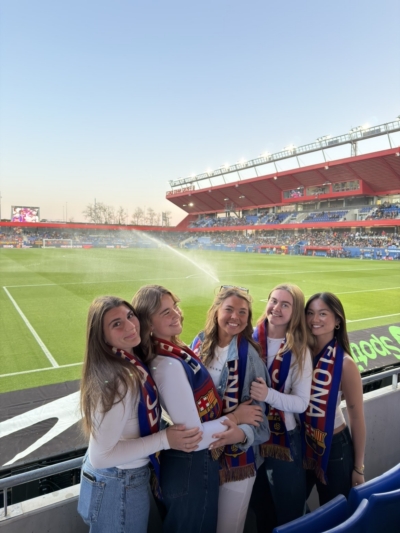
Emily and her friends attend a women’s FC Barcelona soccer match as part of a CET program-organized event.
BUILDING MY COMMUNITY IN BARCELONA
When I arrived in Barcelona, I only knew a few people. By the time I left, I had built a friend group and made so many friendships that I never expected to make.
One of the biggest reasons I was able to find community was because I tried not to go into the experience with a specific expectation of who my friends would be. I stayed open-minded and focused on meeting people rather than trying to find a particular type of friend group.
I went to CET-organized events and tried to say yes to things, even when they pushed me outside of my comfort zone. In my classes, I made an effort to talk to classmates, check in with people, and invite them to do things outside of class. I learned that sometimes you have to be the person who makes the first move instead of waiting for someone else to invite you somewhere.
I also wanted to connect with people outside of the American study-abroad community. Surprisingly, TikTok became one way that happened. By sharing my experience in Barcelona, I was able to connect with local brands and create brand partnerships with Barcelona-based businesses, including Analogin, Atelier Madre, and I Wear Dolls. These opportunities gave me a chance to interact with people who actually lived and worked in the city, rather than only connecting with other American students. For example, through a brand partnership with I Wear Dolls, I became friends with a university student who worked at the store. I stayed connected with her and the rest of the team on Instagram. Whenever I stopped by, they recognized me, caught up with me, and even gave me recommendations for places to explore around the city.
By the end of the semester, I had friendships with people from different backgrounds and different parts of the world. That became one of the most valuable parts of my experience because I wasn’t just learning about Barcelona. I was learning from the people and brands around me.
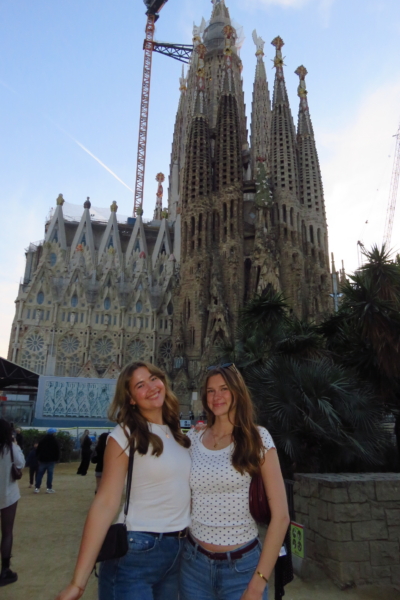
Emily’s roommate (Right) from back home visits her in Barcelona, and the two pose in front of La Sagrada Família.
LEARN TO SEE BUSINESS AND LIFE DIFFERENTLY
Living in Barcelona also made me realize how much of my understanding of everyday life has been shaped by being American.
One of the biggest differences I noticed was the pace of life. In the United States, I am used to constantly feeling like I should be doing something. There is always another class, assignment, meeting, internship, student organization, or career opportunity. Productivity can feel like a measure of how much you are accomplishing.
Barcelona challenged that mindset.
Life felt slower and more focused on connection. People spent time outside, walked around their neighborhoods, met friends, and took their time with meals. Dinner was also much later than I was used to, typically not starting until 8 p.m. or even later, which took some adjusting at first. Dinner wasn’t necessarily something to rush through before moving on to the next thing, either. It could be a long experience centered around conversation and spending time with other people.
Transportation also contributed to this different experience. Instead of automatically driving everywhere, people could walk or take the metro. I found myself walking much more and using public transportation regularly. That meant I wasn’t just moving from one destination to another. I was experiencing the city around me.
As a marketing student, these differences made me think about business in a new way. Consumer behavior does not exist in a vacuum. The way people shop, eat, communicate, spend their time, and interact with brands is shaped by the culture and environment around them. For example, many stores were closed on Sundays, which was different from what I was used to in the U.S., so I had to plan grocery shopping around different hours. Restaurants also often closed during the afternoon and reopened for dinner, showing me how business hours can reflect the routines and expectations of local consumers.
That is something I don’t think I could have fully understood by reading about European consumers in a textbook. I had to live there to see it.
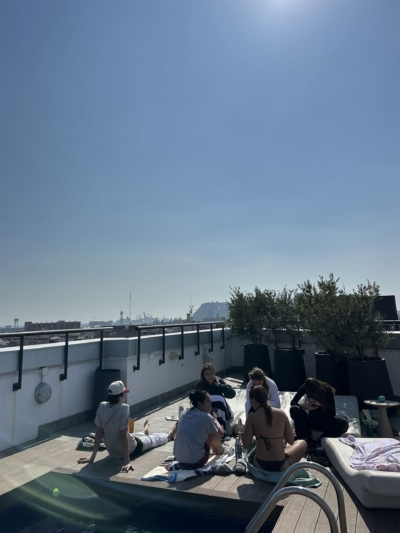
Emily and her friends enjoy a sunny day on the rooftop of their student housing at Beyoo Marina.
EXPLORE YOUR INTERESTS, BUT DON’T MAKE EVERYTHING ABOUT YOUR RESUME
Studying abroad also gave me an opportunity to explore my career interests in a way I wasn’t expecting. I have always been interested in marketing and social media, so I started documenting my experience in Barcelona on TikTok. At first, it was a way to share what I was doing. Over time, it created opportunities to connect with brands, marketers, and people working in the creator space.
That experience showed me that you don’t necessarily need a formal internship abroad to gain career experience. Sometimes, you can create your own opportunities by being curious and putting yourself out there.
At the same time, not every part of studying abroad needs to be productive. As business students, it can be easy to think about everything in terms of what it will add to our resume. We are constantly thinking about internships, networking, leadership positions, and career development. Those things are important, but studying abroad also taught me that some of the most meaningful experiences don’t have an obvious career benefit.
Some of my favorite moments were simple ones: getting coffee with friends, exploring a neighborhood, sitting around and talking, or trying something new. Barcelona challenged my idea that productivity means constantly doing something. Sometimes the most valuable thing I could do was slow down and enjoy where I was.
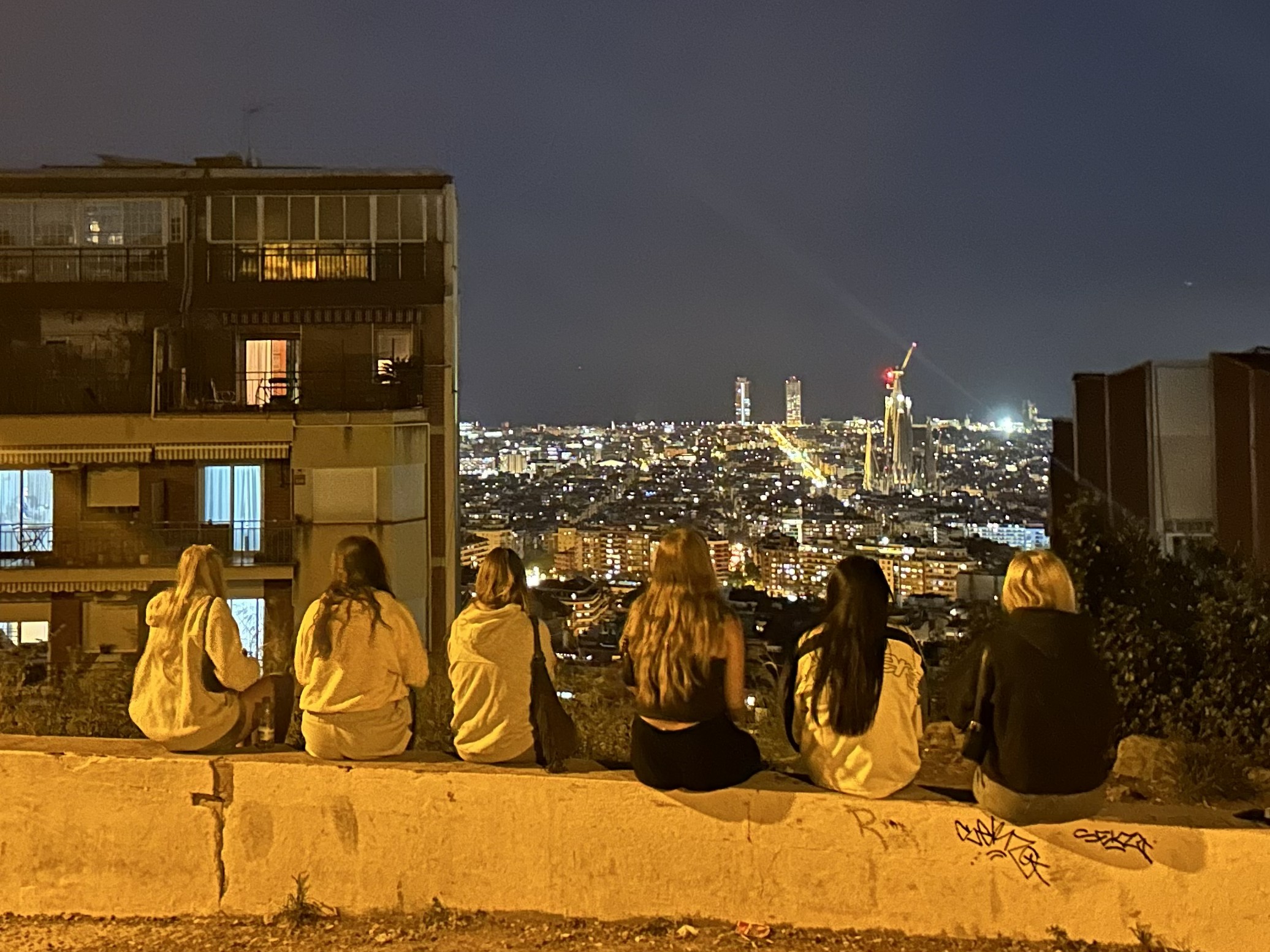
Emily and her friends take in panoramic views of Barcelona from Bunkers del Carmel on their last night in the city.
BRINGING THE PERSPECTIVE HOME
When I came home from Barcelona, I realized that the experience wasn’t really over. I had spent months learning how to navigate a new city, communicate across cultural differences, build relationships with people from different backgrounds, and see everyday life from a different perspective.
The challenge after studying abroad is figuring out how to bring those lessons home.
For me, that means approaching my classes, student organizations, internships, and relationships with a greater awareness that there isn’t always one right way to do something. It means being more comfortable when I don’t immediately know how something works. It means continuing to meet people who are different from me and being willing to question assumptions I might otherwise take for granted.
Studying abroad can be as simple as attending classes, traveling, and coming home with photos and memories. But it can also be an opportunity to become more independent, challenge your presumptions, learn from another culture, explore your interests, and develop a perspective that you could not have gained in a classroom.
For me, the most valuable part of studying abroad wasn’t just what I learned while I was in Barcelona. It was realizing how much I still had to learn once I got there.
MY BIO
Emily Elletson is a Marketing major at Minnesota Carlson, minoring in Strategic Management. She’s a Content & Design Assistant for the Minnesota Carlson undergraduate program and actively involved in the Student Marketing Association and Women in Business.
DON’T MISS:
MINNESOTA CARLSON MOMENTS: MY JOURNEY AS A TRANSFER STUDENT
MINNESOTA CARLSON MOMENTS: MAKING THE MOST OF MY SUMMER INTERNSHIP AT CARGILL
© Copyright 2026 Poets & Quants. All rights reserved. This article may not be republished, rewritten or otherwise distributed without written permission. To reprint or license this article or any content from Poets & Quants, please submit your request HERE.


