






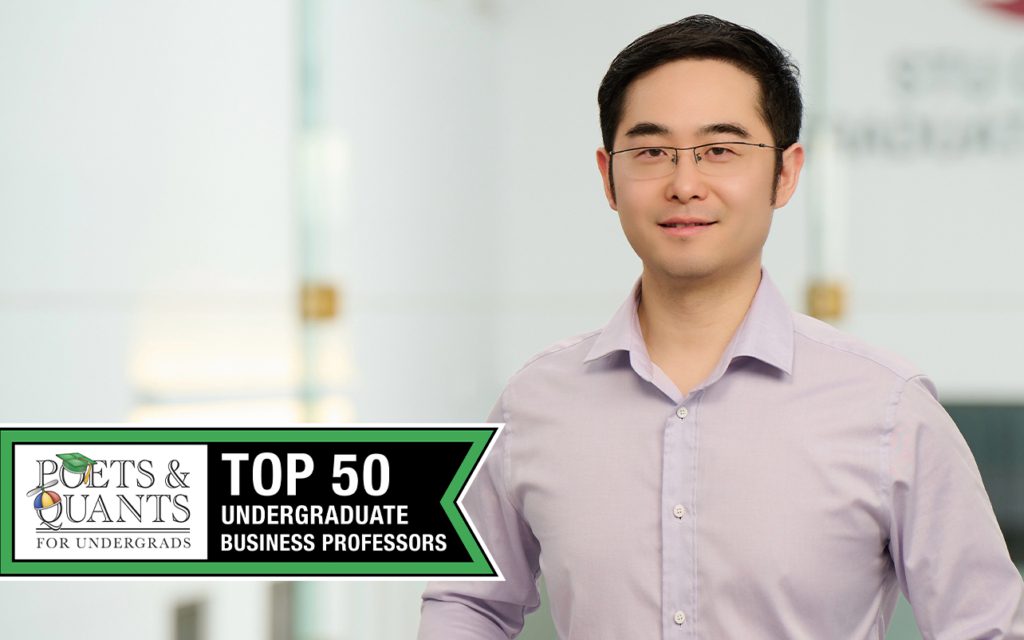
Wei Wang
Asper School of Business
University of Manitoba
“What sets him apart is his genuine care for students and his ability to make each lecture engaging and memorable. One example is his unconventional approach to the final paper, where instead of a traditional assignment, he asks students to write a Best Self Reflection Paper. This exercise encourages students to reflect deeply on their personal journeys, envision their best selves, and identify the situations that allow them to thrive.
“This paper had a life-changing impact on me personally. It gave me the space to reflect on my goals, recognize my strengths, and define the path I wanted to pursue. As a direct result, I began participating in case competitions – achieving podium finishes in all of them – and secured three internships, including two with Big Four firms, ultimately earning a full-time offer a year before graduation.” – Irene Alabi
Wei Wang, 38, is Assistant Professor in Business Administration and the Associates Fellow in Leadership and Ethics at the Asper School of Business, University of Manitoba. He also co-directs the David Dreman Behavioural Management Lab since 2023.
He earned his PhD in Work and Organizations from the Carlson School of Management, University of Minnesota.
His research uses diverse methods to explore the dynamics of leadership and ethics in organizations, with the goal of creating more inclusive and ethical workplaces. Wang has been recognized as the 2019 Society of Business Ethics Emerging Scholar and received the 2022 Anne Tsui Dare to Care Research Award, which recognizes research that seeks to make a difference in the lives of employees. He has published in leading journals such as Journal of Applied Psychology and Journal of Management, and he regularly shares his research and management insights with a broader audience through media such as CBC, Canadian HR Reporter, 680 CJOB, and The Manitoban.
As a lifelong educator at heart, shaped by growing up in a family of teachers, Dr. Wei Wang is passionate about helping students thrive in the classroom and beyond. His dedication to teaching has been recognized with the 2024 University of Manitoba Teaching Merit Award and the 2025 Associates’ Award in Teaching.
BACKGROUND
At current institution since what year? 2022
Education: PhD in work and organizations, the University of Minnesota; Master of Science in Business Administration, the University of British Columbia; Master of Arts in Management, Renmin University of China; Bachelor of Arts in Management, Beijing International Studies University.
List of Undergraduate courses you teach: Organizational Behavior
TELL US ABOUT LIFE AS A BUSINESS SCHOOL PROFESSOR
I knew I wanted to be a business school professor when … My professor, Jun Liu, handed an USB loaded with a dozen of papers on abusive supervision to me (who had never read academic papers before) and painted a vivid picture of all the challenges of being a scholar (i.e., he had a paper rejected after a third-round revision at the Academy of Management Journal the year before). He was trying to discourage me from pursuing an academic career and said I would have a brighter future in the industry. Turns out, the scary part only made me more interested in the research topic and the life of getting paid to study what we love. I am always grateful that he introduced me to the academic world.
What are you currently researching and what is the most significant discovery you’ve made from it? I am currently researching how leader (un)ethicality evolves over time. Traditionally, most research has focused on a static, between-person view of leader (un)ethicality, often defining leaders as either ‘ethical’ or ‘unethical’ based on their behaviors at specific time points. My work has demonstrated that (un)ethical leadership behaviors, like other workplace behaviors, are not isolated episodes but part of ongoing processes. These behaviors can be influenced, reinforced, or restrained by different cognitive processing systems over time. Additionally, I have developed micro-interventions, such as weekly goal-setting exercises and compassion prompts, to promote sustainable ethical improvement and counteract ethical decline within leaders.
If I weren’t a business school professor, I’d be … a management consultant
What do you think makes you stand out as a professor? I see my students as the next generation of leaders from whom I can also learn, and I am committed to mentoring and supporting their growth in and outside the classroom.
One word that describes my first time teaching: exciting
Here’s what I wish someone would’ve told me about being a business school professor: That the most rewarding part isn’t just teaching course content, but inspiring critical thinking, curiosity, and confidence in students on daily basis.
Professor I most admire and why: There are so many professors whose mentorship or work has deeply inspired me that it’s difficult to list them all. Among them, I admire Michelle Duffy for her open mindset and positivity, which always lifts me up when I’m feeling down. I admire Beth Campbell for her creative solutions to problems and her exceptional teaching skills. I also admire Cynthia Lee for her lifelong learning attitude. These professors not only inspire me on my academic journey but have also been steady sources of support and encouragement over the years. They motivate me to mentor and uplift others as well.
TEACHING BUSINESS SCHOOL STUDENTS
What do you enjoy most about teaching business students? My students are curious, creative, eager to learn and grow, and generally appreciative. I enjoy watching them collaborating on the marshmallow challenge in fun and innovative ways, seeing them confidently presenting their consulting projects, and reading their notes telling me how much they enjoyed the course.
What is most challenging? When the class size increases, I find it challenging to get to know my students personally and to provide the best support they need.
In one word, describe your favorite type of student: curious
In one word, describe your least favorite type of student: passive
When it comes to grading, I think students would describe me as … lenient but fair
LIFE OUTSIDE THE CLASSROOM
What are your hobbies? I love travelling, hiking, and watching sports
How will you spend your summer? I will be taking a 6-month research sabbatical in 2026. During the summer, I plan to visit other universities and attend academic conferences.
Favorite place(s) to vacation: Bruges, Belgium
Favorite book(s): Give and Take by Adam Grant
What is currently your favorite movie and/or show and what is it about the film or program that you enjoy so much? The Shawshank Redemption, which uses powerful narratives and profound lines to show how hope and resilience enable people to survive the darkest times and find their way to freedom.
What is your favorite type of music or artist(s) and why? Jay Chou, who nicely integrates Chinese traditional culture such as classical instruments and poetic lyrics into pop music and Taylor Swift, who uses relatable lyrics and catchy melodies to tell compelling stories.
THOUGHTS AND REFLECTIONS
If I had my way, the business school of the future would have much more of this … smaller class sizes to ensure meaningful connections, increased research collaborations with organizations to connect theory and practice, and the integration of AI into work procedures to streamline processes and reduce bureaucracy.
In my opinion, companies and organizations today need to do a better job at … humanizing the workplace rather than focusing solely on a bottom-line mentality.
I’m grateful for … the curiosity and proactivity of my students, wise advice from my mentors, ongoing support from my coauthors and colleagues, and the unconditional care and love of my family.
DON’T MISS THE ENTIRE ROSTER OF 2025’s 50 BEST UNDERGRADUATE BUSINESS SCHOOL PROFESSORS.
© Copyright 2026 Poets & Quants. All rights reserved. This article may not be republished, rewritten or otherwise distributed without written permission. To reprint or license this article or any content from Poets & Quants, please submit your request HERE.


