






If you want to build a billion-dollar startup someday, which college should you pick?
According to new research from Ilya Strebulaev, it’s not Harvard or even Stanford. The undergraduate program with the highest likelihood of producing a unicorn founder is actually Yale University.
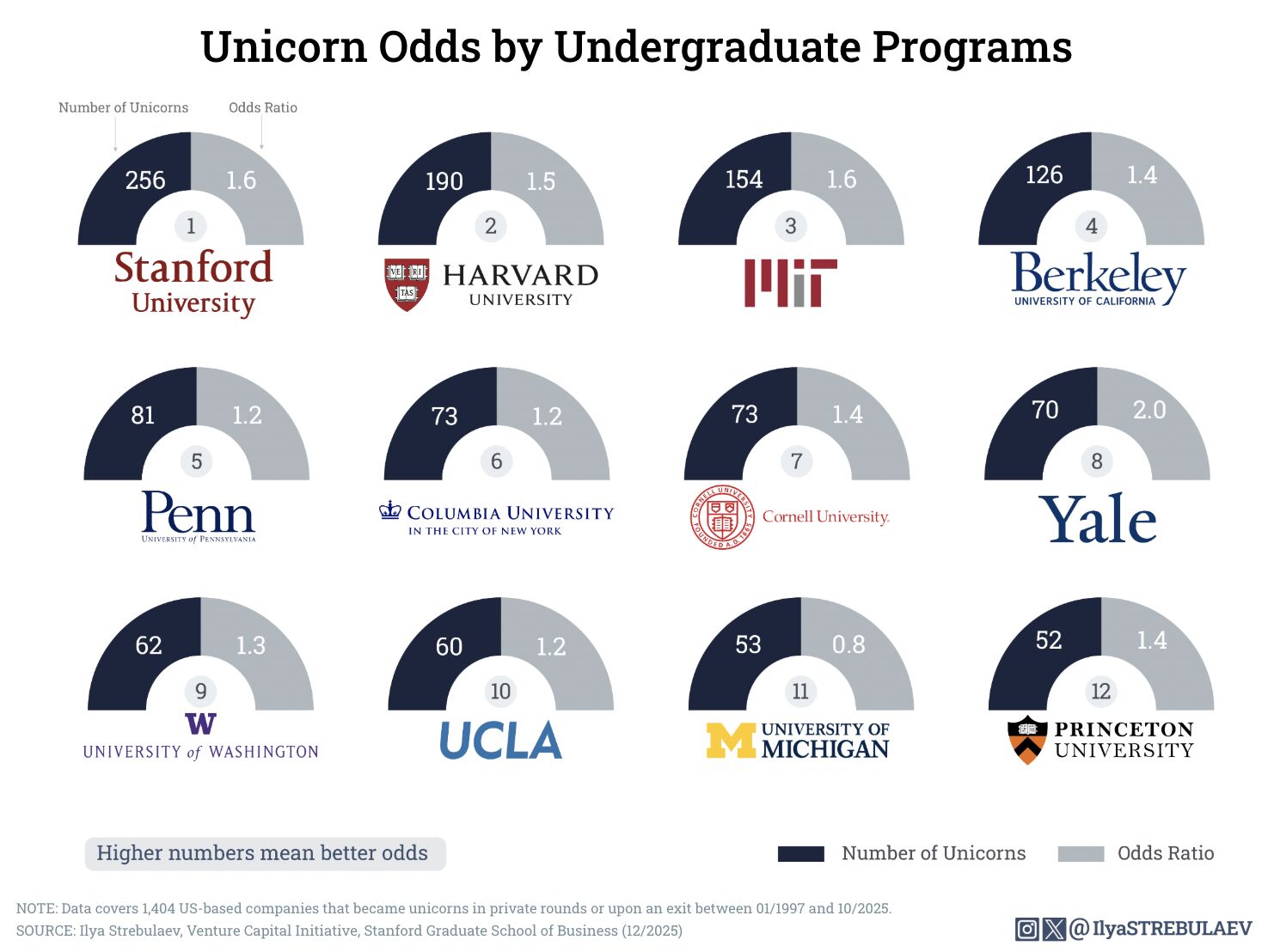
“Stanford University holds the highest number of unicorns in our sample (256) with an odds ratio of 1.6. This means that getting a degree from Stanford increases one’s chances of achieving unicorn status (if one founds a VC-backed startup) by 60% compared to the baseline,” Strebulaev, a finance professor at Stanford Graduate School of Business, writes in a LinkedIn post describing his research.
“Yale University stands out with the highest likelihood: an odds ratio of 2.0, suggesting a 100% increase in likelihood relative to the random sample.”
A DATASET BUILT FOR UNICORNS
Strebulaev posts new venture capital, startups, and innovation research every few days on his highly popular LinkedIn page. His posts generate hundreds to thousands of likes, shares and comments.
In 2015, the Moscow-born researcher founded the Venture Capital Initiative at Stanford GSB to pull together researchers and compile more reliable data. He and his team of research assistants, PhD students, project managers, and lawyers have poured through tens of thousands of pages of VC contracts and other documents, data sets from PitchBook and VentureSource, LinkedIn and other websites, news articles and more in an effort to compile a database that includes every U.S. unicorn startup since 1995. That’s more than 1,400 unicorns so far.
That data has powered a steady stream of highly visual, widely shared posts answering questions students, founders, and policymakers keep asking: How old are unicorn founders? What did they study? Do MBAs matter? And now — where did they go to college?
For Strebulaev, the goal isn’t just cataloging unicorns – a private company valued at $1 billion or more – but understanding the broader innovation ecosystem and what separates companies that break through from those that don’t.
“What I think is also interesting is not just looking at unicorns, but comparing them with all the other companies that will not become unicorns,” he told Poets&Quants in this 2021 interview.
Source: Venture Capital Initiative via Ilya Strebulaev
HOW THEY CRUNCHED THE NUMBERS
For this latest study, Strebulaev’s team analyzed 1,404 U.S.-based companies that became unicorns either through private funding rounds or at exit between January 1997 and October 2025.
They then compared where unicorn founders earned their undergraduate degrees against founders from a random sample of VC-backed companies that did not necessarily reach unicorn status.
The key comparative metrics is a school’s odds ratio, which shows how much more (or less) likely a founder from a given university is to build a unicorn, relative to the baseline.An odds ratio of 1.0 represents the average likelihood. Anything above that indicates higher-than-average odds.
Of the 12 top U.S. universities topping the list, Yale University had the highest ratio of 2.0. In other words, attending Yale as an undergrad boosts the odds of producing a unicorn founder by 100% compared to the baseline. Stanford University and MIT follow close behind, each increasing the odds by 60%, while Harvard University raises them by 50%.
A SURPRISING OUTLIER
Yale actually had the eighth highest number of unicorn founders from the dataset at 70 while Stanford University had the highest at 256.
One of the more interesting findings involves the University of Michigan.
Michigan has produced 53 unicorn founders in the dataset, a high absolute number. But when adjusted for odds, Michigan founders show slightly lower chances than the random sample average.
That doesn’t mean Michigan isn’t producing successful founders. Instead, it highlights a theme that runs throughout Strebulaev’s work: raw counts don’t tell the full story. Scale, alumni base size, and how many founders a school produces overall all matter when interpreting the data.
For high school seniors and college students reading Poets&Quants for Undergrads, the takeaway isn’t that attending a specific Ivy or West Coast school guarantees startup success. Strebulaev has been careful to stress that unicorns are not the same as success, and many unicorns fail.
This particular data doesn’t look at undergraduate majors. Strebulaev looked at that question a couple of years ago, (and it wasn’t business majors.)
But this study does suggest that certain undergraduate environments may offer advantages — dense alumni networks, proximity to venture capital, exposure to entrepreneurship early on, and peer effects that normalize startup risk.
At Stanford, for example, entrepreneurship is part of the air students breathe. Yale, long known for producing leaders across sectors, may offer different but equally powerful social and institutional capital. MIT’s strength lies in its deep technical pipeline. Each school’s advantage likely comes from a different mix of culture, network, and opportunity.
Unicorn Odds by Undergraduate Institution |
|||
| (U.S.-based unicorn founders, 1997–Oct. 2025) | |||
Rank (By No. Of Founders) |
Undergraduate Institution |
Number of Unicorn Founders |
Odds Ratio |
| 1 | Stanford University | 256 | 1.6 |
| 2 | Harvard University | 190 | 1.5 |
| 3 | Massachusetts Institute of Technology (MIT) | 154 | 1.6 |
| 4 | University of California, Berkeley | 126 | 1.4 |
| 5 | University of Pennsylvania | 81 | 1.2 |
| 6 | Columbia University | 73 | 1.2 |
| 7 | Cornell University | 73 | 1.4 |
| 8 | Yale University | 70 | 2 |
| 9 | University of Washington | 62 | 1.3 |
| 10 | University of California, Los Angeles (UCLA) | 60 | 1.2 |
| 11 | University of Michigan | 53 | 0.8 |
| 12 | Princeton University | 52 | 1.4 |
DON’T MISS: ‘SAY JA TO GERMANY’: THREE TOP B-SCHOOLS WOO WORLD’S STUDENTS & RESEARCHERS AND THE STUDENT VENTURE FUND THAT JUST LANDED A DOUBLE UNICORN
© Copyright 2026 Poets & Quants. All rights reserved. This article may not be republished, rewritten or otherwise distributed without written permission. To reprint or license this article or any content from Poets & Quants, please submit your request HERE.


