






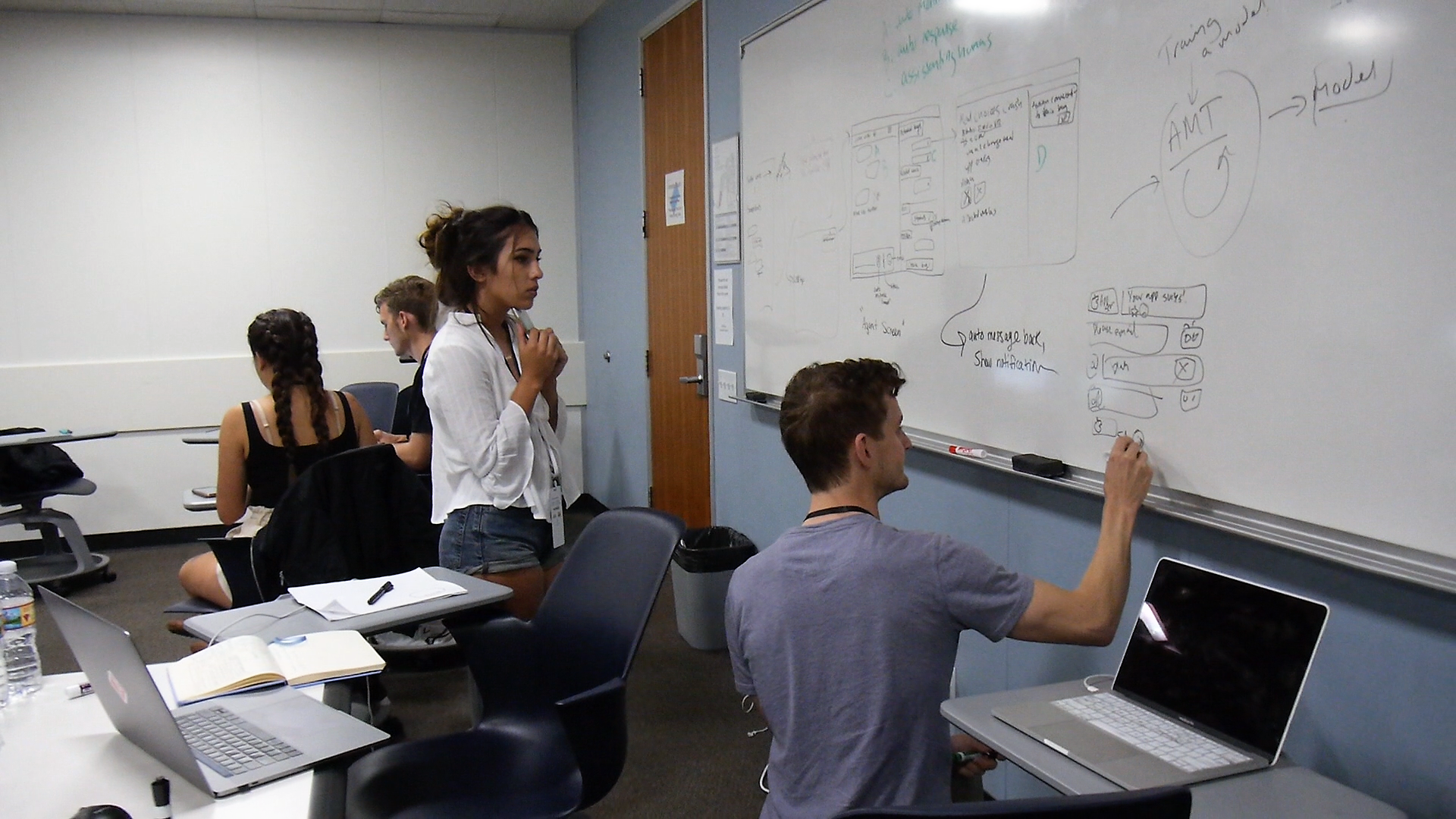
USF Entrepreneurship Club students work during Startup Weekend. In the most recent class, 80% of entrepreneurship students had founded businesses or were generating revenue before graduation. Courtesy photo
Everything is bigger in Texas … except taxes and regulations.
That’s why the state is a business magnet. Home to 54 Fortune 500 firms, Texas is the land of grants galore and incentives aplenty. For 13 years in a row, Texas has claimed Site Selection’s Governors Cup, which honors the states for “job-creating business relocations and expansions.” And Chief Executive has named Texas the Best State for Business for 21 years running.
If Texas were a separate country, it would rank as the world’s 8th largest GDP at $2.4 trillion in value.
Imagine it: By tonnage, Houston ranks as the largest port in the United States. And the Texas Medical Center boasts the world’s largest cancer and children’s hospitals. In recent years, several leading companies have re-located their headquarters to Texas: Tesla, McAfee, Caterpillar, Charles Schwab, Oracle, and Hewlett Packard. Just this month, Nasdaq opened its first regional headquarters in Dallas. And Colonel Sanders must be rolling in his grave knowing his beloved KFC will soon move from Louisville to Plano.
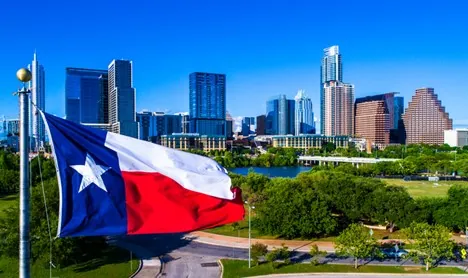
Austin, Texas
TEXAS SCHOOLS TOP RANKING AT GRADUATE & UNDERGRADUATE LEVELS
Texas also hosts 3.5 million small businesses. Earlier this year, U.S. Today named Austin as the best city to start a new business, with early-stage investment reaching $2.9 billion in Silicon Hills from 2022-2024. Not surprisingly, Texas business schools are riding this wave of resources, know-how, and business-friendliness. Just look at the top of The Princeton Review’s Top Schools for Entrepreneurship Studies in 2026, which was released on November 12.
Developed in partnership with Entrepreneur, The Princeton Review produces separate rankings at the graduate and undergraduate levels. Not surprisingly, Texas schools rank #1 in both categories. Among graduate schools, Rice University was again the school to beat, holding the top spot in graduate education for the 7th consecutive year. And clearly Houston is the epicenter for entrepreneurial education, as the University of Houston ranked 1st at the undergraduate level, again for 7 straight years.
Call it the chicken-or-egg argument. Do schools benefit from a high-tech ecosystem accelerated by no state or corporate income taxes (and generous support from the Enterprise and Capital funds)? Or, does the state benefit from rigorous academic training and intensive support given to fledgling ventures in school-run incubators and competitions? Maybe they’re intertwined, but there is no question that Texas business schools stand out in the latest Princeton Review Entrepreneurship Ranking.

Students walk through Rowling Hall at the McCombs School of Business. Courtesy photo
SECRETS BEHIND THE UNIVERSITY OF TEXAS’ SUCCESS
Take the graduate level. Here, the University of Texas holds the #3 spot, moving up four spots from the previous year in the process. Up north, the University of Texas at Dallas placed 13th. At the University of Texas, Sean Finney, a 2024 graduate of the McCombs MBA program, points to several benefits of the school’s entrepreneurship programming. As a student, he founded Tano Skincare, which uses banana sap to rejuvenate skin – collecting $400,000 in funding along the way. He points to his coursework, which provided a solid foundation in business fundamentals. In particular, he cites case studies that exposed him to successful strategies and painful missteps across a variety of industries. At the same time, Finney benefitted from the tutelage of John Doggett, a McCombs mainstay who has mentored hundreds of aspiring founders.
“From the moment I joined his class, he really “got” what I was trying to build and pushed me to think bigger and move faster,” Finney adds. “His no-nonsense approach, combined with his genuine interest in my success, has guided me through some tough stuck points. He has been an incredible sounding board and has always provided clear, actionable advice. His deep knowledge of business and ability to cut through the noise with practical insights have made him one of the most valuable people in my corner.”
Let’s not forget UT’s location, less than a mile from the state capital. Between its culture and resources, Austin is a startup ecosystem that no school can simulate.
“At first, it is almost overwhelming how many resources are available in this town,” Finney continues. “No matter what issue I’ve faced—whether legal, operational, or marketing—I have never been more than two degrees of separation from someone who could help. What I love most about Austin’s startup community is that it’s not a “sharp elbows” environment; people genuinely want to help however they can. A rising tide lifts all boats, and the Austin/UT ecosystem truly embodies that.”

University of Houston, Bauer College of Business
THE WOLFF CENTER MAKES ENTREPRENEURSHIP ‘REAL’
In contrast, picture the University of Houston as the plucky underdog that punches above its weight in the undergraduate space. The program has been long known for its heavy focus on experiential learning and mentoring – along with excellence in developing sales skills. The centerpiece of the entrepreneurship program is the Wolff Center for Entrepreneurship, which has served over 4,300 students over the past year according to the school. Over the past decade, the center has helped launch over 1,100 student ventures and raise over a billion dollars for participants. Along with holding 52 courses and attracting 670 mentors last year, the Wolff Center operates an accelerator and pitch competition. Even more, the center connects students with investors, experts, and entrepreneurs across Houston.
The latter was particularly valuable to Valeria Serenil, a senior who is building a contracting firm that is already generating $600,000-$800,00 in annual revenue. “Mentorship from industry leaders and access to UH’s entrepreneurial network gave us the confidence, community, and capital to expand beyond residential roofing into commercial contracting.”
Maybe one of the biggest differences in the Wolff Center: it teaches more than skills – it instills a mentality. ““You come into this program with the expectation of not studying entrepreneurship but being an entrepreneur,” explains Dave Cook, executive director of the Wolff Center, in a press release. “Everything we do is real — your side hustle is real; your intellectual property is real.”
Of course, Texas isn’t the only state where student entrepreneurs thrive in educational institutions. At the graduate level, California placed 6 schools on The Princeton Review ranking, led by UCLA’s Anderson School which finished 2nd overall. Florida graduate programs accounted for 5 spots on the list, with New York and Massachusetts being represented by 3 schools each. Among undergraduate programs, 6 Florida programs made The Princeton Review Ranking, with the University of Miami (16th) being the highest-ranked program. Texas added 4 schools, including the University of Texas (2nd), University of Texas at Dallas (21st), and Texas Christian University (28th). Along the East Coast, you’ll find 3 schools each across Massachusetts, Pennsylvania, and New York. In a surprise, there are no California school among the undergraduate entrepreneurship list.
THE METHODOLOGY
To develop its Entrepreneurship Ranking, The Princeton Review conducted a survey from June-August of 2025, with 300 schools responding. From there, the ranking methodology covers six dimensions:
Academics: Majors, Minors, and Concentrations; Course offerings (Law, Finance, Strategy, Management, Marketing, Venture Capital, Family Business, etc.); and team projects.
Students and Faculty: Enrollment; Percentage of students enrolled in entrepreneurship programming during the 2024-2025 school year; Number of undergraduate majors; Number of faculty teaching one or more entrepreneurship courses; Percentage of faculty who have started, bought, or run a business; and number of students with a viable business plan.
Alumni Entrepreneurship Ventures: Number of companies started by graduates over the past 5 and 10 years, along with the money raised by these ventures and the percentage still in business over these periods.
Outside the Classroom: Sponsored mentorship programs and the number of mentors involved.
Competitions Hosted By The Schools: Includes Business Plan, Hackathon, Shark Tank, Pitch Deck, and New Venture competitions, along with measuring cash and in-kind prizes.
Scholarships & Aid: Scholarships reserved for entrepreneurs and average dollar amounts involved.
On the plus side, The Princeton Review methodology scores educational institutions against 40 data points, pairing academic scope with hands-on learning opportunities, mentorship, and student support. Like previous years, however, the ranking is dogged by two flaws. First, The Princeton Review doesn’t disclose most of the underlying data such as prize money and faculty data. Instead, it just reveals the total number of entrepreneurship courses and companies started by alumni over the past five years through Entrepreneur. As a result, readers are denied valuable information that would enable them to compare schools side-by-side. By the same token, the ranking fails to disclose which data points and dimensions carry certain weights, making it impossible to understand what truly mattered in formulating the ranking. Even more, the lack of transparency prevents readers from understanding why different schools moved up and down the ranking.
Despite this, The Princeton Review ranking places a spotlight on which programs provide the best training and experience to prospective founders.
“Inside every successful entrepreneur is a willingness to challenge the status quo—and it’s inspiring to see colleges and universities nurturing that spirit of innovation,” writes Jason Feifer, editor-in-chief of Entrepreneur magazine, in a press release. “These programs create real-world opportunities for students to test ideas, build connections, and launch meaningful ventures. We’re excited to spotlight the schools that help turn bold visionaries into tomorrow’s changemakers.”
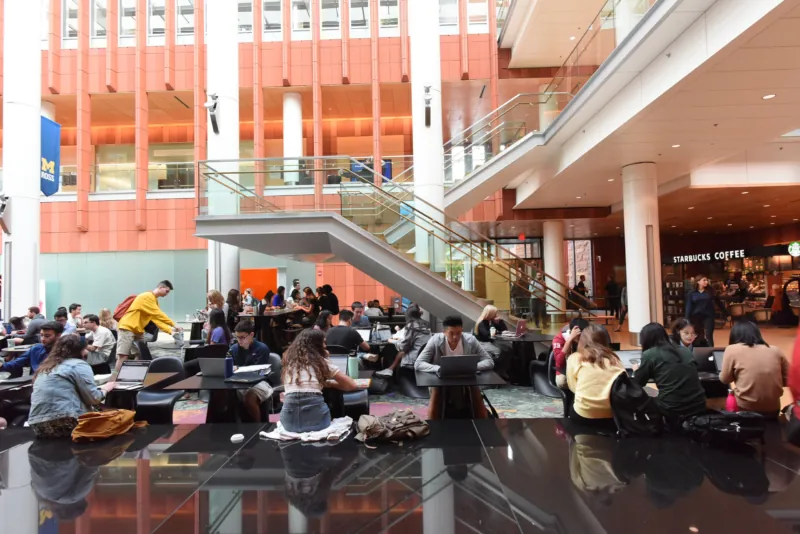
Winter Garden at the University of Michigan’s Ross School
GRADUATE RISERS & FALLERS
That includes the University of Michigan at the graduate level. Ranked 5th overall behind Rice, UCLA, and Texas, UM boasts the largest number of alumni startups over the past five years: 535 in all – 31 more ventures than the previous year. That tops the University of Washington, which ranks 4th and features 519 startups – or 47 more than last year. When it comes to courses, Saint Louis University owns the largest catalog of any graduate school: 112 courses in all.
As a whole, the 2026 Graduate Entrepreneurship Ranking closely resembles its predecessor. Just one program entered the Top 10: the University of Utah at 10 (which displaced the University of South Florida, which slipped to 11th). This year also features several graduate programs that gained ground in the ranking. The University of Syracuse climbed from 24th to 17th, with the New Jersey Institute of Technology improving from 29th to 19th (with one contributing factor likely being the number of alumni ventures doubling from 51 to 115). Temple University (36th to 25th) and American University (39th to 27th) also jumped by 10 or more spots. That said, the biggest drop came courtesy of SUNY in Buffalo, which tumbled from 41st to 50th. At 9th, Erasmus University – based in the Netherlands – remained the highest-ranked international graduate program. Its graduates have raised over $730-million dollars to finance their ventures over the past decade.
Overall, four schools debuted in the graduate ranking, led by Florida Atlantic University at 40th. Among the four programs dropping out of The Princeton Review’s Top 50, you’ll find Arizona State (18th), University of Oregon (27th), and Loyola Marymount (30th).
Looking over a three-year horizon with the graduate ranking, the biggest fallers including the University of Michigan (2nd to 5th), Babson College (3rd to 8th), and Northeastern University (10th to 18th). Meanwhile, Notre Dame (18th to 12th), University of Arkansas (32nd to 20th), and Louisville (39th to 30th) have made noticeable gains over the same period.
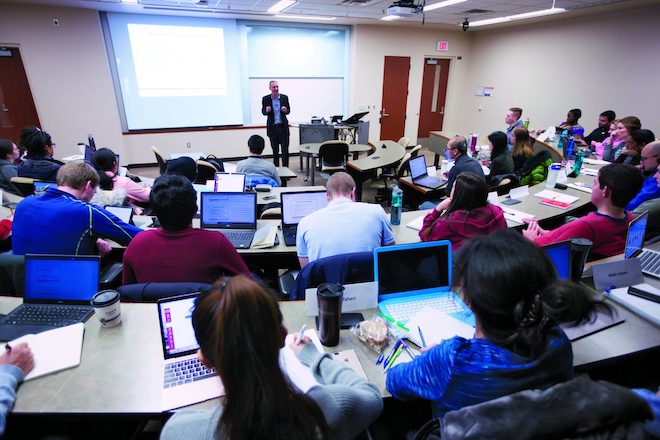
The Ivy College of Business at Iowa State University is the state’s only full-time mBA program. Its leadership hopes to make it one of the stalwart programs of the upper Midwest. Ivy photo
IOWA STATE MAKES A STATEMENT
Moving over to the undergraduate ranking, the University of Houston, University of Texas, and Babson College all remained in the Top 3 – in that order. Like the graduate ranking, the University of Michigan and the University of Washington could also be found in the Top 5. The University of Michigan also conducts the largest number of undergraduate entrepreneurship courses with 236, easily outpacing Texas Christian University (182) and Saint Louis University (166). When it comes to the largest startup network, prospective students would be hard-pressed to find a better school than the University of Texas. Over the past five years, 5,789 alumni have launched ventures, more than double the 2,536 startups that Iowa State produced over the same period.
That volume of startups is one reason why Iowa State surged from 14th to 9th in the 2026 Undergraduate Ranking. The Cyclones weren’t the only ones that made impressive strides over the past year. The University of St. Thomas, a Minnesota stalwart with an enrollment of nearly 6,000 undergraduates, surged from 19th to 11th. Erasmus University, the second highest-ranked undergraduate international program behind Tecnologico de Monterrey, climbed from 20th to 12th. At the same time, South Florida (33rd to 24th), University of Arizona (40th to 30th), and the University of Connecticut (45th to 31st) also made impressive gains over the 2026 ranking.
Like the graduate ranking, few undergraduate schools experienced significant declines. Instead, several dropped out of the Top 50 altogether, led by Miami of Ohio (8th), Baylor University (17th), University of Oregon (23rd), and Loyola Marymount (26th). Conversely, this year’s splashiest debut came courtesy of Florida Atlantic University, which entered The Princeton Review Undergraduate Ranking at 19th.

The Rady School of Management at UC-San Diego. File photo
HOW THE PRINCETON REVIEW COMPARES TO POETS&QUANTS
Looking at the graduate and undergraduate rankings together, three schools made the Top 5 in both: the University of Texas, University of Michigan, and the University of Washington. Washington University and Babson also appeared in the Top 10 across both rankings.
That said, The Princeton Review Graduate Entrepreneurship Ranking deviates sharply from the equally data-intensive ranking produced by Poets&Quants, whose 2026 MBA ranking will be released on November 17th. Just three schools on P&Q’s Top 10 for graduate business schools – Washington University, University of Michigan, and the University of Virginia – matched up to the Top 10 in The Princeton Review. UC San Diego’s Rady School, which finished 22nd in The Princeton Review, also made P&Q’s Top 10 among graduate programs.
Go to these pages to see the following rankings:
PAGE 2: PRINCETON REVIEW TOP 50 GRADUATE ENTREPRENEURSHIP RANKING
PAGE 3: PRINCETON REVIEW TOP 50 UNDERGRADUATE ENTREPRENEURSIHP RANKING
PAGE 4: POETS&QUANTS VS. THE PRINCETON REVIEW GRADUATE RANKING
© Copyright 2026 Poets&Quants. All rights reserved. This article may not be republished, rewritten or otherwise distributed without written permission. To reprint or license this article or any content from Poets&Quants, please submit your request HERE.


