







BBUS 2024 Executive Board (Kendyll far left third from the bottom)
When I first came to the University of Michigan’s Ross School, I knew I wasn’t the typical business student. Most people around me already had their paths mapped out. They spoke confidently about consulting, finance, or investment banking.
I admired that certainty, but I didn’t feel it.
My choice to study business wasn’t about following one clear direction. That’s because I wanted the freedom to explore. Coming out of high school, I was very unsure of what I wanted to do. I loved art, science, music, and entrepreneurship, but I didn’t know what interest would make the best career for myself.
Business felt like the place where I could securely find myself along the way. Business was always something I was surrounded by, but not in the traditional sense. My parents were entrepreneurs in real estate and development, and my brother built his own sports agency. Seeing that made me realize that business is a field with endless directions to explore, whether through entrepreneurship like my family or within the corporate world, where I could carve out my own path. While I didn’t know much about corporate America at the time, I understood the value of being business-minded and saw how the field could connect with many of my interests — from marketing, which spoke to my creativity, to entrepreneurship, where I could bring my own ideas to life.
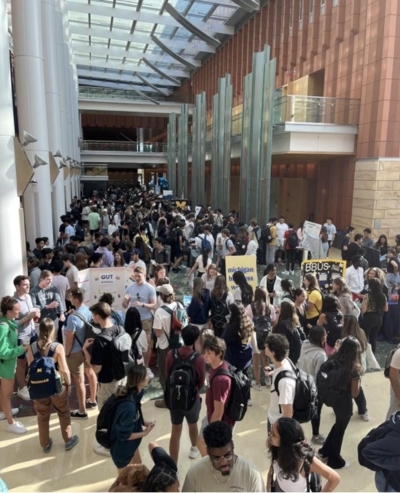
BBA Meet the clubs my freshman year (can kind of see my head at the very bottom)
In those first few weeks at Ross, I felt out of place. As a first-generation college student, I wasn’t familiar with the traditional business paths that many of my classmates already knew about. Terms like consulting and investment banking were new to me, and I was still learning what opportunities existed and which ones aligned with my interests. Sitting in class or passing through the Winter Garden, it seemed like everyone had found their people and purpose. Most people were joining consulting clubs, business fraternities, or investment groups. I wasn’t sure where I fit yet, but I stayed grounded in what genuinely sparked my interest and trusted that my path would come together in time. I might not have known what I wanted to do, but I had a sense of who I was. I’ve always been curious and creative, and I’ve naturally gravitated toward community above all else. That became my anchor.
Exploration played a big role in helping me become more sure of myself. I stayed open to the possibility that paths I hadn’t initially considered might still be right for me. I joined an investment club, competed in case competitions, and set an expectation for myself to try things that felt unfamiliar. Through that process, I became certain about what I didn’t want to pursue. Still, it also left me with a lingering question: What did I want to do?
FINDING MY PEOPLE
That curiosity led me to the Black Business Undergraduate Society. I remember walking into my first BBUS meeting as a freshman, nervous but curious. The room was filled with energy. The e-board members stood at the front introducing themselves, and each one seemed so sure of who they were. When Hailey Love spoke, she had this quiet confidence that immediately drew my attention. I assumed she must be a senior, someone who had already lived the whole college experience.
After the meeting, she came up to my friends and I and started talking with us like we’d known each other for years. When I learned she was only a sophomore, I was shocked. There was something about seeing someone so close in age who carried herself with that kind of assurance. It made me think, maybe I can do this too. That was the moment I decided BBUS would be my community – not just a club, but a place to grow.
The people in BBUS became role models and mentors. They cared deeply about us as freshmen: not because they had to, but because they genuinely wanted to see us succeed. Their support felt different. It wasn’t performative. It was rooted in wanting us to thrive both personally and professionally.
LEARNING THROUGH REJECTION
When I applied for the BBUS e-board that year and didn’t get selected, it was a hit to my confidence. I had poured a lot into that application and was excited to prove myself. Instead of walking away, I kept showing up. I reminded myself that I didn’t join BBUS to collect resume bullets. I joined because I believed in its mission: providing Black students with opportunities, professional development, and a community of peers who understand the realities of navigating both campus life and corporate spaces.
Being part of BBUS that year gave me the chance to grow and absorb what BBUS meant as a member first. I showed up to every meeting, attended the events, and kept learning from those around me. I was able to focus on attending events like the Diversity Career Fair or Corporate Dinner as a freshman without overseeing or planning it. I competed in and won the BBUS x McKinsey & Company Case Competition with a group of three other freshmen students – something I couldn’t have done if I was on e-board. Somewhere along the way, the rejection turned into motivation. It wasn’t about being chosen; it was about becoming ready. I took that time to be patient, grow closer to my community members, and prepare myself to be the leader that I knew I wanted to be.
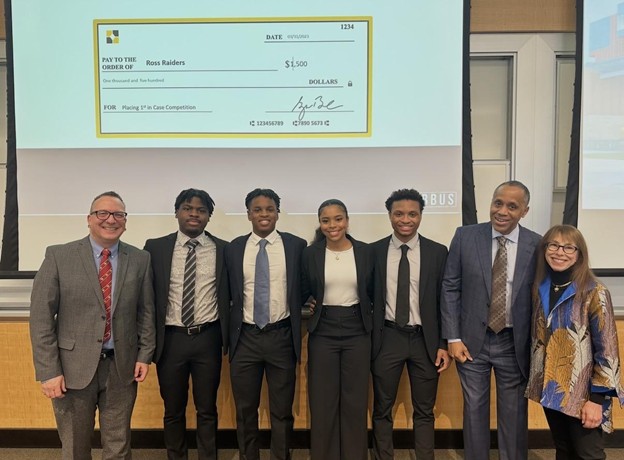
BBUS X McKinsey Co Case Competition winning team and Ross faculty judges pictured (Dennis Oswald, Micheal Adeyemi, Chris Owens, Kendyll Martin, Justin Fleurimont, David Wooten, Cheri Alexander)
BECOMING THE LEADER I WANTED TO BE
By sophomore year, when I applied again and became Vice President of Membership, it felt right and came at the right time. The title was meaningful, but what mattered most was what it allowed me to do. I finally had the chance to pour into others the way BBUS had poured into me. I got to meet new students who reminded me of myself — curious, nervous, and eager to find belonging.
On e-board and during the rest of my time, I had the chance to support members in ways I once needed myself. A few reached out asking how to format résumé bullets or prepare for interviews, while others – often first-year students – just wanted advice on navigating Michigan and finding their place. Several of the students I supported went on to interview for the same positions or join the same clubs I once pursued. It felt special to be there for them through that process, sharing the advice and little pieces of knowledge I wish I’d had when I was in their place. Whether it was answering questions or encouraging them, those moments reminded me why I cared so deeply about being part of BBUS in the first place. Many of the students I mentored eventually became my friends, and a few even went on to take our place on the BBUS e-board.
In that role, I realized leadership doesn’t have to be about titles or being the loudest voice in the room. For me, it’s about connection — listening, showing up, and making people feel seen. That’s the type of leader I learned I was.

McDonald’s x BBUS Dinner during the 2024 BBUS Chicago Trek
COMMUNITY AS A CATALYST
As time went on, BBUS became the foundation for almost everything else I pursued at Ross. It gave me the confidence to step into spaces I might have avoided before — like competing in my first case competition, speaking up in classrooms, and taking part in opportunities such as the first BBUS Trek to Chicago. During that trip, I met someone from McDonald’s who encouraged me to connect with the person overseeing their internship program, something I probably wouldn’t have done without the confidence BBUS helped me build. That small moment ended up opening the door to my internship and showed me how much opportunity can come from simply putting yourself out there.
When I think about my time at Ross now, the lessons that matter most aren’t the ones from lectures or case studies. They’re the ones I learned from people: showing up, being supported, and learning how to support others in return.
FULL CIRCLE
BBUS taught me that community isn’t something you find by accident. It’s something you build, piece-by-piece, through care, consistency, and intention. I came to Ross trying to find my place. I’m leaving knowing that I helped create one for myself and for others who come after me. And somewhere between showing up, being seen, and helping others do the same, I didn’t just build a community. I built myself.
Kendyll Martin is a BBA student at the University of Michigan Ross School of Business, originally from Detroit, MI. At Michigan, she has combined her interests in business and community through her roles as Vice President of membership for the Black Business Undergraduate Society, Community Service Co-Chair for Sister2Sister, Student Engagement Coordinator at Trotter Multicultural Center, and BBA Student Ambassador. Outside the classroom, Kendyll interned with McDonald’s on the U.S. People Team, and she also works in real estate to promote equitable housing opportunities in Detroit. She’s passionate about using business as a force for inclusion and empowerment, and hopes to build a career at the intersection of people, culture, and strategy. After graduation, she will begin her career with McDonald’s on the U.S. People Team.
© Copyright 2026 Poets & Quants. All rights reserved. This article may not be republished, rewritten or otherwise distributed without written permission. To reprint or license this article or any content from Poets & Quants, please submit your request HERE.


