




At Georgia Terry, undergraduates are gaining AI fluency, global experience, and real-world consulting exposure – supported by an alumni network and employer access that students say makes opportunity visible every day.
THE CAREER ENGINE THAT POWERS THE CURRICULUM

Sharen Phinney: “Terry students are very lucky. They have the career center, but then they have us and we specialize”
If Terry’s AI push is the headline, student services is the mechanism that turns preparation into outcomes.
Sharen Phinney, director of undergraduate student services, says Terry keeps professional development open to all students, including intended business majors who may not formally apply until sophomore year.
A central feature is “Employer of the Day,” a rotating series that brings recruiters into the Terry buildings for informal, low-pressure conversations between classes.
Villalobos calls it “a very informal way for you to just talk to the recruiter in between class, and introduce yourself.”
“It is fabulous,” she says. “They at least know us when we’ll submit our application in.”
Bhattacharya points to the same ecosystem, but from the perspective of a student on a structured track. She says Terry’s student organizations and employer access helped her secure recurring summer internships with Deloitte beginning in her first year.
“Each summer with Deloitte, I have been with them since my freshman year,” she says. “It’s all props to Terry.”
Her entry point was a Women in Finance meeting where Deloitte representatives spoke to students. “Sometimes the people that will come will be recent UGA alumni,” she says. “They have very fresh eyes as to what advice we should have.”
One alum connected her to a recruiter. “The Terry network is just constantly evolving,” Bhattacharya adds.
Phinney says Terry’s employer relationships are managed with precision. When companies reach out, one of the first questions is whether they want only business students or broader UGA recruiting. If the employer wants business majors, Terry can engage more deeply and tailor touchpoints through student organizations, coffee chats, and other programming.
“Terry students are very lucky,” Phinney says. “They have the career center, but then they have us and we specialize.”
‘WHY ARE YOU HERE?’ – AND WHY THAT WORKED

“Anywhere in Athens, you talk to somebody for five seconds, you’re best friends now”
Villalobos’s internship story underscores a different kind of advantage Terry leaders want students to recognize: exposure can create opportunity even when you are not looking for it.
She attended a smaller, major-specific career fair with a friend who did not want to go alone. Villalobos went mainly to support her friend. Instead, she wound up talking with a recruiter from Bell Partners, Inc. – and the fact that she was a marketing major at a real estate-focused event became her differentiator.
“Our conversation started with, ‘So you’re a marketing major? Why are you here?’” she says.
They connected on LinkedIn, reconnected later at a larger career fair, and the recruiter encouraged her to apply. Villalobos ultimately worked as a leasing consultant and also spent time in the firm’s corporate business analytics and data architecture work.
The experience helped redirect her academically. “That actually helped me come back here and start my business analytics emphasis as a marketing major,” she says.
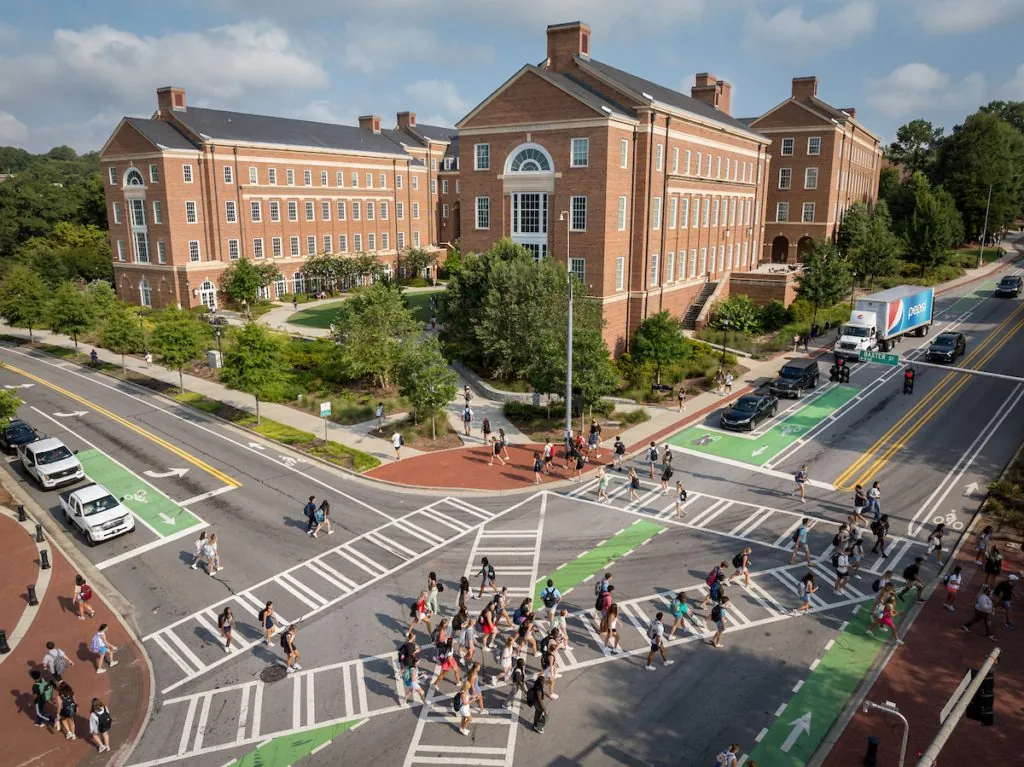
Her takeaway is that Terry’s density of events and its physical design – employers in the same spaces students already move through – creates chance encounters that can become career outcomes.
“Even companies, you might not even be thinking of,” she says.
CERTIFICATES, CAPSTONES, AND REAL CLIENT WORK
Terry’s innovation story is not only AI. Both students emphasize how much of the program is built around hands-on work that can be shown to recruiters.
Villalobos describes marketing coursework where students build strategy portfolios, work with nonprofits or companies, and produce outputs that belong on a resume.
“I can talk to recruiters themselves and tell them what I’ve been doing in my time in Terry,” she says, “and not just sitting there taking notes and lectures.”
Bhattacharya says Terry’s certificate ecosystem functions like highly specialized minors, with projects that put undergraduates into real client work. In her sustainability certificate capstone, she has worked with The Coca-Cola Company throughout the semester to build a sustainability “lunch and learn” training program for the company’s North American operating unit.
“It’s a diverse array of majors that all come together,” she says. “We showcase our teamwork, communication skills and come together on solutions.”
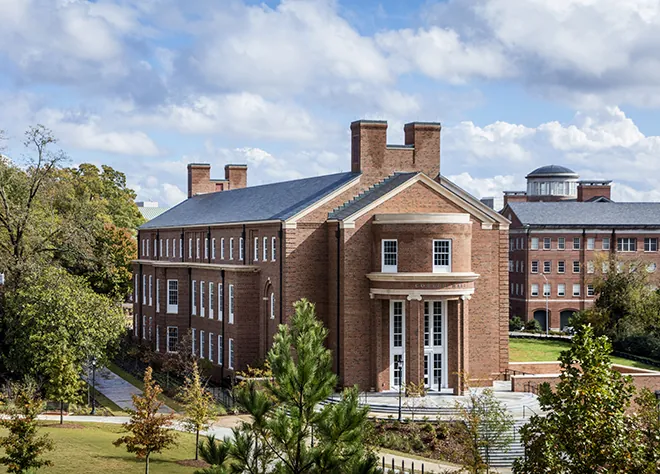
From a competitive AI certificate to an international business co-major and daily employer access, Georgia Terry is redesigning the undergraduate business experience – pairing technical fluency with hands-on learning and a network that students say opens doors early
THE SKILL EMPLOYERS KEEP DEMANDING
For Terry officials, that practical posture connects back to employer expectations that have not changed in one critical area: communication.
“Every year, the employers are saying communication skills,” Ragin says. Students are meeting with clients and professionals older than they are, he notes, and the ability to communicate with maturity remains a differentiator.
“They’re terrified to call somebody on the phone,” he adds.
BELONGING, BY DESIGN
Terry leaders argue that talent development also depends on whether students feel they belong in the space.
Phinney’s office uses peer mentors, including Terry ambassadors, to help younger students navigate what can be an intimidating environment, especially if they do not yet have classes in Terry’s buildings.
A newer initiative is the Terry peer interview coaching program, which grew from student demand for more casing and interview practice. Phinney says Terry now has eight paid student coaches and has logged 700 appointments in a single semester, expanding into behavioral prep, negotiation skills, and investment banking technicals.
“The coaches are students like this,” she says, “who have been through it.”
Both students return to the same message: Terry’s resources matter, but they only work if students use them.
“If you’re not able to make a meaningful connection in Terry,” Bhattacharya says, citing advice she heard often from staff, “it’s because you literally haven’t left your dorm.”
ATHENS – THE SECRET INGREDIENT
In the end, the Terry story is not only about curriculum design or talent pipelines. It is also about place.
Villalobos did not visit UGA before enrolling. “First time coming here was orientation,” she says. But she describes Athens as exactly the college environment she hoped for – big enough to feel alive, small enough to feel navigable, and welcoming in ways she did not expect.
“Anywhere in Athens, you talk to somebody for five seconds, you’re best friends now,” she says.
She calls it “the most perfect, perfect, perfect town,” pointing to food, music, and a sense of community. But the deeper point is what that atmosphere does for students trying to adapt quickly, build networks, and take risks.
“Truly, Athens and UGA is everything I imagined for a college experience for myself,” Villalobos says. “It’s actually amazing.”
© Copyright 2026 Poets & Quants. All rights reserved. This article may not be republished, rewritten or otherwise distributed without written permission. To reprint or license this article or any content from Poets & Quants, please submit your request HERE.


