






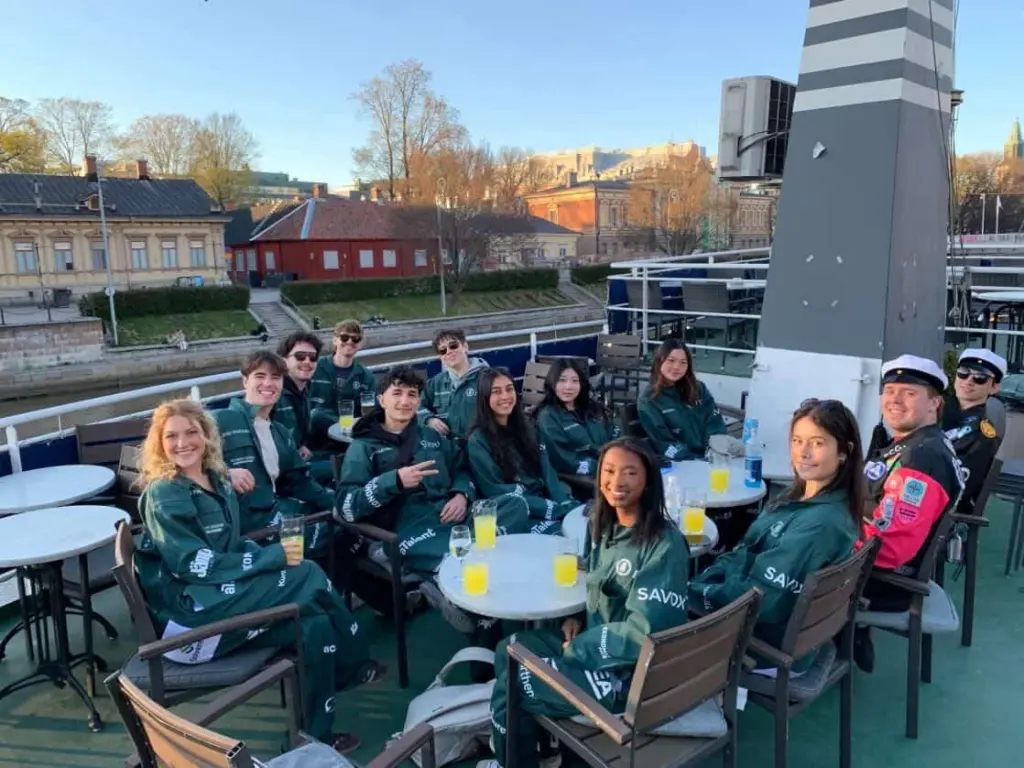
Michigan Ross students wear Finnish student overalls, known as haalarit, for a pub crawl during their three-week exchange at Aalto University School of Business. In Finland, university students collect patches for their overalls to mark events, parties, student traditions and other shared experiences.
A gaggle of American undergrads going on a pub crawl is nothing to write home about. Unless, maybe, they’re crawling around Finland.
There, Nolan Dixon, a rising sophomore at the University of Michigan, was old enough to be served beer and wine. He wore pine-green overalls from pub to pub, chasing stamps that would earn him his first Finnish student patch.
In Finland, the overalls are called haalarit. Different colors mark different fields of study and schools. Patches sewn into them mark the experiences students collect at parties, karaoke nights, festivals, sauna outings, and, in Dixon’s case, one very Finnish pub crawl.
Students from schools across Helsinki had come to crawl on a mission that Dixon and his Michigan classmates chose to accept: “You get different stamps at different pubs. Get 12 stamps, you get the captain’s patch,” says Dixon, one of nearly 40 Ross School of Business students on a three-week study abroad exchange at Aalto University School of Business.
It is the kind of story Dixon and his classmates will take home, if not in writing, at least in anecdotes to share with friends and family.
And isn’t that the point of studying abroad?
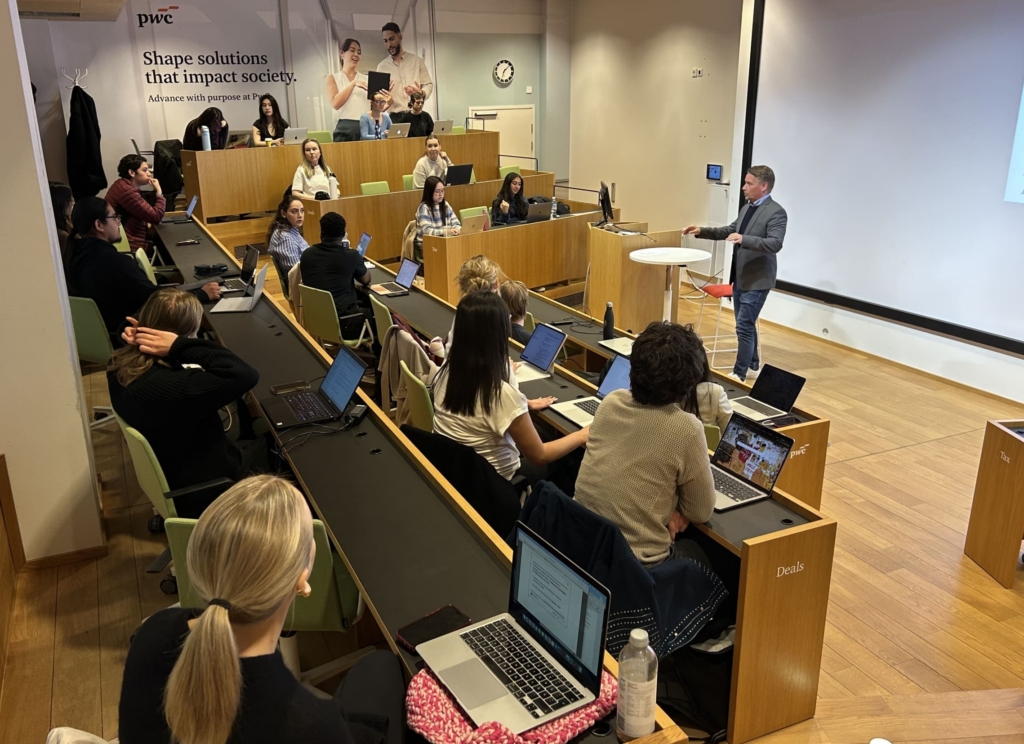
Students from University of Michigan Ross School of Business and Aalto University School of Business participate in “Strategic Retail Management and Marketing,” an intensive three-week course taught by Arto Lindblom during Ross’ short-term immersion program in Finland. The exchange embeds Ross undergraduates directly into Aalto classrooms alongside Finnish and other international students.
LIFE AS AN (ALMOST) FINNISH STUDENT
The Aalto exchange, part of a new model for global immersion at Ross, was one of six short-term exchanges offered this spring. Ross Global Initiatives developed the model to offer more students the chance to study in more countries for less money. Instead of traditional semester or yearlong exchanges that are hard to fit around athletics, internships, work schedules, or rigid academic programs, these exchanges last between one week and three.
Faculty-led trips, while much shorter, are expensive and rely on third-party vendors for logistics like housing, travel, and facilities. Instead, Ross partners with international business schools, like Aalto, to create lower-cost, exchange-based programs designed and taught by local faculty.
Students take real Aalto courses, live like local students, and learn the parts of business culture that don’t show up in a course catalog.
The 37 Ross undergrads and first-year master students stayed in Helsinki for three weeks in May, living at Unihome Töölö Towers with shared kitchens, lounges, and laundry. They navigated trains and trams to get to class on Aalto’s main campus in Otaniemi, Espoo.
“I guess the biggest surprise for me is the efficiency with all the public transport,” says Dixon who, growing up in rural Michigan, is conditioned to drive everywhere.
“It’s been super easy to get around and figure out places to go.”
Ross students also receive the same benefits as Finnish and longer-term exchange students – including the three-Euro lunch, Finland’s government-subsidized meals for university students. A monthly student public transit card, costing about €43, can be used to get around Helsinki and beyond.
For Aalto, the program brings more international students into its classrooms and student life, Lankinen says. For Ross, it expands access to global study without building every detail from scratch.
“I think this particular project is win, win, win. Everyone gets something out of it,” says Jutta Lankinen, manager of the incoming exchange program at Aalto School of Business.
“Obviously it’s a really good experience for Ross students, and I love seeing how much they explore and learn in just three weeks.”
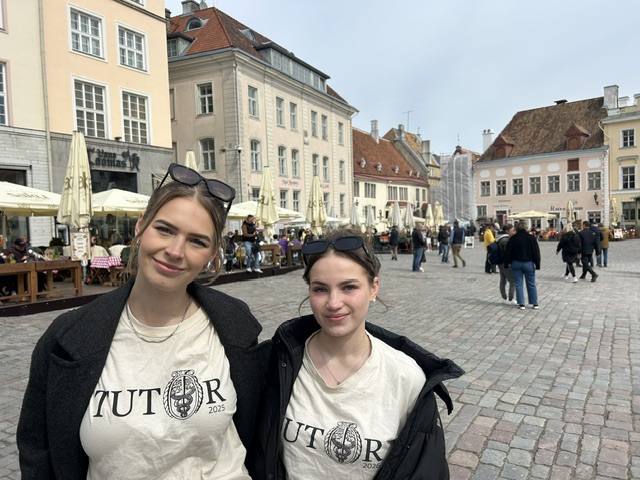
Julia Patja and Eeva Heikkinen, second-year Aalto University School of Business students, pause in Tallinn’s historic Old Town during a day trip to Estonia with Michigan Ross students. As cultural tutors for Ross’ three-week exchange at Aalto, Patja and Heikkinen helped introduce the visiting Wolverines to Finnish student life, from campus logistics to karaoke nights, sauna culture and the country’s student-overall tradition.
MEET AALTO’S CULTURAL TUTORS
Aalto University has more than 200 registered student associations including KY, the association for business students. All are independently run by the students themselves under the umbrella of the Aalto University Student Union.
That gives students a lot to choose from, much of it listed on a student events app. When Dixon counted, there were 168 events listed.
Every new student at Aalto, whether degree-seeking or on exchange, is assigned a local culture tutor, Lankinen says. Their job is to help with nonacademic questions that can shape the first days in a new country. Where classes are held, how to get around campus, how to navigate the grocery store.
More than that, they introduce them to Finnish student culture.
Two of the Ross guides were Julia Patja and Eeva Heikkinen, second-year Aalto business students who had helped lead student life the year before. They introduced the Wolverines to student bars, karaoke clubs, sauna nights, and sitsit – academic dinner parties built around student drinking songs.
Ross students were easy to recruit. Outgoing, curious and willing to say “yes” to almost anything, Patja says.
“Finnish people are very humble. We don’t want to flex. But, we have all these amazing things for student university culture.”
Take the coveralls tradition.
What began as an equalizer for students from different economic backgrounds has become a way to show both belonging and experience. The color links students to their academic community. The patches show where they have been.
“The whole Finnish university experience is very unique, I think, compared to other even European countries,” Patja says. “For American students, you get to not only experience Europe, but you also get to experience Northern Europe. It’s very cool for them.”
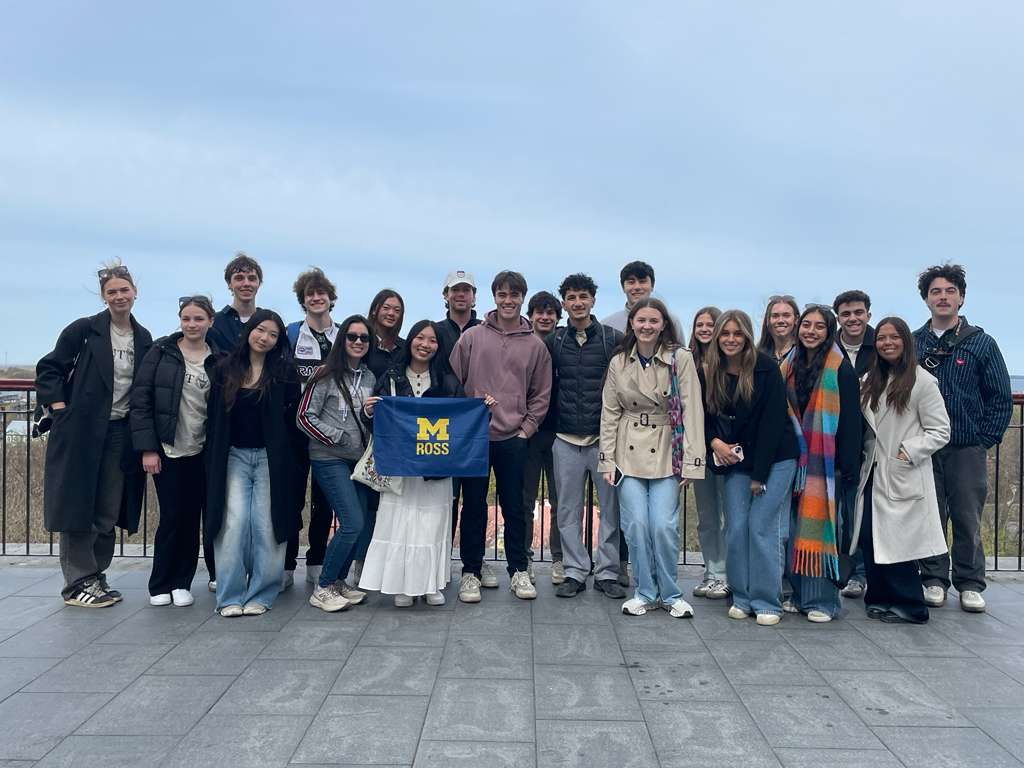
A group of Michigan Ross students display a Ross flag while participating in a new short-term global immersion at Aalto University School of Business. The program is designed to give more Ross students access to international study through lower-cost, exchange-based partnerships.
‘SPEECH IS SILVER, SILENCE IS GOLD’
Between the saunas, salmon soup, and other cultural lessons, Ross students had actual business classes to attend.
Each chose one of six Aalto courses compressed into three weeks to fit the exchange schedule. Wolverines studied alongside Finnish and other international students, learning a different rhythm of classroom participation.
Blake Stark, a rising senior from Grass Lake, Michigan, took Analytics for Sustainability, a course that examines the ethics and algorithms of AI. The class pushed students to think about fairness, bias, and justice when human problems are translated into data.
He made his own course calculations.
“If you want to get a five, which translates to an A, you have to do a lot of work,” says Stark, an engineering major who is minoring in business at Ross. “If you’re okay with settling enough to where you can still go to the sauna at night and do other Finnish things, it’s not as much.
“I’m just going for the four.”
During orientation, Lankinen taught the Michigan students an old Finnish proverb: “Speech is silver, but silence is gold.”
Stark noticed immediately. Finnish students seemed comfortable in the silence following a question. They gathered their thoughts instead of blurting the first thing that comes to mind.
“They’re calculated in what they say,” he sayd. “Once they do have something valuable, they’ll bring it up.”
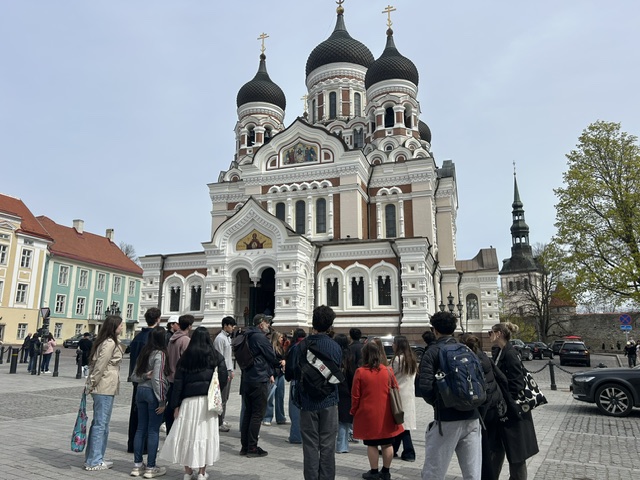
Michigan Ross students visit Alexander Nevsky Cathedral in Tallinn, Estonia, during a cultural excursion connected to their three-week exchange at Aalto University School of Business in Finland. The program combined Aalto coursework with local student traditions, public transit, subsidized student meals, sauna culture and regional travel.
CAVIAR, SAUNAS, AND CAPTAIN PATCHES
On their first Saturday in Finland, the Ross students and their tutors took a day trip to Estonia, boarding a crowded Eckerö Line ferry from Helsinki to Tallinn. The ship had nine decks, casinos, shops, bars, restaurants, and lounges. Nearly every corner was packed with Finnish day-trippers, many of them hauling empty handcarts they would later fill with cheaper Estonian beer and liquor to bring home.
The buffet line was its own introduction to Finnish breakfast: Korvapuustit (Finnish cardamon-spiced cinnamon rolls), egg butter for Karelian pies, smoked salmon, and a wide assortment of sausages, bread, cheeses, fruit, and cold cuts.
“Ooh,” Stark said, plate in hand. “There’s caviar!”
And then there was sauna, the Finnish ritual that likely most tested Ross students’ American sensibilities. Not the gym version where one sweats in a wooden room for 10 minutes after a workout. In Finland, sauna is more social, co-ed, and a lot less modest.
Sompasauna, a free public sauna in Helsinki, is not staffed and always open, decorated with outdoor art and sculptures. It has three saunas, the hottest of which reaches about 110 degrees Celsius. Bathers ladle water over hot stones to make the steam.
The Finnish kicker: When you can no longer stand the heat, you’re meant to plunge into the cold Baltic Sea. And then do it again. And again. The cycle of hot to cold, cold to hot, is the experience. That’s sauna.
For Stark, the rush of icy needles pricking his warm skin was already something to write home about. Doing it with locals – some naked, some almost so – in the clothing-optional public sauna?
“It was the wildest thing I’ve ever done,” he says.
Now, back to Dixon and his mission for his first haalarit badge, a tradition that reminded him of the letterman jackets from American high schools. Was he able to collect all 12 stamps?
Of course he was.
Somewhere between classes, sauna, the student bars, Dixon earned his captain’s patch. More importantly, he earned the story behind it.
DON’T MISS: MICHIGAN ROSS GOES TO FINLAND: HOW THE B-SCHOOL AND AALTO UNIVERSITY REINVENTED STUDENT EXCHANGE AND GOING BLUE: FROM COMMUNITY TO OPPORTUNITY – HOW THE BLACK BUSINESS SOCIETY SHAPED MY INTERNSHIP JOURNEY
© Copyright 2026 Poets & Quants. All rights reserved. This article may not be republished, rewritten or otherwise distributed without written permission. To reprint or license this article or any content from Poets & Quants, please submit your request HERE.


