


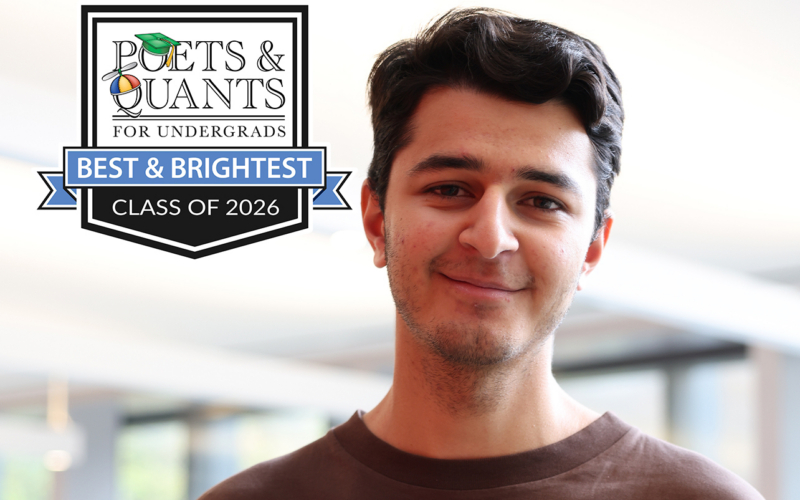
Francesco Salamone
Wharton School (University of Pennsylvania)
“I am of no particular interest to myself. Send me your description.”
Fun fact about yourself: Last summer, I lived as a Zen monk in a 600-year-old Buddhist temple in a tiny fishing village in Japan.
Hometown: Palermo, Sicily, Italy.
High School: Gonzaga Campus
Major: Decision Processes
Minor: N/A
Favorite Business Course: The Political and Social Environment of the Multinational Firm taught by Professor Wit Henisz, about integrating stakeholder opinions, climate risk, geopolitical factors, and much more into financial strategy.
Extracurricular Activities, Community Work and Leadership Roles During College:
- Wharton Impact Venture Associate
- Penn Impact Investing (President)
- ESG-Initiative Work-Study Assistant
- Volunteer, Uplift Grief Support Group
- Volunteer, West Philly Alliance for Children
- Research Assistantships: Prof. Domenic Vitiello (Urban Studies project on mafia and migration), PhD Student Serenity Lee (Organizational Behavior projects on identity and work-life balance)
- Wharton 1010 Head Teaching Assistant, McNulty Leadership Program
- Opinion Columnist, Daily Pennsylvanian
Awards and Honors
- SNF Paideia Fellow (Interdisciplinary 3-year fellowship learning about dialogue, from dialogue and how to dialogue across difference)
- Steven Levin Ochs Memorial Prize (Daily Pennsylvanian)
- Best Opinion Columnist 2024 (Daily Pennsylvanian)
- Herbert S. Steuer Memorial Prize (Top Sophomore Wharton student in scholarship, personality, and qualities of leadership)
- West Point McDonald Conference for Leaders of Characters
- WH1010 TA Perry Prize Winner
Where have you interned during your college career?
Freshman summer, I interned at a LMM PE firm.
Sophomore summer, I did research in organizational behavior in London.
Junior summer, I was unabashedly unemployed. Living life was my internship.
Where will you be working after graduation? I wish I could plan that far into life. I am working on my management thesis about the preprofessional culture of my community, the University of Pennsylvania, and I am taking my first fine arts class, where we are preparing an end-of-semester exhibition also open to my community. My life is here. Once I am done, I can see myself training as an existential psychoanalytic psychotherapist, working in emotional skills coaching, teaching English abroad, writing fiction about business, all, none, or something else. Only time will tell us both. Exciting!
Who is your favorite business professor? Dr. Amy Wrzesniewski doubtlessly. In a world where it is extraordinarily difficult for a scholar to carve out an academic career based upon an empirical investigation of existential issues, I read Professor Wrzesniewski’s research as a clever attempt to make us think existentially (but pragmatically) about why we work and how we find meaning in work. She, alongside colleagues such as her advisor Jane Dutton, permanently changed the field of Organizational Behavior with their research on work orientations and job crafting (we tend to relate to our work as either a job, a career, or a calling, and the meaning is in/by us, not the work itself). I have the privilege of saying I took a PhD class with her, where I fell in love with such questions, which later gave birth to my undergraduate thesis.
As a first-generation lower-income student herself, she came from a world where academia was not merely beyond the realm of possibilities but beyond the realm of imagination. As someone who started making photocopies for the founding father of positive psychology, Martin Seligman, she is a source of inspiration for many and a testament to the transformative possibilities of higher education and knowledge more broadly. In much simpler words, Amy is the kind of professor who not only gives you the key to your life, but who does so by wrapping it up nicely for you to discover, always smiling at you with kindness.
What is the biggest lesson you gained from studying business? Whatever else business may be about, it is certainly not about business. It is applied ethics (a manager and an entrepreneur are first-and-foremost a philosopher whose decisions and designs have pragmatic consequences). It is linguistics (accounting is the language of business). It is twisted literature (marketing is the story of why you should buy). It is the history of religion (the first business was the church, conversion the first product, prayer the first mission statement, the pope the first CEO, etc.). It is abstract physiology (the business cycle is a conceptualization of the human body which cannot avoid getting sick any more than an economy cannot avoid a recession). It is a paradoxical magic trick (a transaction is an agreement about disagreement: the instant I sell because I argue the stock will go down coincides with the instant you buy arguing it will go up). It is child psychoanalysis (kids always want the next best thing so capitalism is for children because it exploits and engages with appetite at a child’s level). It is color theory (an investment portfolio is a painting where each asset is a color and each risk its shade; beauty lies is in the eye of the beholder in the same way that right investments are only right relative to your risk tolerance).
If there is one lesson I have learned from studying business, it is that you cannot study business by studying business because business is polymathy par excellence. As writer Hernan Diaz teaches us: “Every financier ought to be a polymath, because finance is the thread that runs through every aspect of life. It is indeed the knot where all the disparate strands of human existence come together. Business is the common denominator of all activities and enterprises. This, in turn, means there is no affair that does not pertain to the businessman. To him everything is relevant. He is the true Renaissance man.”
What advice would you give to a student looking to major in a business-related field? I have no oracular advice to offer beyond, maybe, to ask yourself why. If those reading me are attendees of prestigious business schools, the push is for finance and consulting, security above risk. I am not that naive to ignore the psychological constraints you face (financial, job market, family, peer pressures), but you cannot also be naive and pretend that conformity and self-awareness are compatible when they are enemies.
The solution to the conformity and uncertainty we face as business majors is undermined by the never-ending questions: What do I want? What do I feel? What is my goal in life? What do I have in me to express and fulfill? It takes a certain psychological profile to be a businessman (I think). Having worked with hundreds of first-years, I have met more self-curated escape artists and actors than genuine fits for the world of business. If business teaches you how to get anything done (I agree!), what teaches you what is worth getting done in the first place? If you are still grieving the harsh adult truth that no one tells you what to do, I would rather you sat down with me and we talked about it than you adopted the investment banking wardrobe to seek validation. Been there, done that. I am not a moral philosopher telling you what you should do (the only thing we should do is abolish the word should). My own compass is sufficient; all I want is for you to build your own compass made of your own materials, and that is done by reflection.
Looking back over your experience, what is the one thing you’d do differently in business school and why? Before starting Penn, I went through the course catalogue to read every single course ever offered in every department, as well as through every single active club on campus. If I could go back (I do not want to), I would treat the interminable list of opportunities as just that: a list. I would follow John Stuart Mill’s advice sooner of choosing an “experiment in living”, treating life as a reality to be experienced rather than a problem to be solved or a lesson to be learned. I would follow curiosity and pleasure, not what I think would be good for me to study, learn, or do.
I wanted to learn about cryptocurrency and coding because I thought it was important. I am proud to say I am graduating without knowing what a line of code is, and it served me well given no one talks much about crypto anymore. While I do not understand coding, my engineering friends tell me AI has made it less important to know it. My concerns lie elsewhere. It takes a certain skill to attend to what you attend to. We are only interested when we are interested in our interest, when we notice our interest. Do that.
What is one way that your business school has integrated AI into your programming? What is one insight you gained from using AI? I am not the most appropriate person to ask. Wharton has always been on the frontlines of innovation: we have a phenomenal AI concentration and center, cutting-edge co-curricular programming, and on-campus events with leading incumbents on AI, so we are doing it.
Syllabi now have a mandatory section on AI policies, with most courses wanting to teach you how to work with it. It does not take an economist to know that AI is not exclusively “replacing our jobs”: we have always re-qualified as a labor force to adapt to technological advancements. The difficulty emerges when you are not being educated on ethics and limitations; I have personally perceived only tailwinds and not a single headwind for AI at Wharton. Every day, I am existentially concerned and grieving the fact that my generation is spiraling into an abyss of numbness and fragmented attention. Worst of all, this is compounded by the false sense of knowledge and confidence that a ChatGPT summary gives you. It is not a mystery – I mean it is absolutely clear: if you use AI this frequently, you forget how to read, how to write, how to attend to the world around you, and most worryingly to human beings.
I often feel treated like AI. Where in the syllabus is the professor warning me about this or teaching about the harmonic balance between why we have AI (to cure cancer, reduce accidents, what do I not know) and why we should not have AI (to give but one example: the youth who have committed suicide under GPT’s advice on how to succeed because asking for help was seen by the algorithm as a failure to the incontestable request of wanting to die).
Which academic, extracurricular or personal achievement are you most proud of? Since I have memory, I have been struggling with internalized homophobia and self-hate. One story is me choosing business school to overcompensate for being queer. One alternative, kinder story is me expanding the definition of what studying business means because it felt more approachable than expanding the definition of what my existence means. What I am most proud of is having recently made the conscious decision (my concentration is decision processes) to not be driven by shame any longer, but by self-love. I used to tell myself, “I would rather be dead than queer,” and now I say, “I would rather be queer than dead.” My life is a miracle. I am queer, and I am here.
Which classmate do you most admire?Mima Kohn. To you: brilliant individual passionate about city planning and Jewish history, youngest of seven, granddaughter of four Holocaust survivors from diverse Jewish backgrounds, fierce traveler and sidequester. To me: just Mima. With Mima (there is so much of Mima), you feel immunity against dissociation. At least I do. Some describe her as chaotic, and since I tend to render myself apparently predictable to myself (routine is the defense against chaos), I see Mima as a living reminder that the only freedom we really have is the freedom to choose an unpredictable future for ourselves. Surrealist poet Paul Éluard is reported to have said, “There’s another world, but it’s in this one.” Mima is the only person who inhabits it (I suspect). There is us, and then there is Mima. Thank you, Mima.
Who would you most want to thank for your success? My sister Martina, obviously. It would be too easy to thank my mentors and friends, but they all came after I gave birth to myself at Penn. The only person who has not merely seen me but truly lived alongside me both before and after Penn is my sister. When I did not know how to write a sentence intelligibly in middle school, she was the one who sat down with me to read my work. When I did not know how to make a decision, she was the one I would defer to. She is the living reminder that I used to be a kid. Her patience in dealing with me for a lifetime is enviable (she would not be my friend if I was not her brother). Before I was born, my parents gave my sister a pink bunny and a blue one, asking her to choose whether she wanted a little sister or brother. She chose the blue one and, with it, my life. The rest is irrelevant.
What are the top two items on your professional bucket list?
- Train under British psychoanalyst Adam Phillips
- Work for philosopher Alain de Botton
What made Francesco such an invaluable addition to the Class of 2026?
“Francesco is an invaluable addition to the Class of 2026 because he combines intellectual seriousness with a rare capacity to elevate other students—at scale and in deeply personal ways. He is academically outstanding (Decision Processes) and unusually broad in his curiosity across philosophy, psychology, film, and religious studies. Since its founding in 1881, Wharton has upheld the belief that business leaders are also civic leaders, integrating finance and economics with the liberal arts. Francesco exemplifies this ideal, combining rigorous analysis and technical expertise with a broad civic and humanistic perspective.
Equally important, Francesco demonstrated exceptional leadership in one of Wharton’s most visible student-facing roles. After excelling in WH1010: Business & You, he was selected from a highly competitive applicant pool to join the WH1010 TA community and quickly earned increasing responsibility, ultimately serving as Head TA. In that capacity he has led a 33-person TA team supporting more than 600 students in our gateway course. He has brought both operational excellence and moral clarity to the work—setting standards, coaching peers, and consistently strengthening the student experience.
Francesco has had a profound impact on the sense of belonging among the first-year students. Student feedback repeatedly describes him as empathic and genuinely present—someone who notices the quiet student, makes time for the uncertain student, and helps peers feel seen and capable at Wharton. Simply as illustration, one student wrote: “WE LOVE FRANCESCO!! His passion is evident. He brings everything he has to our one-on-ones, gives great advice, and goes out of his way to help us succeed.” Francesco mentors others with discretion and warmth, and he models what values-driven leadership looks like in everyday interactions. In recognition of his outstanding service as a TA, I was delighted to have the opportunity to recognize him as one of the winners of the Jonathan Perry Prize in 2024.
Francesco’s service orientation extends well beyond the classroom: through grief-support work with children in Philadelphia, mentoring Title I high school students, and conducting qualitative research on migration and anti-mafia movements in Sicily his junior year. These experiences are not resume builders for him; they are expressions of a consistent commitment to dignity, community, and purpose.
Finally, Francesco has used his public voice thoughtfully and responsibly. As an award-winning Daily Pennsylvanian opinion columnist, he engages the Wharton community in reflective conversations about preprofessional culture, meaning, and moral seriousness—helping his peers ask better questions about what success is for and how they want to lead.
In sum, Francesco Salamone is one of the most formative undergraduate leaders I have encountered at Wharton: intellectually rigorous, operationally excellent, deeply compassionate, and uncommonly grounded in purpose. He strengthened the culture of the Class of 2026 and left Wharton better than he found it.”
Anne M. Greenhalgh, Ph.D.
Senior Director, McNulty Leadership Program
Adjunct Professor of Management
The Wharton School
University of Pennsylvania
DON’T MISS: 100 BEST & BRIGHTEST UNDERGRADUATE BUSINESS MAJORS OF 2026
© Copyright 2026 Poets & Quants. All rights reserved. This article may not be republished, rewritten or otherwise distributed without written permission. To reprint or license this article or any content from Poets & Quants, please submit your request HERE.


