





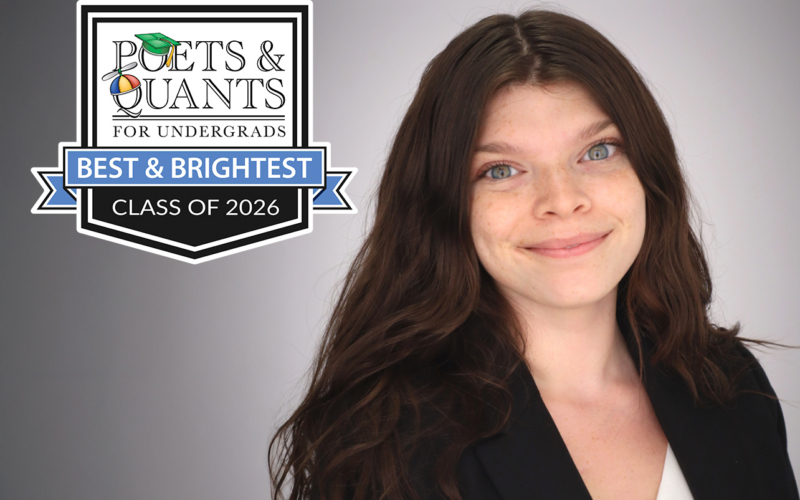
 Jonna Crocker
Charles H. Dyson School of Applied Economics and Management, part of Cornell SC Johnson College of Business
“Spreader of positivity and builder of community—one smile, conversation, and connection at a time.”
Fun fact about yourself: I have seen over 85 musical artists live in concert!
Hometown: Howell, New Jersey
High School: Howell High School
Major: Applied Economics and Management, Concentration in Marketing
Minor: Health Policy
Favorite Business Course: AEM 3249: Entrepreneurial Marketing & Strategy
Extracurricular Activities, Community Work and Leadership Roles During College:
Extracurriculars:
- Quill and Dagger Senior Honor Society (Inductions Chair)
- Dyson Dean’s Student Advisory Council
- Dyson Undergraduate Council (President)
- Dyson Admissions Ambassadors (President)
- A Seat at The Table Consulting Club (Advisory Board)
- Teaching Assistant: AEM 2700 Management Communication
- Teaching Assistant: AEM 2100 Introductory Statistics
- Resident Advisor
Community Work:
- Founder of Fighting H.A.R.D. Foundation, a 501c3 nonprofit organization that has raised over $850,000, with the mission of helping children with rare diseases and chronic illnesses not feel alone.
Awards:
- Dyson Scholar (Top 10%)
- Dean’s List
Where have you interned during your college career? Enterra Medical, Marketing Communications Specialist (2024-2026); Marketing Intern (2023)
Where will you be working after graduation? Enterra Medical, Marketing Specialist – Patient Engagement & Advocacy
Who is your favorite business professor? My favorite business professor is Dyson School Senior Lecturer Terry Alexander. I still vividly remember my freshman spring in Introductory Macroeconomics, when I was catching up after having missed a few lectures while sick in the hospital. Instead of rushing through my questions, Terry took the time during office hours to sit with me and work through each lecture step by step, making sure that I truly understood the material and didn’t leave with any lingering questions. One phrase he said to me that stuck was this: ‘Not understanding something doesn’t mean that you aren’t good at it; it simply means that it hasn’t been explained in a way that makes sense to you yet.’ And even in a 400+ person lecture, he would always find ways to make the class feel personable and would remember your name in the hallways outside of class. His encouragement and true love for teaching made a lasting impact on me, and I am grateful I had the opportunity to learn from him.
What is the biggest lesson you gained from studying business? One of the biggest lessons that I learned from studying business is that opportunities are often built through taking initiative. During my freshman year, I was encouraged by a business club that I was in to start building my LinkedIn network. While I initially connected with classmates and professors, I also took the chance to connect with alumni and companies that resonated with me.
One message changed my life more than I could have ever expected. I reached out to the CEO of Enterra Medical to express my gratitude for the work that the company was doing for patients with Gastroparesis, a rare stomach disease that I have. After receiving his response, our initial conversation led to internship opportunities that ultimately shaped my career path. This experience taught me the value of reaching out, even when there’s no guarantee of a response. Always be willing to start the conversation, because you never know where it can lead you.
What advice would you give to a student looking to major in a business-related field? My advice is to follow your passion. The Dyson School’s motto, “Our Business is a Better World”, captures this idea perfectly. It reminds us that business is not solely about profit, but also about impact. As Dyson students, we are encouraged to use the tools we gain through our education to make a meaningful difference in the world.
One of my favorite parts of studying business is the diversity of passions it brings together. Whether students are focused on agriculture, sustainability, fashion, healthcare, or finance, we are all connected by a shared commitment to turning ideas into action. When you pursue what genuinely motivates you, business becomes more than a simple career path. Instead, it becomes a way to contribute to something larger than yourself.
Looking back over your experience, what is the one thing you’d do differently in business school and why? If I could do one thing differently, I would have engaged with my professors more intentionally and proactively. Early in my undergraduate experience, I primarily viewed office hours as a resource for when I had a difficult question or process that I didn’t understand. Over time, I realized that some of the most meaningful learning experiences happened outside of the classroom borders. Conversations about how my professors made their way into academia, the questions driving their research, and the ideas they believe will shape the future of their fields broadened my perspective. These moments not only deepened my understanding but fostered more genuine relationships, making it easier to ask questions or get support when needed.
What is one way that your business school has integrated AI into your programming? What is one insight you gained from using AI? Reflecting on ways that my business school has integrated AI into our programming, I think back to the first time I was explicitly encouraged to use AI for an assignment. This happened in my AEM 4550: Economics of Advertising course, where we were asked to use AI tools to create visualizations of our data findings. Before this assignment, I had primarily used AI platforms like ChatGPT for writing support or to brainstorm ideas. This was my first experience using AI in a more analytical and data-driven way. Creating visualizations quickly allowed me to gain more insights from the data in less time.
Initially, I was hesitant to allow myself to use AI more frequently due to the fear that it would take over more of my life. Many people talk about how Artificial Intelligence will start to replace jobs or diminish work ethic and drive. However, this assignment reshaped my perspective. It made me realize that to be a successful business student and future professional, it is essential to learn how to work with AI and truly utilize the tools it offers. Embracing AI with intentionality helps good business leaders to stay ahead of the curve.
Which academic, extracurricular or personal achievement are you most proud of? The achievement that I am most proud of as I graduate from Cornell is the community that I have helped to build in the spaces that are important to me.
I am the co-founder of Fighting H.A.R.D. Foundation, a 501c3 nonprofit organization dedicated to helping children with rare diseases to not feel alone. Over the past 10 years, we have raised more than $850,000, supporting more than 65 families across New Jersey. With the funds raised, we purchase medical necessities not covered by insurance, send dinners after long days of treatment, offset expenses for families who need to travel across the country for specialized care, host recurring support group meetings, and contribute to advances in care, policy, and research for rare conditions. Having a rare disease myself, the work we do is deeply personal. Creating a space where families feel understood, supported, and connected has been incredibly meaningful to me, and our in-person gatherings have become a cornerstone of community for many families navigating the feelings of isolation that occur with rare conditions.
I have carried this same commitment to community into my time at Cornell through my involvement in the Dyson Undergraduate Council. In this role, I worked closely with our Office of Student Services, faculty, and staff to host programs that amplify student voices and strengthen the undergraduate student experience. This past year, I had the honor of leading our “Better Business Week”, a week-long series of programs including a Dean’s Distinguished Lecture, student and alumni panels, and our Grand Challenges Impact Competition, which serves as a capstone of our undergraduate studies.
As I transition to post graduation, I look forward to beginning my professional career as a Marketing Specialist in Patient Engagement and Advocacy at Enterra Medical, where I will continue building community for gastroparesis patients and beyond.
Which classmate do you most admire? The classmate that I most admire is Ada Chinye. Her leadership consistently stands out to me in the many spaces we share on campus. This year, we worked closely together on the Dean’s Student Advisory Council. As chair of the council, she is deeply committed to ensuring that students’ voices are heard and that programs are enacted to improve the student experience. One of our main initiatives this year was the creation of “student pods” that grouped transfer, first-generation, and other student groups to provide mentorship and support through the job recruitment process. Through this work, along with her role as a teaching assistant for one of Dyson’s main courses, Ada mentors underclassmen and dedicates her time to giving back to the business community.
What I admire most about her, however, is her kind heart. She truly leads with empathy and cares deeply about others and their passions. She will be the first one to listen to your story, help you with a tricky homework question, or just lend an ear. Her impact on the community goes beyond the classroom in the way that she supports those around her.
Who would you most want to thank for your success? No one has been more dedicated to my success as both a student and a person than my mom, Tara Crocker. Since the age of 11, I have lived with a rare disease that has required frequent hospitalizations, many surgeries, and extensive travel for medical care. For years, my mom would drive ten hours from our home in New Jersey to Nationwide Children’s Hospital in Columbus, Ohio, as we navigated my diagnosis together. Through thousands of days in the hospital, she never once left my side.
When I told her that I wanted to go to college, she was my biggest supporter and fiercest advocate. She helped me to research schools, took me on college visits, and transformed any doubt I had into hope and possibility.
My health condition has continued to present challenges during college, to the point where I now require a wheelchair to get to most of my classes and meetings. While there were doctors each semester who told me that I should consider taking a health leave and that it would not be possible to remain at school with my condition, my mom helped me continue to follow my dreams. She frequently would drive five hours to bring me medical supplies, take me home for appointments (and bring me right back the next day to make it on time for my exams), and stay right by my side for surgeries and procedures, all while keeping a smile on her face and jamming out in the car along the way.
We have always been a team, and I truly do not know where I would be today without her support. My mom has taught me the power of infectious optimism and resilience. Because of her, I know that I can accomplish anything I set my mind to. I am so grateful to have her by my side, and I cannot wait to see her cheering me on as I cross the finish line in May, just as she has done for my whole life. Mom – this one is for you!
What are the top two items on your professional bucket list?
1. Obtain my MBA to further my career and make a greater impact at the intersection of business and healthcare.
2. Grow and scale my nonprofit organization to help more families impacted by rare diseases
What made Jonna such an invaluable addition to the Class of 2026?
“In my time working with Jonna Crocker, I have been consistently impressed by her rare combination of leadership, emotional intelligence, and deep commitment to strengthening the Dyson community. Her work on Better Business Week exemplifies this. As part of the Dyson Undergraduate Council, Jonna helped shape and execute a full week of student‑facing programming that brought together faculty, alumni, and more than 200 students. Her ability to coordinate across stakeholders, keep teams energized, and ensure that each event felt both professional and welcoming reflects her instinct for building inclusive, high‑impact spaces. The tone and cohesion of BBW were very much a reflection of Jonna’s thoughtful planning and her belief that business education is most powerful when it is community‑centered.
In the classroom, particularly in AEM 3000, Jonna further distinguishes herself. She elevates discussions with a perspective grounded in purpose, empathy, and curiosity, and she consistently works to bring others into the conversation. Her presence changes the dynamics of a room: she listens carefully, encourages peers, and makes academic spaces feel more collaborative and humane. Whether through her coursework, her leadership roles, or her quiet mentorship of younger Dyson students, Jonna has had a transformative impact on our community. Dyson is unquestionably a better place because she has been part of it.”
Sarah Wolfolds
Director of Undergraduate Studies for the Dyson School
DON’T MISS: 100 BEST & BRIGHTEST UNDERGRADUATE BUSINESS MAJORS OF 2026
© Copyright 2026 Poets & Quants. All rights reserved. This article may not be republished, rewritten or otherwise distributed without written permission. To reprint or license this article or any content from Poets & Quants, please submit your request HERE.


