





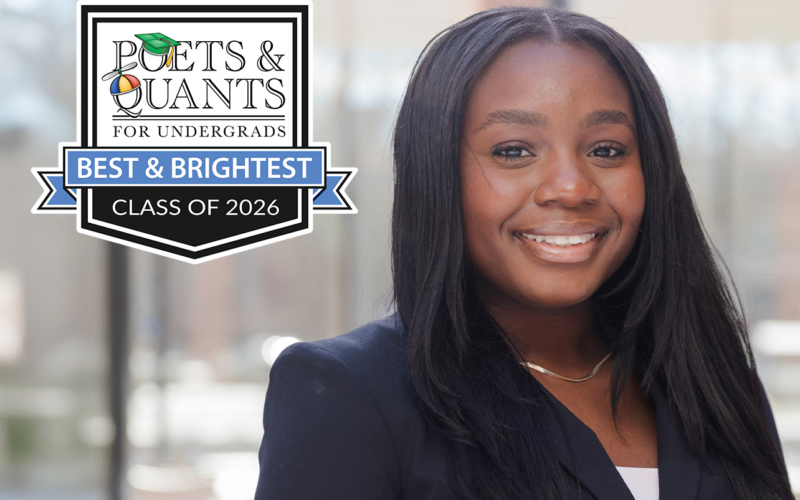
Leah Elesinmogun
Wharton School (University of Pennsylvania)
“Curious, bold, and sharp—good vibes, big ideas, and somehow making chaos look effortless.”
Fun fact about yourself: I fell in love with horseback riding, started training to race, and I’m currently on track to earn my racing certification so I can compete at a more professional level.
Hometown: Bowie, Maryland
High School: College Park Academy
Concentrations: Finance and Legal Studies
Favorite Business Course: Negotiations
Extracurricular Activities, Community Work and Leadership Roles During College:
- Joseph Wharton Scholar
- Future JD Candidate at Harvard Law
- Most Representative of Wharton’s Values Award – Black Wharton
- Black Wharton Undergraduate Association – President
- Black Pre-Law Association – President
- Penn Leads the Votes – Wharton Coordinator
- Section Head Teaching Assistant – Wharton 1010: Business and You, LGST 2180: Diversity and the Law, and LGST 1010: Law and Social Values
- GirlsBringUpGirls – Founder & Head of Education
- Wharton Successful, Transition & Empowerment Program – Summer Mentor (Volunteer)
- UPenn Africana Summer Institute Peer Mentor
- Penn Carey Law School – Weekly Volunteer
Where have you interned during your college career?
- Goldman Sachs – Morristown, New Jersey – Summer Analyst
- National Institute of Health – Bethesda, Maryland – Pathways Intern/Budget Analyst
- Virginia Commonwealth Attorney’s Office – Fairfax, Virginia – Paralegal Intern
Where will you be working after graduation? I will be working at Goldman Sachs as a full-time Investment Banking Analyst.
Who is your favorite business professor? My favorite business professor is Professor Mason Ashe. I took his Sports Law class without any prior interest in the field, but the way Professor Ashe engaged the class completely changed my experience. He has a unique ability to make complex material interesting and accessible, and he consistently encouraged students to speak up and share their perspectives. What stood out most, though, was how much he showed up for his students beyond the classroom. He advocated for us, made himself available, and genuinely cared about our growth and well-being. His commitment to his students and his passion for teaching made the class one of the most impactful experiences I had at Wharton.
What is the biggest lesson you gained from studying business? One of the biggest lessons I took away from studying business is that it’s really about people, not just numbers. I came in thinking business would be mostly technical—spreadsheets, models, and outcomes. But over time, through classes, group projects, and leadership roles, it became clear that the numbers only tell part of the story. What really drives decisions are people: how leaders show up, how teams work together, the values behind choices, and who those choices affect. I saw how the same data can lead to completely different outcomes depending on incentives, personalities, and culture. As a pre-law student, that perspective mattered a lot. It reminded me that law and business both operate in human systems, where decisions have real consequences. Business taught me to slow down, look beyond the surface, and think about impact—not just results.
What advice would you give to a student looking to major in a business-related field? As someone whose younger brother is now a freshman at Wharton, this is advice I gave him often while he was applying—and still give him now. Stay curious and don’t feel pressured to have everything figured out right away. Business is much broader than it seems, so give yourself time to explore different classes, industries, and interests before narrowing in on one path. At the same time, don’t let the competitive environment intimidate you or make you second-guess yourself—focus on your own growth and trust that you belong. Some of the most valuable parts of a business education come from relationships, so invest in people as much as opportunities. Say yes early, learn by doing, and refine as you go. There’s no single “right” path in business, and everyone’s journey looks different.
Looking back over your experience, what is the one thing you’d do differently in business school and why? Looking back, the one thing I would do differently is trust myself sooner. Coming into such a competitive environment, it was easy to feel overwhelmed at times and to question whether I was doing enough or measuring up. Early on, that pressure sometimes made me second-guess my ideas or hesitate to speak up. Over time, through experience and leadership roles, I realized that I belonged in those spaces and that my perspective mattered. If I could do it again, I would give myself more credit from the start—trust my instincts, speak with confidence, and not let the competitiveness of the environment quiet my voice.
What is one way that your business school has integrated AI into your programming? One way Wharton has integrated AI into its programming is by encouraging its use as a learning and productivity tool across classes, rather than treating it as something separate or off-limits. In several courses, AI tools were incorporated into research, case preparation, brainstorming, and writing support, with clear guidance on how to use them ethically and effectively. This approach emphasized AI as a complement to human judgment, not a replacement for it. One key insight I gained from using AI is how powerful it can be for structuring thinking and accelerating early-stage analysis, while still requiring critical thinking to evaluate, refine, and apply its outputs. It reinforced the importance of asking the right questions and exercising judgment—skills that are essential in business.
Which academic, extracurricular or personal achievement are you most proud of? From my freshman year, the Black Wharton Undergraduate Association became more than just a student organization—it became a family. It gave me a community that supported me both personally and professionally throughout my time at Penn. Through Black Wharton, I gained mentors, built lasting relationships with alumni, and formed connections that directly helped me secure a job. I had the opportunity to work closely with Wharton administrators and Wharton alumni, which exposed me to leadership at an institutional level from being a freshman logistics coordinator, the director of marketing, the vice president of internal affairs, and the 50th President. Being involved in initiatives like the Howard E. Mitchell Memorial and the Ivy League Business Conferences pushed me to grow, take responsibility, and lead with purpose. Black Wharton taught me what it truly means to be a leader and how to show up for others the same way the community showed up for me.
Which classmate do you most admire? The classmate I most admire is Leslie Njingang.
Leslie has always been there for me through thick-and-thin—right-or-wrong—in moments of success and moments of struggle. Through every high-and-low, she has shown up with unwavering loyalty, honesty, and support through all four years at Penn. She embodies the true meaning of being a dependable friend: someone who stands beside you not only when it’s easy, but especially when it’s hard. Her consistency, integrity, and genuine care for others are qualities I deeply admire and strive to emulate.
Who would you most want to thank for your success? The people I would most want to thank for my success are my parents: my dad, Joshua Elesinmogun, and my mom, Oluwafunmilayo Elesinmogun. They have both been my rock through every step of my journey, constantly supporting and encouraging me with unconditional love. Even though I’m in Philadelphia for school, they are always just a phone call away—whether I need advice, motivation, or simply someone to listen.
They celebrate my wins, help me navigate challenges, and remind me to keep perspective when things feel overwhelming. There has never been a moment where I doubted that they had my back, and that kind of unwavering support has made all the difference. Their belief in me has given me the confidence to pursue opportunities I might have been too afraid to try on my own, and I truly wouldn’t be where I am today without their guidance, encouragement, and love.
What are the top two items on your professional bucket list? The top two items on my professional bucket list are to successfully graduate from law school and to share my insights through conferences and thought leadership.
Graduating from law school represents a major milestone in my journey and is the foundation for the career I hope to build, combining my legal knowledge with my business undergraduate background. I’m excited to explore the ways law and business intersect, whether in corporate law, compliance, or other areas where legal decisions shape business outcomes.
Equally important to me is contributing to the broader conversation by publishing thought leadership and speaking at conferences. I want to share what I’ve learned, highlight the connections between business and law, and inspire others to think critically about how these fields work together. Both goals reflect my desire to grow, lead, and make an impact in the professional world.
What made Leah such an invaluable addition to the Class of 2026?
“In my role as Associate Director of Student Engagement, I advise over 45 recognized undergraduate student clubs and organizations. This position allows me to work closely with an exceptional group of student leaders. I regularly meet club presidents and committee members who are ambitious, thoughtful, and deeply engaged, but even within this talented cohort, Leah has stood out as an invaluable member of the Class of 2026 and the Penn community.
I have worked closely with Leah over the past three years on a range of student initiatives, and I have consistently been impressed by her drive, thoughtfulness, and kindness. From her first year at Wharton, Black Wharton was, in her words, “more than just a student organization. It became a family.” What she does not always acknowledge is that she did not simply benefit from that support; she helped build it by deepening relationships and expanding support networks across the Penn community with integrity and care.
During our meetings, Leah often reflected on how her Wharton experience connected her to mentors and meaningful professional opportunities. As a senior, she became deeply intentional about ensuring those same pathways were more visible and accessible to younger students. Through her wide-ranging commitments, she strengthened student and alumni engagement and enhanced professional programming, enabling underclassmen to approach opportunities with greater confidence and preparation. She showed up for others with the same care and investment that shaped her own growth. Because she understands that true leadership is grounded in authentic relationships rather than personal advancement, Leah leaves behind a more connected and supportive community.
Her impact is visible in the programs she led and the titles she earned, but her true contribution lies in the culture of care, support, and resource-sharing she helped embed within her class.”
Isabelle Glass
Associate Director of Student Engagement
Wharton Undergraduate Division
DON’T MISS: 100 BEST & BRIGHTEST UNDERGRADUATE BUSINESS MAJORS OF 2026
© Copyright 2026 Poets & Quants. All rights reserved. This article may not be republished, rewritten or otherwise distributed without written permission. To reprint or license this article or any content from Poets & Quants, please submit your request HERE.


