






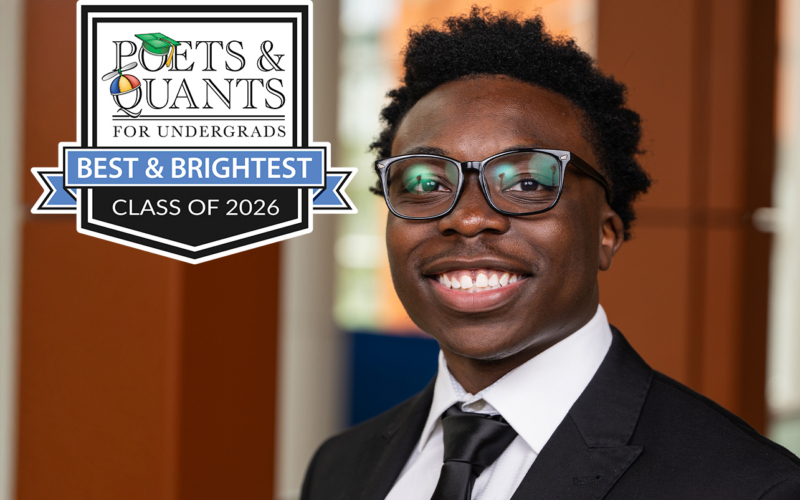
 Marvin Tetteh
University of Michigan, Ross School of Business
“Big-picture thinker, people connector, and idea starter who somehow makes ambitious plans actually happen… usually on deadline.”
Fun fact about yourself: I’ve visited more international countries than I’ve visited US states.
Hometown: Brewster, New York
High School: Brewster High School
Major: Business Administration
Minor: Intergroup Relations Education
Favorite Business Course: MO 324: The Science of Adaptability & Resilience In An Ever-Changing Business World
Extracurricular Activities, Community Work and Leadership Roles During College:
- VP of Operations- The Black Business Undergraduate Society
- Treasurer- African Student Association
- Co-President- The Black Business Undergraduate Society
- EnspiRED Runway Vice-President
- Ross Summer Connection Mentor
- Office of Undergraduate Admissions Peer Recruitment for Outreach Ambassador
- Student Engagement Coordinator- Trotter Multicultural Center
- Empower & Thrive Initiative Peer Mentor (First-Gen Student Mentor)
- Sigma Gamma Rho Black Male Highlight Scholar
- Ross Office of Undergraduate Programs Impact Award
Where have you interned during your college career?
Ernst & Young – EY, McLean, VA, Consulting Intern
Amazon, Arlington, VA, Program Manager Intern
Where will you be working after graduation? Currently exploring full-time roles in product, program, or people operations within technology and consumer companies
Who is your favorite business professor? My favorite business professor is Professor Cheri Alexander. I first met Professor Alexander when I was a prospective student at Ross, and I was fortunate to later take one of her classes during my junior year before studying abroad. Even before enrolling in her course, I knew she was a world-class business leader and an incredibly knowledgeable educator.
Taking her study abroad class significantly shaped my perspective on international business and cross-cultural communication. The course challenged me to think more intentionally about how culture, context, and communication styles influence decision-making and collaboration across borders.
This experience has been especially valuable, given that my internships have involved working with international teams in the UK and Latin America. The frameworks and perspectives I gained from Professor Alexander’s class equipped me to navigate those environments with greater confidence, cultural awareness, and effectiveness. Her ability to bridge academic insight with real-world application is what made her class so impactful and why she stands out as my favorite professor.
What is the biggest lesson you gained from studying business? No matter the field or industry, people will always be at the center of every organization. This idea feels especially important today amid the rapid rise and uncertainty surrounding artificial intelligence. While many people fear being replaced or feel unsure about what their roles may look like in the future, I am prepared to enter the post-graduate workforce because I view AI not as a threat but as a powerful tool that will transform how businesses operate and make decisions.
From my background in intergroup relations education, I understand that individuals bring different lived experiences, values, and perspectives that shape how they interpret the same information. That same principle applies to how we interact with and benefit from AI. The technology itself is neutral, but the outcomes it produces depend on the questions we ask, the data we prioritize, and the human judgment applied to its insights.
As a future business leader, I have learned the importance of acknowledging these differences and intentionally creating space for diverse perspectives. By doing so, teams are better positioned to use AI thoughtfully, ethically, and creatively. I aim to champion collaboration between people and technology, ensuring that human insight remains central while AI serves as an enhancer of impact rather than a replacement for it.
What advice would you give to a student looking to major in a business-related field? I advise students interested in majoring in a business-related field to start by exploring their passions and then think intentionally about how those interests can align with business. When I first entered business school as a first-generation student, I didn’t have a strong understanding of the different career paths available. When people asked what I planned to focus on, I often said consulting or finance, even though I wasn’t fully sure what those roles actually involved.
As I gained more exposure to coursework and eventually worked in the consulting industry, I quickly realized that it was not the right fit for me. That experience forced me to step back and reevaluate my goals. Instead of choosing a path based on familiarity or prestige, I asked myself what truly motivated me.
I realized that people had always been at the center of the work I found most fulfilling. Looking back at my undergraduate experiences, whether serving as a mentor, ambassador, or team member, I consistently gravitated toward roles focused on supporting, developing, and connecting others. That clarity led me to explore the intersection of business, people, and technology, which now serves as the foundation of my academic interests and long-term career goals.
My advice to students is to remain open-minded, seek out hands-on experiences early, and permit yourself to change direction as you learn more. Business is an incredibly broad field, and success does not come from following a predetermined path but from building a career that aligns with your strengths and values.
Looking back over your experience, what is the one thing you’d do differently in business school and why? Looking back on my experience in business school, the one thing I would do differently is pursue more experiential learning opportunities outside of the classroom earlier in my college career. As a first- and second-year student, I often hesitated to participate in case competitions, client challenges, or programs like StoryLab because I didn’t feel “good enough” or prepared yet.
In hindsight, those experiences were designed for learning, not perfection. They would have given me earlier exposure to ambiguity, teamwork, and real-world problem-solving skills that are difficult to develop fully through coursework alone. I now recognize that growth often comes from stepping into situations before you feel completely ready.
While I was fortunate to gain meaningful hands-on experience later through my academics and extracurricular involvement, I wish I had pushed myself to take those risks sooner. Putting myself out there earlier would have accelerated my confidence and learning curve, and I truly appreciate it today. That perspective has shaped how I now approach opportunities with curiosity, initiative, and a willingness to learn by doing.
What is one way that your business school has integrated AI into your programming? What is one insight you gained from using AI? My business school has done a strong job integrating AI across its core business competencies, including Technology & Operations, Finance, and Management & Organizations. Rather than treating AI as a standalone topic, it is embedded into coursework and discussions in a way that reflects how it is actually used in practice. Through the elective courses I’ve taken, I’ve learned practical ways to apply AI within my technology and management concentrations, particularly to support decision-making, process improvement, and people-centered leadership.
Beyond the classroom, Ross has also created opportunities to learn directly from industry leaders about how AI is reshaping the workforce. One example that stood out to me was a talk by Michigan alumna and McDonald’s Global Chief People Officer, Tiffanie Boyd. She shared how AI is being used to augment talent strategy, improve workforce planning, and enhance the employee experience at scale.
One key insight I gained from these experiences is that AI is most impactful when paired with strong human judgment. The technology can surface patterns and efficiencies, but people provide context, values, and ethical direction. That understanding has shaped how I approach AI, not as a replacement for human work, but as a tool that enables better, more informed leadership decisions.
Which academic, extracurricular or personal achievement are you most proud of? The achievement I am most proud of is serving as President of the Black Business Undergraduate Society (BBUS). I spent my entire college career involved with the organization, which allowed me to witness and contribute to its growth at every stage. When I was first encouraged to take on the role of president, I was hesitant and unsure of my ability to lead the organization to the next level. However, with encouragement from former presidents, I stepped into the role and embraced the challenge.
During my term, I helped drive some of the organization’s most impactful initiatives. I led the planning and execution of the first BBUS business trek to Chicago in over 20 years, providing students with direct exposure to corporate environments and professional networks. I also raised $12,000 in just 24 hours during Giving Blue Day for our annual need-based scholarships, representing a 150% increase from the previous year. In addition, I successfully organized a case competition sponsored by Eli Lilly & Company and orchestrated a 160-person corporate dinner that brought together Fortune 500 recruiters, undergraduate students, and MBA students.
Beyond the measurable outcomes, this role has been meaningful because of the people it impacted. I had the opportunity to mentor and support undergraduate students at the University of Michigan, watching them grow in their business knowledge, confidence, and professional development. Seeing members secure internships and full-time roles as a result of the resources and community we built is what makes this achievement the most rewarding to me.
Which classmate do you most admire? The classmate I most admire is Jala Taylor-Pickett. I admire her ability to balance personal authenticity with professional excellence thoughtfully. As someone who is also pursuing a non-traditional path in technology, I’ve seen firsthand how she navigates the space with confidence while staying true to herself.
Jala brings her own personal brand into the tech environment in a way that feels intentional and impactful, proving that success does not require sacrificing identity. Her approach has been inspiring to watch, and it has reinforced for me that there is space in tech for diverse voices, perspectives, and leadership styles.
Who would you most want to thank for your success? The person I would most like to thank for my success in undergrad is Kimberly Williams. Her outreach work is the reason I decided to enroll at the University of Michigan. Through her leadership of the Ross Preview Weekend, I was able to see myself at this university and envision a future where I belonged and could thrive.
Beyond that initial introduction to Ross, Kimberly has been a constant champion throughout my time here. As a supervisor and mentor, she has created a space where my peers and I can be candid and honest about our experiences, challenges, and aspirations. She leads with empathy, authenticity, and trust, which has allowed me to grow both personally and professionally.
Whenever I have felt doubtful or discouraged, she has consistently shown up with encouragement, warmth, and confidence in my abilities, pushing me to show up as my best self even when I struggled to see it myself. I am deeply grateful for her support, and I hope to one day emulate her leadership by creating spaces where others feel seen, supported, and empowered to succeed.
What are the top two items on your professional bucket list?
One item at the top of my professional bucket list is to go on my first official business trip. While I’ve been flown out for super-day interviews, I’m excited to be on the other side of that experience, traveling to meet with a client, collaborate in person, and see how business decisions are made in real time. To me, that moment represents a tangible milestone in my transition from student to professional.
The second item on my bucket list is to be invited back to Ross to speak one day. I’ve been deeply inspired by alums and industry leaders who returned to campus to share their journeys, often unknowingly shaping the direction of my college experience and career aspirations. As I look ahead to my future, I hope to have the opportunity to give back in the same way by sharing my story, lessons learned, and encouragement with students who may be searching for clarity or confidence in their own paths.
What made Marvin such an invaluable addition to the Class of 2026?
“Marvin Tetteh is the kind of student every educator hopes to encounter: intellectually engaged, globally curious, and deeply service-oriented. From the moment he arrived at Ross, it was clear to me that he was special. In my Global Competency course, he brought curiosity, humility, and a deep commitment to leadership in the service of others. Watching him grow through his overseas assignment was a privilege; he returned more grounded, more confident, and even more purposeful in how he seeks to lead and serve in the world going forward.”
Cheri Alexander
Lecturer of Management and Organizations
DON’T MISS: 100 BEST & BRIGHTEST UNDERGRADUATE BUSINESS MAJORS OF 2026
© Copyright 2026 Poets & Quants. All rights reserved. This article may not be republished, rewritten or otherwise distributed without written permission. To reprint or license this article or any content from Poets & Quants, please submit your request HERE.


