




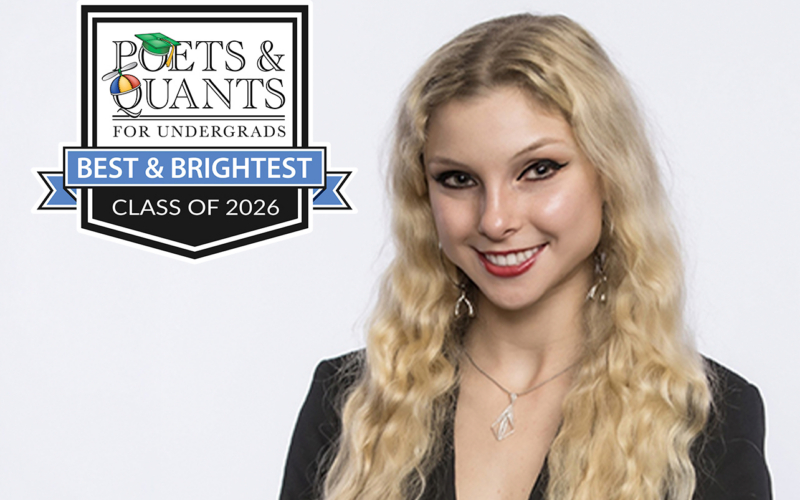
Mary Esposito
University of North Carolina, Kenan-Flagler Business School
“Artist, entrepreneur and investor proving soft skills build hard assets.”
Fun fact about yourself: So far, I have visited 34 countries and all 50 U.S. states.
Hometown: Raleigh, North Carolina
High School: Cary Academy
Major: Business
Minor: N/A
Favorite Business Course: My favorite course was BUSI 527: Gender at Work with Dr. Sharon Cannon. The class gave language and research to dynamics I had noticed as a woman entering male-dominated spaces like finance, but hadn’t yet been able to fully articulate. The assigned reading “Likeable Badass” completely shifted how I approach mentorship, from prioritizing formal asks to building genuine relationships over time. Through a class project, Dr. Cannon connected me with a UNC alumna, and that introduction evolved into an ongoing professional collaboration. Genuinely, I credit BUSI 527 with shaping how I now build relationships in my career.
Extracurricular Activities, Community Work and Leadership Roles During College:
- Purple Pear— Founder
- Money with Mary— Founder
- Carolina Financial Well-Being Center— Peer Coach
- ReadWorks— Social Media Strategist
- Dove Self-Esteem Project— Film Lead
Awards & Honors
- Morehead-Cain Scholar
- UNC Kenan-Flagler Rose Scholar
- UNC Kenan-Flagler RISE Fellow
- BMTX Financial Empowerment Scholar
- UNC Study Abroad Fellow
- Her Campus “22 Under 22”
- Dean’s List (all semesters)
Where have you interned during your college career? Instead of traditional internships, I spent college growing and monetizing my social media platforms. Through my LLC, I consult with organizations on their digital marketing strategy and educational programming.
Where will you be working after graduation? After graduation, I will work full-time as an artist, entrepreneur and investor, continuing to scale my businesses, Money with Mary and Purple Pear.
Who is your favorite business professor? Dr. Sharon Cannon is my favorite professor because she teaches people, not just careers. Her course challenged my transactional view of networking and encouraged consistent, organic relationship-building. She also actively connects students with alumni and makes sure those relationships last. I still keep in touch with people I met through her class, which is one of the most practical and helpful outcomes a professor can create.
What is the biggest lesson you gained from studying business? The greatest lesson I learned is the importance of opportunity cost. I first encountered the term in freshman economics, but live it daily while balancing entrepreneurship and academics. With limited time, every yes requires a no— a project, rest or time with friends. Studying business taught me that success comes from intentionally choosing what matters most and accepting the tradeoffs of your decisions, whatever they may be.
What advice would you give to a student looking to major in a business-related field? Start something before you feel ready. I began a business at 14 and learned by figuring things out as I went. Even a small hands-on project teaches more than studying hypotheticals. Today, information is accessible— the biggest barrier is beginning. Don’t wait for a credential or permission to start! Experience compounds faster than preparation.
Looking back over your experience, what is the one thing you’d do differently in business school and why? Looking back, I would have shared my work publicly earlier. I spent a long time refining ideas privately before sharing them, yet some of my biggest opportunities came from videos I almost didn’t publish because they felt messy or unfinished. Ironically, many of my most viral posts took less time to film and edit than lower-performing ones I spent hours curating. Virality created visibility, which opened doors. In this way, imperfect work sparked conversations, collaborations and partnerships in ways polished plans never did.
What is one way that your business school has integrated AI into your programming? What is one insight you gained from using AI? In one of my business courses, we completed a project where we interacted with AI as if it were an employee we were supervising. Instead of simply asking questions, we gave structured instructions and provided iterative feedback. Part of the final deliverable was a transcript of the full conversation so the professor could evaluate our communication and managerial approach. From this assignment, my biggest takeaway was that AI does not replace leadership skills; rather, it makes them more important.
Which academic, extracurricular or personal achievement are you most proud of? I am most proud of being featured in The Wall Street Journal for my investing portfolio and financial education work through my platform, Money with Mary. I started the social media account to make financial concepts more accessible to people my age. Watching it reach a wider audience and recognition beyond Instagram validates that my work is actually helping others make more informed decisions with their money.
Which classmate do you most admire?
I most admire Rotimi Kukoyi. We met freshman year and I’ve had the privilege of watching him accomplish incredible things, including major academic honors, while still being deeply present for friends and community. I used to think success required sacrificing your social life for career progress. Seeing how thoughtfully he balances his ambition with his relationships challenges that core belief and reminds me that achievement does not have to come at the expense of enjoying the people and moments around you.
Who would you most want to thank for your success? I would like to thank my grandmother, Janice (“Gam”). She always encouraged my creativity as a child, whether that meant photoshoots with big hats and flowers, letting me play in bright blue eyeshadow or buying me tutu skirts, patterned shirts and art supplies. She made (and still makes) expression feel normal and worth investing in. That early encouragement helped shape how I see the world and myself as a canvas, and my creativity eventually blossomed into entrepreneurship and everything I do today.
What are the top two items on your professional bucket list?
My first goal is to make the Forbes 30 Under 30 list. When I was 15, I journaled as if I had already achieved it. Before I understood traditional business metrics, it became my concrete benchmark of success, so earning the title would feel like a full-circle moment and proof to my younger self that the effort mattered.
My second goal is to give an official TED Talk. After speaking at both my high school and university TEDx events, I discovered how much I value storytelling as a way to share ideas and connect with people, so a main-stage TED talk feels like the natural next step.
What made Mary such an invaluable addition to the Class of 2026?
When I met Mary in fall 2025, I was amazed to learn all that she’s achieved already in life. At 14, she began a crocheting business, where she used social media to connect with her audience. That success in engaging with an online community led her to create videos to help peers build confidence with money.
She had already developed the background to become a peer coach at UNC’s Carolina Financial Well-Being Center. All of her visibility as a college-aged financial influencer has led to many interviews, and even The Wall Street Journal featured her in the article “How Five Gen Z-ers Are Playing This Year’s Volatile Market.”
She was always prepared to discuss the cases students were reading for my Gender at Work class. One course assignment involves students engaging with a mentor. As I read through all she did to get to know the entrepreneur who mentored her, I was amazed that when the mentor suggested she read a book, she did so immediately. Most students, because they’re engaged with coursework, would have put that recommendation on a “to do” list for the future.
Mary also really impressed me with the relationship she built with her mentor. She immediately considered how she might help her mentor as well.
Mary is simply on fire. She delivers high-quality assignments in class while also giving back to others and moving forward with her entepreneurial activities. I look forward to continuing to see what she does next.”
Sharon Cannon
Clinical Professor of Management and Corporate Communication
DON’T MISS: 100 BEST & BRIGHTEST UNDERGRADUATE BUSINESS MAJORS OF 2026
© Copyright 2026 Poets & Quants. All rights reserved. This article may not be republished, rewritten or otherwise distributed without written permission. To reprint or license this article or any content from Poets & Quants, please submit your request HERE.


