





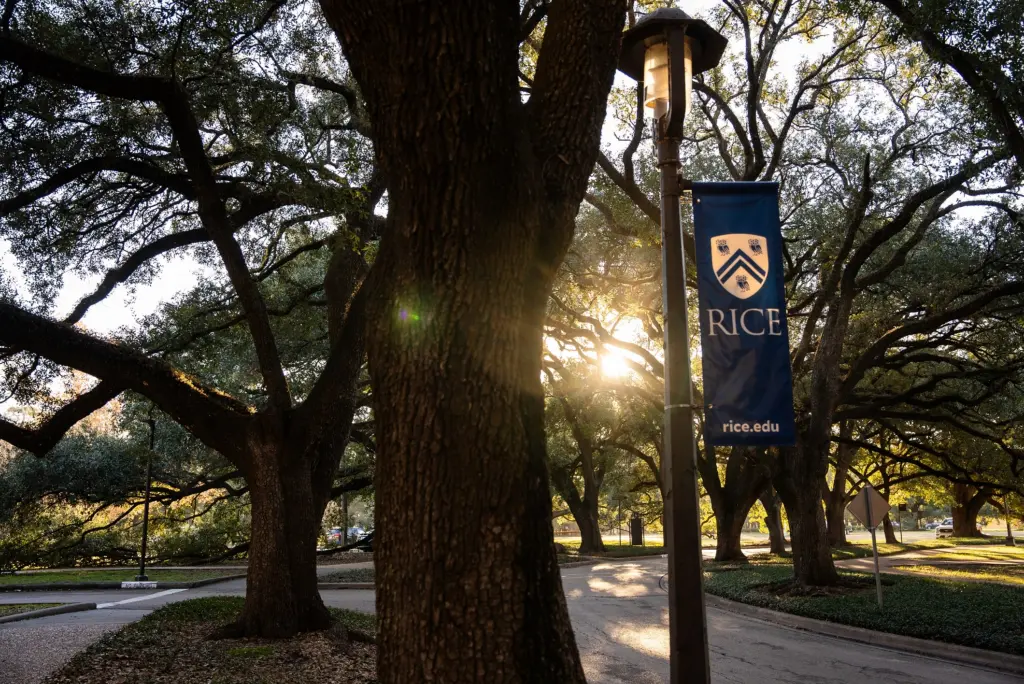
Beginning in fall 2027, Rice University will offer free tuition to students from families earning up to $200,000 and cover tuition, fees, room, and board for those earning less than $100,000. (Photo courtesy of Rice University)
Rice University is making its increasingly popular undergraduate business degree more affordable to a much wider group of students.
Beginning with the class entering in fall 2027, Rice will offer free tuition to admitted university students from families earning up to $200,000 per year, the university announced today (August 3). Students from families earning less than $100,000 will have tuition, mandatory fees, room, and board fully covered.
Rice will also continue to meet 100% of demonstrated financial need for all admitted students without requiring them to take out student loans.
The expansion significantly raises the income limits of the Rice Investment, the university’s signature financial aid program launched in 2019. Under the previous structure, students from families earning less than $75,000 received full coverage of tuition, fees, room, and board, while students from families earning between $75,000 and $140,000 received free tuition.
“This is a defining moment for Rice University and for the future of higher education,” Rice President Reginald DesRoches said in the announcement. “Talent exists in every community and across every socioeconomic background.”
For prospective business majors, the new aid policy arrives as Rice is making one of its largest investments yet in undergraduate business education. The university launched its business major in 2021, renamed it the Virani Undergraduate School of Business in 2024, and this fall will open a new building designed to give the growing program a more distinct identity and campus presence.
A FAST-GROWING BUSINESS MAJOR
Rice’s undergraduate business program is still relatively young, but demand has risen quickly.
The major was the culmination of a long-running effort by former Rice Business Dean Peter Rodriguez, Poets&Quants’ 2025 Dean of the Year. When Rodriguez arrived at Rice in 2016, the university did not offer a traditional undergraduate business degree, even as many students assembled their own business education through economics, sports management, and other courses.
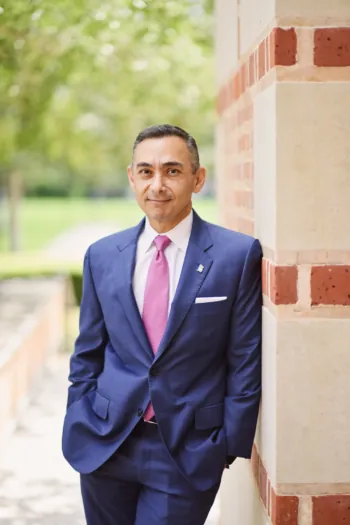
Former Rice Dean Peter Rodriguez
Rice launched the major with only a handful of classes in fall 2021. By 2025, between 600 and 650 undergraduates were pursuing the degree, and surveys of incoming freshmen showed more interest in business than in any other academic field.
“We started small in the fall of 2021 with just a couple of classes,” Rodriguez told Poets&Quants last year. “By 2022, the program was up and running, and it was instantly popular.”
The program received a major boost in 2024 through a gift from Rice alumni and Houston business leaders Asha and Farid Virani. The gift, described as the largest in Rice Business history, established the Virani Undergraduate School of Business and provided support for faculty, career services, experiential learning, and community engagement.
Farid Virani immigrated to Houston from Pakistan at age 19 before building a career through several entrepreneurial ventures. Asha Virani attended Rice, as did the couple’s son, Faraz.
The school’s priorities reflect the family’s interest in entrepreneurship, mentorship, nonprofit service, and engagement with the broader Houston community.
“The values of the undergrad school are an emblem of the Viranis’ values and what they believe in,” Rodriguez said when the gift was announced. (Rodriquez left Rice on July 1 to become president of Wake Forest University. Rice Business is conducting an international search for a replacement, while Jeff Fleming, the Fayez Sarofim Vanguard Professor of Finance and director of the doctoral program, will serve as interim dean.)
A NEW HOME FOR UNDERGRADUATE BUSINESS
This fall, Rice is also preparing to open Asha and Farid Virani Hall, a 112,000-square-foot facility next to McNair Hall, the longtime home of Rice Business.
The building will bring undergraduate and graduate business students together while giving the undergraduate school a dedicated hub. It will include flexible, technology-enabled classrooms, breakout rooms, research space, faculty offices, event venues, a café, an enclosed atrium, and open gathering areas.
Rice leaders say the design is intended to support the kinds of informal interactions that often shape the student experience: group projects, networking events, conversations with faculty, and chance meetings with students from other disciplines.
“We hope Virani Hall becomes more than a place to learn,” Asha Virani said. “We hope it becomes a place to belong, where friendships are formed, curiosity is sparked, ideas are challenged and memories are made.”
Across the university, Rice has increased its undergraduate population by about 25% since 2020 and expanded its faculty by approximately 20%, while maintaining a student-to-faculty ratio of roughly 6-to-1.
“As Rice grows, accessibility and excellence must grow together,” said Amy Dittmar, Rice’s provost and executive vice president for academic affairs.
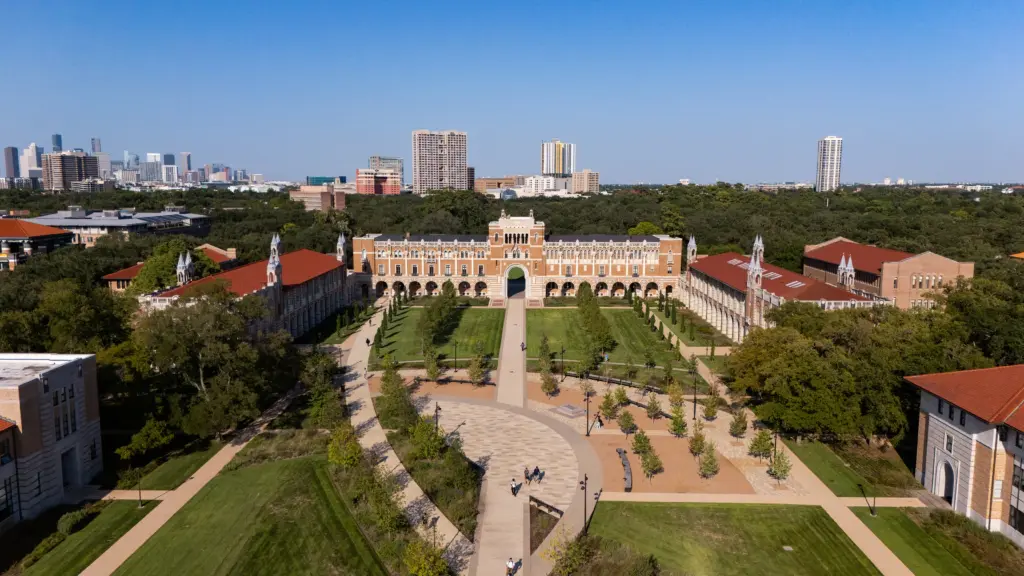
Rice University’s Academic Quadrangle, with the Houston skyline in the distance. (Photo courtesy of Rice University)
LOWERING THE FINANCIAL BARRIER
Rice’s latest aid expansion is designed in part to reach families who may earn too much to qualify for generous aid at some universities but still struggle with the cost of a private college education.
Undergraduate tuition and fees for the 2026-2027 school year at Rice, including for business majors, is about $72,000 per year. Cost of living and other expenses raises the cost to about $97,000 per year. The average aid package for Rice freshmen is $75,000.
“At many universities, families with middle or upper-middle incomes often assume they will not qualify for meaningful financial aid,” said Yvonne Romero, Rice’s vice president for enrollment and dean of admissions and financial aid. “This expansion changes that conversation and simplifies the criteria.”
Rice has provided more than $1 billion in financial aid since launching the Rice Investment in 2019, a 75% increase over the amount distributed during the seven years before the program began.
The initiative has also helped reduce student borrowing. By late 2024, Rice reported that the percentage of students graduating with debt had fallen from about 25% before the program’s launch to 14%. More than half of undergraduates received some form of financial aid during the 2023-2024 academic year.
Unlike some tuition guarantees, the Rice Investment is paired with a broader commitment to meet every admitted student’s demonstrated financial need without including loans in the aid package. Assistance may instead come through university grants, scholarships, and work-study.
“We want students and families to know that cost should not discourage them from considering Rice,” Romero said. “Thanks to the generosity of the Rice community, we can tell more extraordinary students: ‘Yes, you belong here.’”
DON’T MISS: TCU NEELEY UNDERGRAD DEPORTED TO EL SALVADOR AFTER TRAFFIC STOP AND SURVEY: MAJORITY OF AMERICANS SAY COLLEGE NOT AFFORDABLE
© Copyright 2026 Poets & Quants. All rights reserved. This article may not be republished, rewritten or otherwise distributed without written permission. To reprint or license this article or any content from Poets & Quants, please submit your request HERE.


