
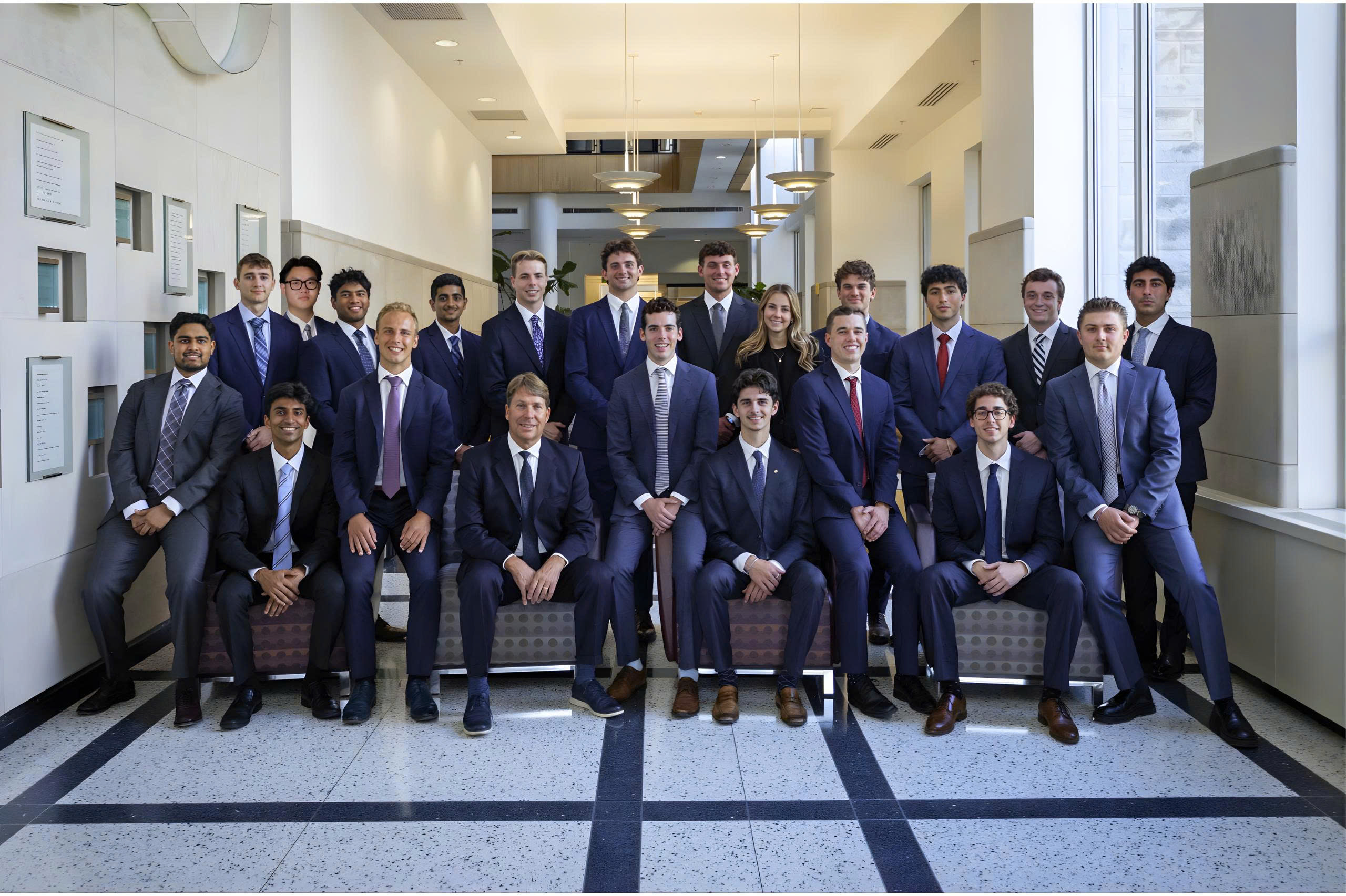
Members of the 2025–2026 Sample Gates Management class with faculty advisor Tom Peck. The student team manages Kelley’s real estate private equity funds, raising $7.8 million for Fund II and deploying $4.2 million across 12 investments nationwide.
On its face, Blake Albert’s telephone pitch was not so unusual for a private equity fund manager seeking millions in capital. An investor grilled him for 45 minutes, pressing him with the same blunt questions he’d pose to anyone pitching for his money.
What was unusual was that Albert was, and still is, an undergrad. At 21, a senior in Indiana University’s Kelley School of Business, Albert was calling and meeting face-to-face with real investors for deals with real money and real risk. In class, he’d learned to come up with something to say when he wasn’t sure. On investor calls, he learned to say he didn’t know – but he would find out.
“That’s one of the big differences when you’re dealing with a real business versus a hypothetical case. If you’re talking to an investor, you’re expected to be able to answer any question. Otherwise, how could they trust you to handle their money?” says Albert, president of Sample Gates Management, IU Kelley’s student-managed real estate private equity fund.

Blake Albert, Class of 2026
“Being 21, 22 years old, working with real investors, real deals, seeing every side of how a real private equity fund operates, it’s completely separate from a traditional curriculum where you’re learning from a textbook and a lecture. You’re basically skipping a bunch of levels to get experience you otherwise wouldn’t for decades into your career.”
Three years after launching, Sample Gates is itself growing up. It recently closed its Fund II at $7.83 million, surpassing its $6 million target and bringing total capital managed to about $12 million across two funds. It has so far invested $4.2 million in real estate projects nationwide.
By both total capital raised and individual fund size, program leaders say the platform remains the largest student-led fund of its kind at the undergrad level.
‘THESE STUDENTS ARE RUNNING A BUSINESS’
In 2020, then Kelley freshman Patrick Engels approached professors with the idea of starting a student-managed real estate private equity fund. Within three years, Sample Gates Management Inc. had raised $4.2 million – not university money or a single donor, but from more than three dozen real estate, financial firms, and individual investors.
The fund officially launched in January 2023. Since then, successive classes of Kelley seniors have taken on the work of running it. By October 2025, the students had fully deployed the capital across 12 investments spanning multifamily, industrial, hospitality, manufactured housing, and retail projects across U.S. markets. Projects include equity stakes in apartment communities such as Echo Park in Bloomington, Indiana, and development projects like Alto Apartments in Lenexa, Kansas.
If the goal of experiential learning is to remove the wall between academia and practice and put students in positions to do the work, then it’s hard to imagine a clearer example than this.
“These students are running a business,” says Tom Peck, faculty advisor to the program and Chief Investment Officer of the Hageman Group. “We have bills to pay, we have investor relations software, we’re doing tax returns, a lot of asset management work. Almost all of those things aren’t covered in the standard curriculum.”
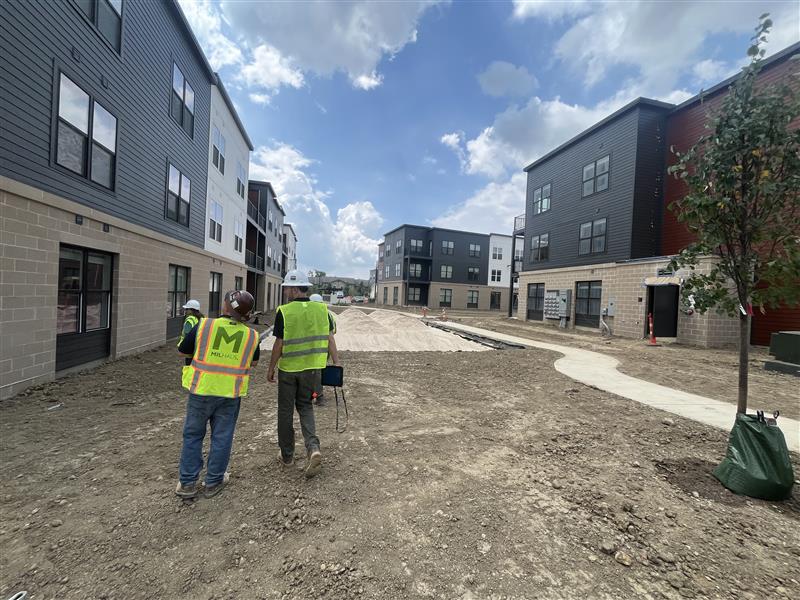
Students visit a Sample Gates Real Estate Fund I investment currently under construction. Site visits give students firsthand exposure to projects they’ve underwritten and help connect classroom concepts to real-world development.
FUND II: SCALING THE MODEL
If Fund I proved that undergraduates could operate a real investment platform, Fund II shows Kelley undergrads could raise money at scale.
The second fund closed in February at $7.83 million, more 30% above the $6 million target and almost twice as much as the first. Students conducted more than 200 meetings and calls with prospective backers, securing commitments from 73 investors.
While alumni remain a core base, the fund also attracted seasoned real estate operators and private investors who had no prior connection to Kelley. More than half of Fund I investors returned for Fund II, even though most of the original investments have yet to fully cycle.

Jathaved (Ved) Pasham, Class of 2026
Fund II carries terms typical of institutional real estate vehicles: a five-year life, an 8% preferred return, and a minimum commitment of about $60,000. That structure signals the program’s evolution from an experimental student fund to something closer to a boutique private equity platform.
Because the fund doesn’t buy property itself, but invests in larger projects that are raising $10 to $20 million from multiple sources, it needed a team to keep its own investors up to date on asset performance.
Students started building that team this year from the ground up, says Jathaved (Ved) Pasham, a finance major and a member of that new team.
Students had to define their own goals and responsibilities, design the tools to support them, and create new dashboards to track every property in the portfolio. They digested sponsor reports and prepared quarterly updates so they can answer any question investors have about performance.
“We’re talking to CEOs and CFOs well into their careers. To be able to ask them questions, and to have the ball in our court a little bit is really exciting. We learn so much being only seniors in college before our actual careers start,” Pasham says.
HOW IT WORKS
Student-run private equity funds are not uncommon, particularly at the graduate level. What sets Kelley’s apart is that it is managed by undergraduates and backed by a diverse group of investors.
“One of the things that makes what we have done and are doing particularly unique is that the students are not just investing money that comes from the foundation or one or two alumni,” Peck says. “They have the experience of being 21 years old, standing up in front of investors making their pitch, not sure what kind of questions they’re going to get. That is great experience that I personally didn’t have till I was probably 15 years older than they are now.”
Each year, about 20 Kelley seniors are selected to run the fund through a pipeline that begins with the Kelley Real Estate Club, advances through the Commercial Real Estate Workshop, and culminates in enrollment in the IU Real Estate Private Equity Program. The current class also plays a role in selecting and training the next.
Once inside, students are divided into functional teams that mirror a professional private equity firm: asset management, investor relations, finance, legal and accounting, and research and outreach. Together, they source deals, underwrite investments, manage relationships, and track portfolio performance.
Potential investments are vetted through a structured process before being presented to an investment committee made up of experienced real estate executives and alumni. That committee ultimately approves — or rejects — each deal.
“They hold us to a very high standard,” says Albert who is studying finance and real estate at Kelley. “If they don’t have full confidence in a deal, then it’s not going to be approved.”
FROM PIPELINE TO PLACEMENT
Rendering of a grocery-anchored retail center, the most recent investment approved by the Sample Gates Management class in October as the final deal in Fund I.
The program has now reached its seventh associate class, with 118 students trained since inception. The program so far has a 100% full-time placement rate after graduation, with students going onto roles at firms such as Apollo, PGIM, CBRE, Bain Capital, Evercore, and Freddie Mac — companies that typically recruit from top MBA programs or experienced analysts.
While real estate private equity can be difficult to enter straight out of college, fund alumni who want to work in PE are landing roles. Albert, for example, will move to Chicago after graduation to work as a transactions analyst on Harrison Street’s equity team.
Pasham, meanwhile, landed his full-time job at Rialto Capital in Miami after a fellow fund associate interned at the firm, and leaders decided to start a recruitment pipeline directly from Kelley’s real estate program generally and the Sample Gate fund specifically.
“That pipeline we’ve created is going to last a long time,” says Pasham who will work in commercial mortgage backed securities with Rialto. “Those are the kinds of relationships we are building.”
WHAT COMES NEXT
With two funds now operating and roughly $12 million under management, the next test will be actual returns. None of the 12 first investments have fully cycled, but students are watching a couple that may be sold before summer.
The fund was able to approve its first set of investor distributions at its last Investment Committee meeting, and at least five of the 12 are generating cash, Albert says.
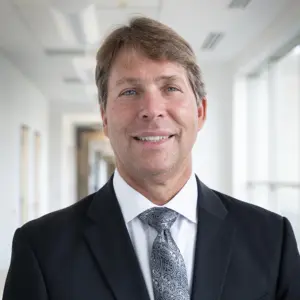
Tom Peck, faculty advisor and chief investment officer of the Hageman Group
As Fund II moves into deployment, students are seeing deeper deal flow driven by relationships built over time.
“We’ve developed really significant relationships, much deeper and wider, with alumni who have operating companies in Indianapolis, Chicago, New York, and the Southeast. We’re starting to develop a lot of connections, which translates into deal flow from all over the country with a lot of unique opportunities,” Albert says.
That work will soon be handed off to the next class. Incoming students are already shadowing the current team, learning the deals, and preparing to take over — a transition designed to maintain continuity in a model built on constant turnover.
For Peck, the long-term vision is less about scale and more about purpose.
“The program is doing what we thought it would do,” he says. “It’s been very successful for the student experience.”
DON’T MISS: POETS&QUANTS’ BEST UNDERGRADUATE BUSINESS SCHOOLS OF 2026 AND FORBES’ 100 BEST STARTUP EMPLOYERS IN AMERICA FOR 2026
© Copyright 2026 Poets & Quants. All rights reserved. This article may not be republished, rewritten or otherwise distributed without written permission. To reprint or license this article or any content from Poets & Quants, please submit your request HERE.


