






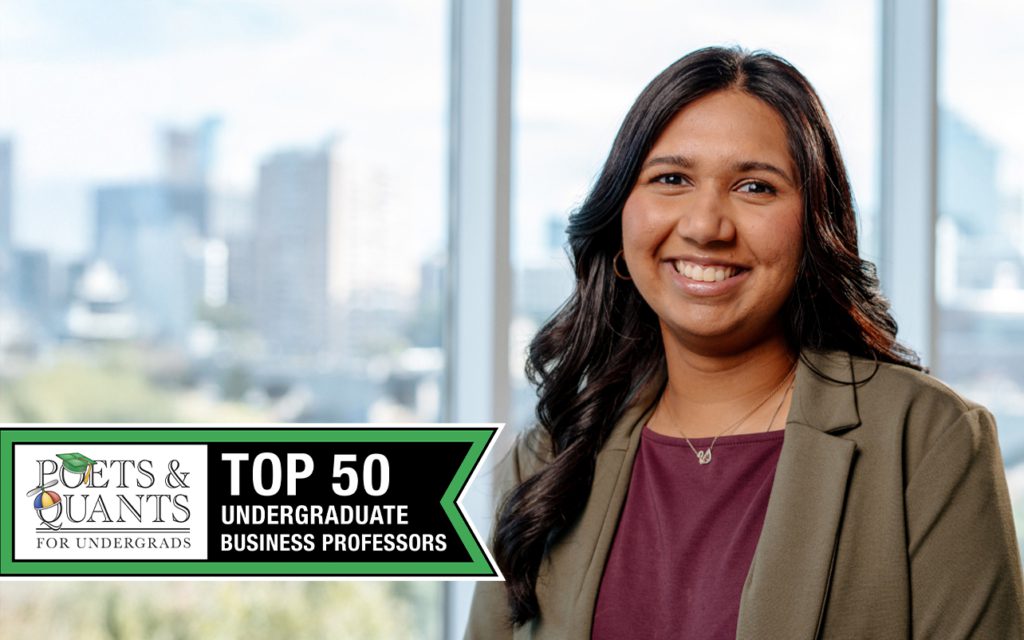
Anusha Vissapragada
Hult International Business School
“She is one of the most outstanding professors I have had in business school. She genuinely cares about every student’s growth, encouraging us not only to learn complex concepts but also to apply them to real-world situations. Her teaching in business analytics has been especially impactful, she makes challenging material accessible, practical, and inspiring.” – Ritsuko Yoshida
Anusha Vissapragada, 25, serves as Faculty Lead for Business Analytics and Computer Science at Hult International Business School’s Boston Undergraduate Campus. She also serves on Hult’s Task Force on Teaching Philosophy, a cross-campus group shaping the school’s approach to experiential and AI-driven education.
Recognized for her innovation in teaching and curriculum design, she is among the youngest faculty members to lead a STEM-designated analytics program at Hult. She was one of the architects behind Hult’s first undergraduate STEM-designated analytics pathway, designed to prepare students to think critically about the role of data in modern business.
Vissapragada believes analytics education should not be limited to theory. Her courses combine data science with real-world projects, where students partner with organizations across industries to create measurable impact. Her students have helped nonprofits improve engagement, advised small businesses on operations, and supported healthcare organizations in optimizing costs—together generating more than $1 million in value. She encourages students to think like analysts, act like entrepreneurs, and lead with empathy.
Her research explores how artificial and human intelligence intersect in education. She studies how large language models can support student learning without replacing critical thinking. She is particularly interested in how tools like ChatGPT can be used to build curiosity, reflection, and confidence in problem solving.
Vissapragada is the author of two textbooks—Introduction to Business Analytics and Regression and Databases and Quantitative-Based Decision Making—both published in 2024. She has written teaching cases for The Case Centre and is a frequent speaker on the future of AI in education. Her TEDx talk, Why We Should Partner AI with Human Intelligence, and her Voices of Hult podcast feature, Business Analytics for Dummies, have positioned her as a thought leader in reimagining analytics education for the AI era.
Before joining academia, she held data analytics and strategy roles at Barclays, Sema4, and Mashreq Bank. In those positions, she applied predictive modeling and business intelligence to drive decision-making and operational efficiency. She holds an M.S. in Business Analytics and Project Management and a B.S. in Data Science, both from the University of Connecticut, and is currently pursuing an Executive Ph.D. in Business at Bentley University. Her doctoral research focuses on AI-enabled pedagogy and how educators can measure skill development in analytics classrooms.
Raised in Dubai and inspired by her mother, an early childhood educator, she believes education is the most powerful tool for creating change. She brings that belief to her teaching every day, blending data with empathy and technology with purpose.
BACKGROUND
At current institution since what year? 2023
Education: Ph.D. – Business Analytics, Bentley University; M.S. – Business Analytics & Project Management, University of Connecticut, B.S. – Data Science, University of Connecticut
List of Undergraduate courses you teach: Business Analytics, Machine Learning, Quantitative-Based Decision Making, Data Storytelling and Visualization, Computer Science
TELL US ABOUT LIFE AS A BUSINESS SCHOOL PROFESSOR
I knew I wanted to be a business school professor when … I realized that learning never really ends, and that the best way to keep learning is to teach. I wanted to build a space where classroom learning and industry practice could meet. I wanted students to see that analytics is not just about formulas or code, but about thinking critically, asking questions, and solving problems that matter.
What are you currently researching and what is the most significant discovery you’ve made from it? My current research explores how large language models can support learning in business analytics. The most interesting discovery so far is that when students use AI tools intentionally, their curiosity and confidence grow. When guided correctly, AI doesn’t replace human reasoning; it strengthens it. It helps students explore ideas, reflect on outcomes, and think about problems in ways they hadn’t before.
If I weren’t a business school professor, I’d be … A chef or documentary producer, combining storytelling, food, and humor. Cooking has always been my outlet—it’s where structure meets spontaneity. Whether in a kitchen, behind a camera, or in a classroom, I’d still be finding ways to make ideas and experiences meaningful, accessible, and inspiring.
What do you think makes you stand out as a professor? I treat every course like a startup. Each class has a goal, a plan, and a measurable impact. Students learn through real projects, not simulations. They work with live data, design models, and present insights to actual organizations. My role is to guide them as they connect the dots between data, strategy, and human behavior. That entrepreneurial spirit—combined with an emphasis on empathy and ethics—defines my teaching.
One word that describes my first time teaching: Transformative
Here’s what I wish someone would’ve told me about being a business school professor: There’s more learning involved than teaching. Every class and every question pushes me to think differently. It’s one of the few jobs where you grow just as much as your students.
Professor I most admire and why: Jennifer Eigo, my advisor at the University of Connecticut. She taught me that data only becomes meaningful when paired with context. That lesson has shaped every class I’ve taught since. I remind my students that numbers tell stories, but it’s their job to listen carefully to what those stories mean.
TEACHING BUSINESS SCHOOL STUDENTS
What do you enjoy most about teaching business students? Business students are curious and action oriented. They don’t just want to understand models; they want to know how to use them to make better decisions. I love the moment when a student realizes that analytics can be versatile—that data can tell a story or drive change. Those realizations turn a technical exercise into something personal and exciting.
What is most challenging? Teaching students that analytics is rarely black and white. There’s often more than one correct answer, and the right choice depends on context, ethics, and human judgment. Helping students get comfortable with uncertainty can be difficult, but it’s also what makes the field so rewarding.
In one word, describe your favorite type of student: Creative.
In one word, describe your least favorite type of student: Disengaged.
When it comes to grading, I think students would describe me as … Fair and constructive. My feedback is specific and focuses on how to grow. I want students to see grades not as an end point, but as part of the learning process.
LIFE OUTSIDE THE CLASSROOM
What are your hobbies? Cooking, scriptwriting, and stand-up comedy. Cooking gives me the ability to experiment and enjoy a meal at the same time. Writing and comedy remind me to see things from different perspectives and to stay curious about how people think.
How will you spend your summer? Relaxing by the beach, testing new recipes with testing new coffee and food recipes, and continuing my research on AI and learning. Summer is when I recharge and reflect on how to make the next semester more engaging.
Favorite place(s) to vacation: New York City for its energy, inspiration, and the friends who always make it feel like home. Dubai and Hyderabad for family, comfort, and memories. Each place represents a different part of who I am.
Favorite book(s): Mostly nonfiction, including Weapons of Math Destruction by Cathy O’Neil, which I assign in my classes, and Brave, Not Perfect by Reshma Saujani, which reminds me to embrace progress over perfection.
What is currently your favorite movie and/or show and what is it about the film or program that you enjoy so much? Rose de Chine, a French short film that captures the beauty of transformation through silence and reflection. It reminded me that growth often happens quietly.
What is your favorite type of music or artist(s) and why? A mix of Anirudh Ravichander, Bollywood film music, and Coldplay. It’s an eclectic mix that reflects my life between cultures and continents.
THOUGHTS AND REFLECTIONS
If I had my way, the business school of the future would have much more of this … A stronger balance between technology, ethics, and humanity. Students should leave business school fluent in data but also grounded in empathy and responsibility. The best learning happens when they apply AI and analytics to real-world problems and reflect on the human impact behind their work.
In my opinion, companies and organizations today need to do a better job at … Redefining what success means. Beyond profit, organizations should measure their influence on people, well-being, and sustainability. Businesses that value social impact often end up being more innovative and resilient.
I’m grateful for … Every student who challenges the way I think and every colleague who shares ideas generously. I’m thankful for my family and friends, who have been my constant support system and biggest cheerleaders. Most of all, I’m grateful to my parents. Their courage and sacrifices as immigrants gave me opportunities they could only dream of. Everything I achieve is built on the foundation they created and the values they live by.
DON’T MISS THE ENTIRE ROSTER OF 2025’s 50 BEST UNDERGRADUATE BUSINESS SCHOOL PROFESSORS.
© Copyright 2026 Poets & Quants. All rights reserved. This article may not be republished, rewritten or otherwise distributed without written permission. To reprint or license this article or any content from Poets & Quants, please submit your request HERE.


