






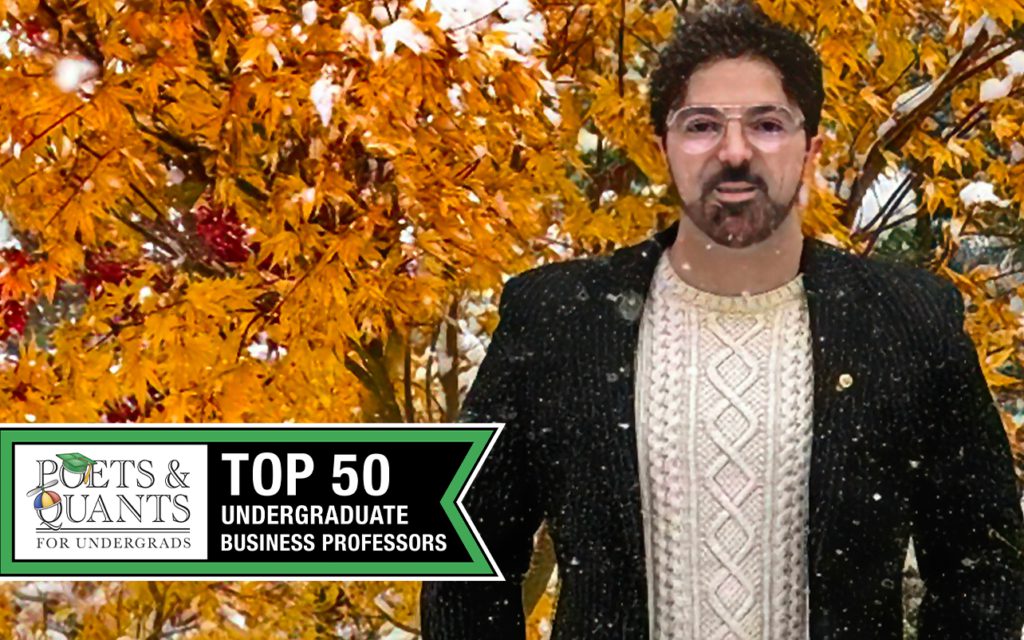
Kıvanç A. Avrenli
Whitman School of Management
Syracuse University
“Between Fall 2021 and Fall 2025, Dr. Avrenli has taught 65 in-person, 3-credit courses, reaching approximately 2,700 students. His courses, which focus primarily on business analytics, are known for their clarity, energy, and relevance. He consistently earns near-perfect ratings from students, and he is the highest-rated professor at Syracuse University on Rate My Professor.” – David Weinbaum, Finance Department Chair
“Dr. Avrenli is hands-down the best professor I’ve had. He walks into class with a contagious smile, turns stats into something you actually look forward to, and makes you feel like you can tackle anything.” “He’s the gold standard for what a professor should be — clear, hilarious, and always in your corner.” – Student Evals
Kıvanç A. Avrenli, 44, is a Professor of Practice at Syracuse University’s Whitman School of Management, where he teaches managerial statistics and specializes in applied statistical methods, probability theory, statistical modeling, and the design of experiments.
His teaching career began at the University of Illinois at Urbana–Champaign, where he earned an “outstanding” rating seven consecutive times on the university’s List of Teachers Ranked as Excellent by Their Students. He received Illinois’ Alumni Award in Teaching Excellence in 2014.
At Whitman, Avrenli has become one of the school’s most decorated instructors. He is a multi-year recipient of the Faculty of the Year Award — earning the honor in 2021 and 2022 — and was named Undergraduate Faculty of the Year in 2020. He has been selected as Best Faculty and Class Marshal an extraordinary six times for his work teaching U.S. Army students in Syracuse’s Defense Comptrollership Program. The University has also recognized his dedication with the Laura J. and L. Douglas Meredith Teaching Recognition Award and a Faculty Recognition Award from the Office of Disability Services.
Avrenli’s academic foundations span both engineering and statistics. He earned his B.S. and M.S. degrees in civil engineering from Bogaziçi University in Istanbul—formerly Robert College, the first American college established outside the United States. He later completed a second M.S. in statistics and a Ph.D. in civil engineering with a specialization in commercial aviation safety at the University of Illinois at Urbana–Champaign.
BACKGROUND
At current institution since what year? 2015
Education: Ph.D. Civil Engineering, University of Illinois at Urbana-Champaign; M.S. Statistics, University of Illinois at Urbana-Champaign; M.S. Civil Engineering, Boğaziçi University (former Robert College, the first American college founded outside of the U.S.); B.S. Civil Enginerring, Boğaziçi University (former Robert College)
List of Undergraduate courses you teach: Algorithmic Trading with Python, Business Analytics for Management Decisions, Data Mining, Financial Analytics, Introductory Statistics for Management, Predictive Learning
TELL US ABOUT LIFE AS A BUSINESS SCHOOL PROFESSOR
I knew I wanted to be a business school professor when … when I began TA’ing a statistics course for business and crop science students. Indeed, I have always wanted to be a teacher since childhood. The main reason I pursued a PhD was to teach in higher education. Before TA’ing business students, I had TA’d for civil engineers. Engineers are brilliant, but business students bring a remarkable diversity of backgrounds: Some are fluent in calculus, others are fluent in persuasion. Teaching analytics to them opens doors to an extraordinary range of real-data problems, from predicting consumer behavior to optimizing automated trading bots on the stock market. It’s where mathematics meets messy reality, and that intersection never fails to inspire me.
What are you currently researching and what is the most significant discovery you’ve made from it? My research focuses on optimizing power-off (engine-out) emergency landings and analyzing bird-strike incidents involving commercial aircraft. In other words, studying how to keep an aviation emergency from becoming the focus of a disaster documentary ✈️.
Using full-flight simulators of the Airbus A320, I examined the aircraft’s “green dot speed”, the official clean-configuration gliding speed recommended in the event of total power loss. I discovered that when engines fail at low altitude, for example, after a bird strike during the initial climb in clean configuration, the optimal glide speed for a safe return may be significantly lower than the manual’s guidance. That’s because sometimes, slowing down can tighten the turn radius, shorten the glide path, and conserve precious energy when every foot of altitude counts.
Much like in business analytics, this research reinforces that real-world outcomes often defy textbook assumptions.
If I weren’t a business school professor, I’d be … A Civil Engineering professor in transportation and still teaching, still analyzing movement, just with a bit more sophisticated traffic flow models.
What do you think makes you stand out as a professor? My energy level, which is the human equivalent of a quad-shot espresso, and the lively animated visuals I deploy to demystify complex concepts.
One word that describes my first time teaching: Loud
Here’s what I wish someone would’ve told me about being a business school professor: That not every business student takes off with the same amount of mathematical fuel. Coming from an engineering background, I initially assumed everyone had similar training in calculus and algebra. It didn’t take long to realize that while engineering students cruise through equations on autopilot, business students prefer to hand-fly them. I soon learned to adjust my own flight plan and simplify complex mathematical concepts without losing altitude on the insight.
Professor I most admire and why: Anyone who truly prioritizes students. After all, without students, higher education would be like an airport with no passengers but lots of infrastructure, plenty of staff, and absolutely no reason for any of us to take off.
Professors who put students first keep the whole academic aircraft in the air. Without students, we wouldn’t even have clearance for takeoff on research, let alone teaching.
What do you enjoy most about teaching business students? Business students always want to connect theory to the runway of real life. They want to understand how data becomes real-world decisions and how analytical models eventually land in boardrooms. Preparing them for those real-life challenges turns every class into a new and exciting flight plan.
What is most challenging? My eternal headwind is convincing students to fully utilize the lecture materials I post on Blackboard. 😄
For instance, I record clean, edited lecture videos, detailed software demos, and even full video solutions to homework problems that are posted while students are actively working on the assignments, well before the deadline. I essentially provide both the in-flight training manual and the step-by-step flight demonstration.
Yet every semester, a few students still ask, “Professor, how do I solve this homework question?” And when I point to the video solution posted directly beneath the homework problem in bold font, they admit, “Oh… I didn’t watch it.”
Some hope that knowledge from two weeks ago will magically reappear, like a plane emerging from the clouds. But when you’re juggling multiple courses, material from two weeks ago either vanishes or turns into mush. Without reviewing the lecture and homework solution videos, important concepts quietly drift out of the brain’s airspace.
In one word, describe your favorite type of student: Curious because curiosity is the fuel that keeps every learner airborne.
In one word, describe your least favorite type of student: Off-course – misses key content because their attention keeps drifting from the flight path.
When it comes to grading, I think students would describe me as: Straightforward
LIFE OUTSIDE THE CLASSROOM
What are your hobbies? Wandering into nature with my camera in hand and capturing landscapes the way a pilot admires the world from above. I am also pretty active on Instagram, where I share those moments.
How will you spend your summer? I teach in-person classes to the U.S. Army students in our Defense Comptrollership Program, and they are an absolute joy to work with: focused, disciplined, and always ready for takeoff the moment class begins.
I also visit my home country, Türkiye, but I avoid sightseeing in the summer. First, it’s too warm for me. I love freezing cold, gloomy weather and would happily take 20°F (–6°C) over 80°F (27°C) any day. Yes, I stand by that!! Second, the major sights get incredibly crowded in summer, and my ideal vacation does not involve taxiing behind thousands of tourists.
The one exception this year is a quick trip to Palma, Spain to watch the total solar eclipse on August 12, 2026. And if the weather doesn’t cooperate, that’s perfectly fine. I have already seen three total solar eclipses, so at this point I’m just collecting bonus rounds.
Favorite place(s) to vacation: Lapland and Lofoten Islands in Winter; Wasatch and Uinta Mountains in Fall.
Favorite book(s): Night of the Grizzlies (1969), Flying Blind: The 737 MAX Tragedy and the Fall of Boeing (2021)
What is currently your favorite movie and/or show and what is it about the film or program that you enjoy so much? I’m a big horror fan. Even when I’m studying, I usually have a horror movie playing in the background (often something I’ve already seen) and strangely, the suspense makes me more productive and creative.
My favorite film is Barbarian (2022). For a horror movie, it has an unusually multidimensional and sophisticated plot that goes way beyond the usual formula. It starts off looking like one type of film, then takes a sharp turn, and then shifts again. Yet it all still fits together and pushes the genre in refreshing directions. It also mixes real tension with some unexpected bits of dark humor.
What is your favorite type of music or artist(s) and why? I’m a big fan of “The Anix”. His music blends electronic, rock, and atmospheric elements in a way that feels both futuristic and cinematic. It has just enough dark, moody energy to satisfy my horror-movie side, but it’s still motivating rather than terrifying.
I even play The Anix’s songs in the few minutes before class starts. It helps students wake up, set the mood, and gives the room a subtle “prepare for takeoff” vibe.
THOUGHTS AND REFLECTIONS
If I had my way, the business school of the future would have much more of this … Hands-on teaching with real data, real tools, and real problems; less textbook taxiing and more actual takeoff. And a free coffee machine for students during midterms and finals, because no one should attempt liftoff without proper fuel.
In my opinion, companies and organizations today need to do a better job at … sustainability.
I’m grateful for … my students, my colleagues, and any student who watches my lecture and homework solution videos before asking me the question the video already answers. Also: the cloudy, cold, and snowy Syracuse winters.
DON’T MISS THE ENTIRE ROSTER OF 2025’s 50 BEST UNDERGRADUATE BUSINESS SCHOOL PROFESSORS.
© Copyright 2026 Poets & Quants. All rights reserved. This article may not be republished, rewritten or otherwise distributed without written permission. To reprint or license this article or any content from Poets & Quants, please submit your request HERE.


