







Every year at this time, Poets&Quants asks leaders from the world’s top business schools to put a stake in the ground for the year ahead – a resolution that signals what they think is changing fastest, what still matters most, and what management education should be optimizing for now. Last year’s collection showed deans grappling with the same mix of pressure and promise: rapid technological change, an uneven global backdrop, and rising expectations that business schools prove their value. (See previous sets of resolutions here, here, and here.)
This year, the tone is sharper. The question animating many of the submissions is no longer whether business education must adapt, but how leaders should be formed when certainty is scarce and scrutiny is high. In that context, several deans draw a clear distinction between tools and judgment – and argue that the latter is what will ultimately separate effective leadership from technical competence.
At UC Berkeley Haas School of Business, Dean Jenny Chatman frames her resolution as a decision to “double down on what makes us high-impact humans,” insisting that judgment remains “the secret sauce” for navigating complexity. Her focus is not on slowing change, but on ensuring that human discernment keeps pace with it.
“I’d really like us to dream big,” Chatman writes, “and I think our Haas community is the one to really do this.”
HUMAN JUDGMENT UNDER PRESSURE
That emphasis – on human judgment over technical speed – runs through many of this year’s reflections. Deans are not backing away from innovation, but they are more explicit about what it cannot replace. Again and again, the submissions stress leaders who can ask better questions, recognize tradeoffs, and make decisions under pressure – even as technology accelerates faster than organizations can fully absorb it.
At Duke Fuqua School of Business, Dean Mary Frances Luce approaches the year from a different angle, focusing on polarization as a defining condition of modern leadership. She argues that disagreement now shapes markets, workplaces, and stakeholder expectations, making the ability to navigate difference thoughtfully a core leadership competency rather than a peripheral skill. “The ability to navigate difference thoughtfully and constructively has become a core leadership competency,” Luce writes.
That concern with how people work together also shapes how schools are rethinking classrooms. At the Tepper School of Business at Carnegie Mellon University, Dean Isabelle Bajeux-Besnainou describes an education designed to anticipate change and embrace complexity, combining experiential learning, global exposure, and applied problem-solving to prepare students for leadership amid uncertainty. “Above all,” Bajeux-Besnainou writes, “our resolution for the year is to continue developing leaders who are resilient, data-informed, and comfortable leading through uncertainty.”
PURPOSE, COMMUNITY & ACTION
Across Europe, several deans lean heavily on values and community as stabilizing forces. At IESE Business School, Dean Franz Heukamp emphasizes that while innovation is accelerating, strong human relationships remain essential – particularly in a polarized world. His resolution centers on ensuring that progress stays anchored in purpose, ethics, and service, because, as he writes, “not even the most far-reaching transformation can substitute for strong human relationships.”
Others frame 2026 as a moment that rewards decisive action. At the University of Michigan Ross School of Business, Dean Sharon Matusik describes the coming year as “a golden age for builders,” urging leaders to meet disruption not with hesitation, but with execution. Her focus is on placing students where ideas turn into enterprises and learning quickly translates into doing. “Golden ages,” she writes, “are defined not by ideas alone, but by action. One of our key differentiators at Ross is action – through our action-based learning orientation and the bias towards action our graduates are known for. Here, we are preparing leaders who see opportunity in complexity and possibility in change – leaders who are ready to build.”
And as Duke’s Dean Luce writes, “Leadership is fundamentally about bringing people together to achieve what none of us could accomplish alone.”
See the elite B-school deans’ thoughts on the coming year below and in the following pages.
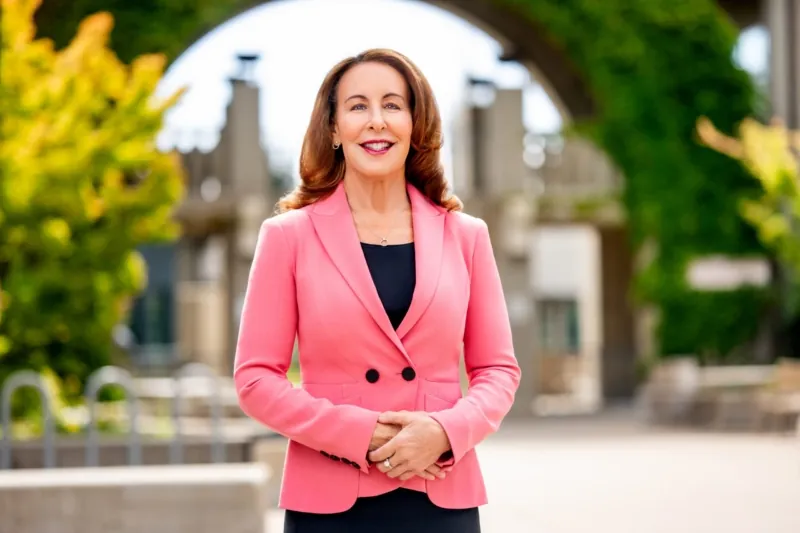
UC Berkeley Haas School of Business Dean Jenny Chatman: “In 2026, we are incredibly excited about focusing on four key areas that demand innovative leadership: AI, entrepreneurship, sustainability and social impact, and health.”
Resolution: Double down on what makes us high-impact humans
OUR NEW YEAR’S RESOLUTION AT UC Berkeley Haas is to double down on what makes us high-impact humans: ingenuity, determination, and collaboration. We believe this is how our graduates will move business and society forward.
Human judgment is the secret sauce for confronting the complex challenges we face – leaders who can navigate uncertainty, ask the right questions, and use technology to amplify human capability to make business better. In our schoolwide strategic narrative project, we involved hundreds of our Haas community members to gain a renewed sense of purpose about why our people, academic excellence, culture, and location make Berkeley Haas unique. We’re inspired by what we learned and are using it to guide us in 2026 and beyond.
Part of what we affirmed is what we’ve known all along – that Haas was built not just to teach business as usual, but to question it and move it forward.
In 2026, we are incredibly excited about focusing on four key areas that demand innovative leadership: AI, entrepreneurship, sustainability and social impact, and health.
First, our Bay Area location puts us in the heart of the AI revolution, with the central movers and shakers – OpenAI, Anthropic, Meta, Google, and Nvidia – all just steps away from campus. UC Berkeley has played a foundational role in developing computational intelligence, and we approach AI as an enormous opportunity to have a positive impact on the world – while continuously probing its implications. As I mentioned in a recent OneHaas podcast interview, AI is such a sophisticated tool – a way of amassing all previous information. I want us to use this powerful tool to bring us up to speed on what we already know, and then leapfrog into sophisticated solutions to some of the world’s most difficult and vexing challenges. Can we solve world hunger, and climate change? I’d really like us to dream big, and I think our Haas community is the one to really do this.
Building on our strengths, which include over 30 courses with significant AI content, and faculty who are leading the way in AI research, we launched our new AI certificate program for MBAs, adding to our graduate certificate in business analytics and AI-focused courses in our top-ranked Master of Financial Engineering Program and Undergraduate Program. We’re teaching students to evaluate where AI creates value and where human judgment is irreplaceable.
Our faculty are asking important questions and investigating AI’s trajectory, both what’s working and what’s not, including how large language models (LLMs) show a skewed picture of gender and age and offer slanted investing advice; how AI might increase our reliance on superficial signals of status; how to identify pirated content used in LLM training; how AI might pull people into doing more work than they realize; and how these technologies can be better harnessed for marketing and on-the-job training. This leading-edge research also powers our teaching, equipping faculty to train the leaders who will shape the future of AI in enterprises around the world.
Our second key initiative is entrepreneurship and innovation, which of course are part of our essential DNA. We are expanding access to opportunities for all our students at Haas and campus-wide.
UC Berkeley is a powerhouse when it comes to entrepreneurship, and we have been named the #1 university in the world for alumni founders, venture-backed startups, female founders, and female-founded companies for the last three years (according to PitchBook). Harnessing the Bay Area’s startup energy and a fantastic $10 million alumni gift, we’re enhancing our curriculum, mentorship, pitch days, team collaboration opportunities, founder support, and more. The next generation of startups is coming to life at the Berkeley Haas Entrepreneurship Hub and in flagship programs like the Berkeley Haas Entrepreneurship Program, Berkeley StEP, SkyDeck, and UC LAUNCH, where recent Demo Day winners pitched companies that are using AI to accelerate pharmaceutical clinical trial enrollment and predict wildfires in real time.
We already excel in sustainability and social impact – and we are doubling down on both. In 2026, we will cheer the first graduates of our new MBA/Master of Climate Solutions program with the UC Berkeley Rausser College of Natural Resources. These newly minted sustainability leaders – equipped with business acumen and deep climate science knowledge – are brilliant; by offering deep solutions to complex problems, they will move industries forward. Meanwhile, the Strauch Cleantech to Market Program, going into its 18th year, is boosting Berkeley graduate students so they can commercialize high-demand startup technologies – from low-carbon energy to water technologies. Our MBA students have become sophisticated climate and social impact investors by running student-managed funds like the Haas Impact Fund and the Climate Solutions Fund.
We have incredible strength in healthcare spanning the entire UC Berkeley campus, from public health to economics to our best-in-the-world life sciences departments. Our faculty, students, and alumni are solving some of the greatest health challenges by bringing biomedical breakthroughs to the people who need them and shaping AI to improve healthcare efficiency, equity, and patient outcomes. For example, Biotech@Berkeley connects those who are driving scientific breakthroughs with those who can commercialize them (guess who that is? Haas students!). Take alum Hannah Weber, MBA/MPH 23, who co-founded HOPO Therapeutics with scientists at the Lawrence Berkeley National Laboratory to develop new treatments for people exposed to toxic heavy metals. The company will continue its work in 2026 with a $226 million federal R&D contract to advance its medical treatment.
Our faculty in the health space are equally inspiring. World-renowned Haas researcher Paul Gertler runs randomized control trials on the most effective ways to reduce health disparities in the developing world; Ambar La Forgia’s work reveals how management structures change health outcomes; and behavioral economist Jon Kolstad, who is the founding director of the Center for Health Care Marketplace Innovation and also a faculty member in the Computational Precision Health Graduate Group at UC Berkeley and UCSF, develops AI systems to improve clinical and health insurance systems.
All of this cutting-edge work inspires me and fuels my optimism for 2026 and beyond. I believe that the biggest success stories of the year will center on people who harness technology to fix problems others have deemed unsolvable. I resolve, as Haas dean, to do all I can to support them.
– Dean Jenny Chatman, Haas School of Business, UC Berkeley
Next Page: Deans from Duke Fuqua, CMU Tepper, and IESE offer their resolutions for 2026.
© Copyright 2026 Poets & Quants. All rights reserved. This article may not be republished, rewritten or otherwise distributed without written permission. To reprint or license this article or any content from Poets & Quants, please submit your request HERE.


