







Cambridge Judge’s Gishan Dissanaike: “I have no doubt that the current period of turbulence will lead to breakthroughs that we cannot now predict but will change the lives of this and future generations.”
Innovation, responsible business and leadership in a turbulent world
THE PAST YEAR HAS BEEN turbulent on many fronts, from the conflicts in Ukraine and the Middle East to uncertainty over trade barriers and how artificial intelligence will transform our workplaces and our lives – and 2026 will likely be another year of complexity and upheaval in areas ranging from climate change to cybersecurity to supply chain fragility.
These challenges are global and interconnected. At the same time, expectations around responsible business have never been higher, and while the world faces huge risks there are also enormous opportunities for knowledge-based solutions in these many difficult areas.
History reminds us that periods of profound uncertainty and adversity often give rise to transformative innovation – including inventions during the Great Depression of the 1930s that included the car radio, instant coffee, the parking meter and widespread use of nylon in consumer items like stockings and toothbrushes. Likewise, the financial crisis of the early 2000s ushered in fintech solutions that are transforming finance while helping millions of people formerly “unbanked” and excluded from other financial services. I have no doubt that the current period of turbulence will lead to breakthroughs that we cannot now predict but will change the lives of this and future generations.
I am convinced that business education can and will play a key part in this next wave of invention – and I am resolved that Cambridge Judge Business School will play its part.
Top global business schools like Cambridge Judge Business School already are deeply tapped into diverse networks of experts in fields ranging from healthcare to supply chain management to the cutting edge of fintech, as our professors and other experts engage deeply with others seeking new solutions to problems in these and many other crucial fields. At the same time, we pay great attention in this era of technological upheaval to the human side of the workplace through projects such as the Human-Centric Approaches to the Future of Work initiative involving numerous members of our faculty.
Many of our initiatives in areas such as climate change, AI and healthcare involve members of the Cambridge Judge Business School community working alongside peers in other departments of the University of Cambridge and practitioners in the hugely successful Cambridge ecosystem that includes biotech, speech recognition and other cutting-edge sectors.
This is all by design because, in today’s volatile environment, business schools embedded within world-class universities are uniquely positioned to help leaders navigate complexity. Cambridge’s longstanding international networks and intellectual breadth offers an advantage in equipping individuals and organisations to innovate responsibly and lead successfully – and that, after all, is the core mission of a world-class business school.
– Gishan Dissanaike, Dean of Cambridge Judge Business School

University of San Francisco’s Otgo Erhemjamts: “Grounded in our Jesuit tradition of ethical leadership and strengthened by nationally recognized entrepreneurship and innovation programs, we are uniquely positioned at the intersection of business, technology, and purpose.”
From a Century of Purpose to a Future of Adaptive Leadership
THE YEAR 2025 MARKED A defining moment for the University of San Francisco School of Management as we celebrated our centennial – 100 years since our founding in 1925 as the College of Commerce and Finance. With more than 50,000 alumni living and working across 97 countries, the centennial year honored not only our legacy but also our responsibility to lead boldly into the future. Alumni receptions, a centennial all-day retreat, School of Management nights at a San Francisco Giants game and at a USF Men’s Basketball game, the creation of a history book, and a culminating centennial gala reflected the strength of our community and partnerships.
As we look to 2026, the School of Management resolves to deepen those partnerships – with industry, alumni, and global networks such as AACSB – to advance business education in an era defined by volatility, uncertainty, complexity, and ambiguity. The conversations that shaped our centennial year made clear that collaboration and adaptability will be essential as higher education navigates enrollment pressures, rising costs, and evolving external expectations.
That forward-looking focus was evident at our January 2025 centennial retreat, which convened more than 120 faculty, staff, students, alumni leaders, and university partners. Panel discussions on the Future of Jobs, Sustainability and Climate Change, and AI and Emerging Technologies underscored both the urgency and opportunity facing business schools—and reaffirmed our commitment to preparing ethical, adaptive leaders who are ready to address complex challenges and navigate technological change.
Our centennial gala in September gathered more than 330 alumni, faculty, students, and friends to celebrate a century of purpose and impact. Highlights included remarks from USF President Salvador D. Aceves, the presentation of the inaugural “Heart of a Don Award” to alumnus Jeff Silk ’87, a keynote conversation with Financial Times Global Education Editor Andrew Jack, and a San Francisco Mayoral Proclamation declaring September 25, 2025, as USF School of Management Day.
Intellectual engagement also was a hallmark of the centennial year through the Silk Lectures featuring Nobel Laureates Eric Maskin (2007), Jean Tirole (2014), and Paul Milgrom (2020). Their talks examined voting system design and political polarization, the role of expertise in shaping a better society, and the evolution of online display advertising and market design – demonstrating the school’s commitment to promoting rigorous scholarship with real-world impact.
Momentum from the centennial year positions us strongly for 2026. National recognition continues to grow: the school partnered with AACSB and the BBC as part of the Leader Generation series. We are currently ranked in the top 25 percent of business programs nationwide, with six undergraduate and six graduate specialty programs ranked in the top 50 by U.S. News & World Report. In 2025, AACSB recognized our Gellert Family Business Center with its “Innovations That Inspire Award,” and the San Francisco Chamber of Commerce named the school one of three finalists for its “Excellence in Business Award.”
We completed our two-year redesign of our BSBA core curriculum, streamlining it from 52 units to 40 units to increase flexibility for our students. We launched an accelerated dual BS/MS program in Fall 2025, and a new online MS in Accounting program in Spring 2025. We are also contributing to our university’s capital campaign and remain on target for our portion of the fundraising goal.
Looking ahead, we will leverage our San Francisco location to engage thoughtfully and adaptively with the city’s AI-driven economic resurgence. Grounded in our Jesuit tradition of ethical leadership and strengthened by nationally recognized entrepreneurship and innovation programs, we are uniquely positioned at the intersection of business, technology, and purpose. Our proximity to the Bay Area’s vibrant startup ecosystem empowers our students and faculty to lead – and shape – the future of business and society with both ingenuity and conscience.
In 2026, we will further expand executive education as a strategic priority, drawing on faculty and alumni expertise to deepen corporate partnerships, support lifelong learning, and generate new revenue streams. As the school enters its second century, we do so with clarity of purpose, renewed partnerships, and a steadfast commitment to advancing business education for the common good.
– Otgontsetseg “Otgo” Erhemjamts, University of San Francisco School of Management
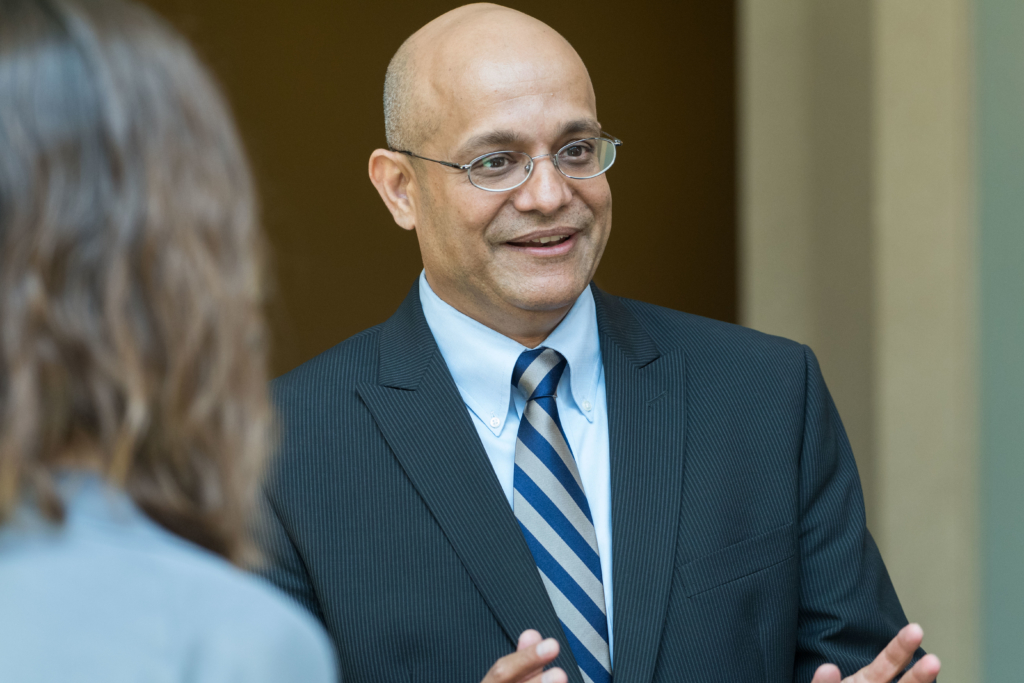
Georgetown McDonough’s Paul Almeida: “We teach the most sophisticated business tools and analytical frameworks, and we do so with the conviction that business can and must be part of the solution to society’s most pressing global challenges.”
AS WE BEGIN A NEW year, my resolution is to be even more intentional about how we define and deliver academic excellence at Georgetown’s McDonough School of Business.
Excellence is not only about what students learn, but how they learn, why it matters, and ultimately who they become. Education is a formative journey. It shapes intellect and character and pairs skills with purpose. It also has a ripple effect – when done right, education fosters a lifelong mindset for growth and development, it inspires others to do well, and it encourages people to go out into the world and use their knowledge for good.
This is an especially important commitment at a moment when higher education faces real challenges and scrutiny. Our duty remains clear: to educate people with our values in focus, to prepare them for meaningful careers, and to equip them to lead with integrity in a complex, ever-evolving world.
In 2026, we are taking a more intentional approach to articulating how our longstanding traditions shape our programs – by more deeply embedding our values into our curriculum, co-curricular experiences, and the everyday culture of our school. This work is grounded in three core principles of our Catholic, Jesuit identity that define what a values-based approach to business education means for our community.
First, cura personalis – or care for the whole person. We provide a rigorous business education while also attending to students’ well-being, resilience, and formation. We believe education should encompass the heart, mind, and spirit, forming leaders who are both capable and compassionate.
Second, serving the common good and being women and men for others. We teach the most sophisticated business tools and analytical frameworks, and we do so with the conviction that business can and must be part of the solution to society’s most pressing global challenges. Whether our students are studying finance, strategy, or entrepreneurship, they are learning how to lift up communities and create value that endures.
Third, cura apostolica – clarity of mission. As educators and scholars, our core work is teaching and research, guided by the Jesuit tradition of learning, acting, and reflecting. That means we ask how even the most technical courses, from accounting to operations to mergers and acquisitions, can be informed by ethical reflection, concern for others, and a broader sense of purpose. When we keep these principles in focus as we build new curricula and projects, we ensure education is accomplishing its most fundamental mission as a tool for good.
This integration of values is not an add-on at McDonough; it is central to how we understand academic excellence and our mission as a business school in the world today. It is what prepares our graduates not only to succeed, but to lead across industries, across cultures, and across borders.
As we enter the new year, my resolution is simple and ambitious: to ensure that our Jesuit values continue to animate everything we do, shaping leaders who are ready to meet the world’s needs with skill, creativity, and purpose.
In the Jesuit tradition, we encourage our students to go forth and set the world on fire – by striving to do well as a person, to do well in society, and then to proactively go out into the world and serve communities globally.
– Paul Almeida, Dean and William R. Berkley Chair, Georgetown University’s McDonough School of Business
Next Page: Deans from TCU Neeley, Emory Goizueta, and HEC Paris offer their resolutions for 2026.
© Copyright 2026 Poets&Quants. All rights reserved. This article may not be republished, rewritten or otherwise distributed without written permission. To reprint or license this article or any content from Poets&Quants, please submit your request HERE.


