






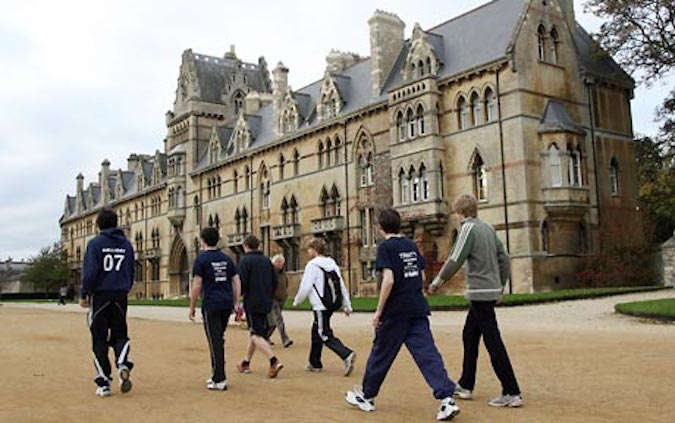
Students at Oxford University in the United Kingdom. Oxford’s Said Business School has launched a competition for high schoolers with innovative ideas to combat climate change. Courtesy photo
Inside Oxford Saïd’s Climate Tech Competition
This year, The University of Oxford’s Saïd Business School is launching their reimagined 2026 Global Climate Tech Challenge.
This year, the competition will be centered around young people engineering technological solutions that could shape the planet’s future. Saïd is opening this opportunity up to high school students and teachers from all around the world.
A NEW ITERATION
Last year’s Climate Change Challenge cast a wide net and drew a record-breaking 1,600 entries from 75 countries, inviting students to share any climate-focused idea they could imagine – from awareness campaigns and community projects to policy concepts, sustainability initiatives, and robotics.
One of the winning student teams used robotics to restore coral reefs, while teachers submitted lesson plans that could turn classrooms into climate‑action labs.
Students aged 15–18 are being asked to design solutions that could have the potential to shift how communities respond to climate change. The stakes are higher, too. After submissions close on 30 June 2026, the top five student teams and top five teachers will be flown fully funded to Oxford for the global final awards.
Winners of the competition will earn a place at the 2027 Future Climate Tech Innovators summer program, and the top teacher will be offered the honor of a spot in an Oxford Saïd executive education program.
The awards are just part of the competition’s return. “One of the most powerful aspects of this challenge is the global community it creates,” said Josephine Fawkes, Director of Global Inclusion and Youth Education at Oxford Saïd.
For information on how to enter, the school asks that you follow this link.
© Copyright 2026 Poets&Quants. All rights reserved. This article may not be republished, rewritten or otherwise distributed without written permission. To reprint or license this article or any content from Poets&Quants, please submit your request HERE.


