






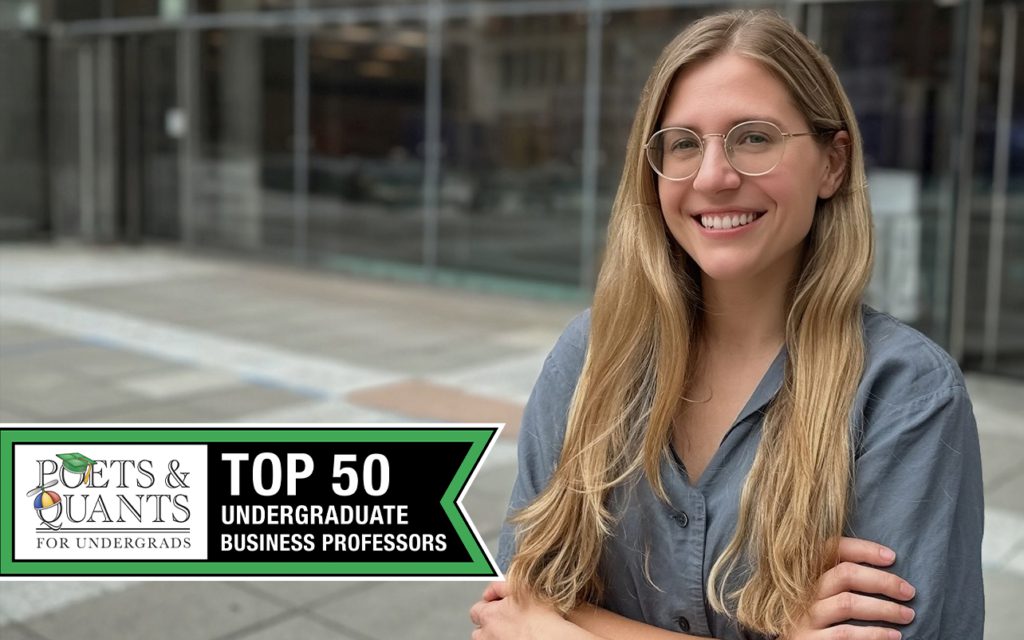
Callen Anthony
Stern School of Business
New York University
“Professor Anthony has profoundly shaped my educational journey through her Strategic Analysis class, which was one of the most transformative experiences of my time at NYU. She is not only incredibly engaging but also has the rare ability to connect with every student in the classroom by fostering active participation and creating an environment where diverse perspectives are valued.
“At a school as globally diverse as NYU, where many students speak English as a second language, Professor Anthony stands out for her intentional inclusivity. From case discussions to group collaboration to visual frameworks, she ensure that every student, regardless of background or learning preference, can engage deeply with the material.
“What makes her most deserving of recognition, however, is her genuine commitment to student success. She invests in her students as individuals, offering guidance, encouragement, and mentorship that inspire confidence and curiosity. The impact she has had on me and many of my classmates is profound, and I can confidently say she has left an indelible mark on our education and future paths.” – Meredith Cummings
Callen Anthony, 38, is Assistant Professor of Management and Organizations at NYU Stern School of Business, where she teaches strategy. She is currently leading the launch of Stern’s undergraduate Strategic Management course into the core curriculum.
Anthony has won numerous awards for her research and teaching. Most notably, Anthony has not one, but two emerging scholar awards for her body of research from the Industry Studies Association (2021) and from the Academy of Management’s Technology and Innovation Management Division (2024). This most recent award is given to someone “who has completed their PhD in the last 7 years whose scholarly publications show exceptional quality and great promise of becoming influential in the area of technology and innovation management.”
Beyond her research and teaching, Anthony is a co-coordinator of the Future of Work Initiative at Stern, and she sits on the editorial boards of Administrative Science Quarterly and Organization Science.
Known for making learning practical among students for their future careers, Anthony is sought after by national media outlets including the Wall Street Journal, among others, for her research expertise.
BACKGROUND
At current institution since what year? 2018
Education: Undergraduate degree in Business Administration from the Ivey Business School at Western University; Masters degree in Social Anthropology from the University of Oxford; PhD in Organization Studies from Boston College
List of Undergraduate courses you teach: Strategic Management
TELL US ABOUT LIFE AS A BUSINESS SCHOOL PROFESSOR
I knew I wanted to be a business school professor when … I was an undergraduate business school student.
What are you currently researching and what is the most significant discovery you’ve made from it? My research focuses on the interactions between technological change and expertise. The themes of my research are highly aligned with contemporary problems facing many firms and industries surrounding the development, implementation, and use of new analytical tools like AI. For example, my research examines problems like how analysis produced using algorithmic technologies can come to be seen as trustworthy; how expert users can demand older technologies and alter the trajectory of innovation within industries when new technologies subsume and constrain the use of expertise; how mentorship relationships invert hierarchical learning with the arrival of new technologies; and how client relationships are managed when new analysis is introduced.
With a grant to study “AI and the Future of Work” (joint with my colleague NYU Stern Professor Rob Seamans), I am currently unpacking how expertise and technologies coevolve across multiple technological changes within the investment banking industry. Drawing on 75 years of firm archives coupled with oral histories from cohorts of investment bankers, I am examining how the work of these experts coevolves with technology across generations. More specifically, I am analyzing how the junior work in this knowledge-intensive occupation – which was previously crucial to developing expertise – is coming to depend less on expertise, and how interactions across roles become hierarchically stratified in ways that undermine expertise.
If I weren’t a business school professor, I’d be … most likely applying my knowledge of strategy within a firm, likely working in corporate development or internal M&A.
What do you think makes you stand out as a professor? I am not sure, I would love to know what my students think! If I had to guess, I’d say it’s my enthusiasm for strategy. I am genuinely excited for each class, and I work hard to foster an intellectual environment where students are comfortable sharing their ideas. I truly believe that in a class like Strategic Management where the business problems are complex and subjective, everyone has a nuanced angle into the same problem. Each angle is valuable, and I seek to get as many angles into our discussions as possible. I believe that enriches everyone’s thought processes and strengthens our analytical conclusions.
Otherwise, it could be the breadth of materials I pull into our class discussions: I’m equally likely to engage in a deep analysis of Boeing and Airbus’s rivalry as I am to unpack Mariah Carey’s strategic choices.
One word that describes my first time teaching: Humbling
Here’s what I wish someone would’ve told me about being a business school professor: Honestly, just how much effort it takes to really take the craft of teaching seriously. When I started my PhD program, I was mostly focused on my love of research. I hadn’t fully appreciated what would be required to teach at a place like Stern – our students are very sharp and hardworking! I take my teaching seriously and am constantly searching for ways to enhance students’ learning opportunities.
Professor I most admire and why: Professor Sonia Marciano! She is completely committed to the value of strategy education and seeks continuous improvement in how to present the material in ways that students connect with and can apply. And, she does so with good humor and cheer. Professor Marciano is among my most treasured mentors, and I feel so fortunate for the opportunity to learn from her so early in my career.
TEACHING BUSINESS SCHOOL STUDENTS
What do you enjoy most about teaching business students? Students that end up in business programs are inherently interdisciplinary. Business relies on knowledge from a breadth of social sciences – psychology, economics, and sociology – and right off the bat students must learn how to think across theories and traditions to analyze problems. I love the intellectual flexibility that accompanies such a broad perspective.
What is most challenging? Students feel pressured about making the “right” career choice. I think these dynamics are exasperated by a decision-making logic rooted in optionality (‘I just want to keep my options open / do something that opens as many doors as possible’). There is of course value in this approach, but it also has its costs. In particular, I’ve seen it paralyze students from making intentional choices with eyes wide open about trade-offs. Truthfully, any experience gives you knowledge about yourself, and that knowledge is a gift to make the next set of choices. Maximizing optionality can get in the way of developing insight into what you like, and equally as important, what you don’t.
In one word, describe your favorite type of student: Curious
In one word, describe your least favorite type of student: Arrogant
When it comes to grading, I think students would describe me as … Thorough and fair
LIFE OUTSIDE THE CLASSROOM
What are your hobbies? I seek creative outlets outside of my work. In particular, I love music and play several instruments (guitar, ukulele, piano). I also recently started taking a drawing class.
How will you spend your summer? My summer is chock full of academic conferences, where I’ll present my research and catch up with coauthors and colleagues from other institutions. It’s also an important time to collect data and make research progress given the reduced teaching commitments. In addition, I hope to find some time to hike and enjoy a beach somewhere.
Favorite place(s) to vacation: Anywhere with my family – for me, how I experience a place is entirely shaped by the people I am with. But come to think of it, I really love being with my family in Spain…
Favorite book(s): I read a lot, and I especially love to read about the social and political underpinnings of scientific work. A book I am currently reading (and am really enjoying!) is called “Lords of the Fly: Drosophila Genetics and the Experimental Life” by Robert E. Kohler. It’s about how geneticists in the early twentieth century began using fruit flies for their research. The book traces how the social structures and relationships of scientists shaped the use of the fruit fly as a research instrument, which had a profound effect on scientific knowledge as it enabled scientists to study genetics across generations.
Outside of academic literature, I love to read poetry, and especially love twentieth century American poets. A few of my favorites are Wallace Stevens, Louise Glück, and Elizabeth Bishop (I have an original print of ‘The End of March’ hanging in my office).
What is currently your favorite movie and/or show and what is it about the film or program that you enjoy so much? A show I keep coming back to is “Schitt’s Creek”, created by Toronto native (shout out!) Dan Levy. The show is about a family who has lost their fortune and finds themselves living in a run-down motel in a middle-of-nowhere town. The show is hilarious, and watching the characters get to know themselves and revitalize their family relationships is very heartening. It’s *simply the best.*
What is your favorite type of music or artist(s) and why? I absolutely love music and associate different genres/artists with different periods of my life. Picking a favorite is impossible! Lately, I’ve been listening to a lot of Tame Impala, David Byrne, and LCD Soundsystem. They help me get pumped up for class. A big reason is because I love their use of classic synthesizers. LCD Soundsystem in particular uses modular synths with a million little patch chords to get their rich analog sounds. It’s especially fun to see them play live at their annual New York residency!
THOUGHTS AND REFLECTIONS
If I had my way, the business school of the future would have much more of this … simulated decision-making environments where students have to navigate relationship dynamics in teams while analyzing data and driving to a clear conclusion/plan of action.
In my opinion, companies and organizations today need to do a better job at … thinking about and allocating resources toward the development and use of AI. Every technological change will inevitably have consequences, many of which are not the ones we hope for or expect, and some of which are unknown and unanticipated. Particular consideration toward the knock-on effect of altering work is especially important now more than ever, because when work is altered, it influences the development and management of expertise.
I’m grateful for … The privilege of being a scholar. I love my research, and am inspired by my colleagues and students. I still can’t believe this is a real job and it’s mine!
DON’T MISS THE ENTIRE ROSTER OF 2025’s 50 BEST UNDERGRADUATE BUSINESS SCHOOL PROFESSORS.
© Copyright 2026 Poets & Quants. All rights reserved. This article may not be republished, rewritten or otherwise distributed without written permission. To reprint or license this article or any content from Poets & Quants, please submit your request HERE.


