






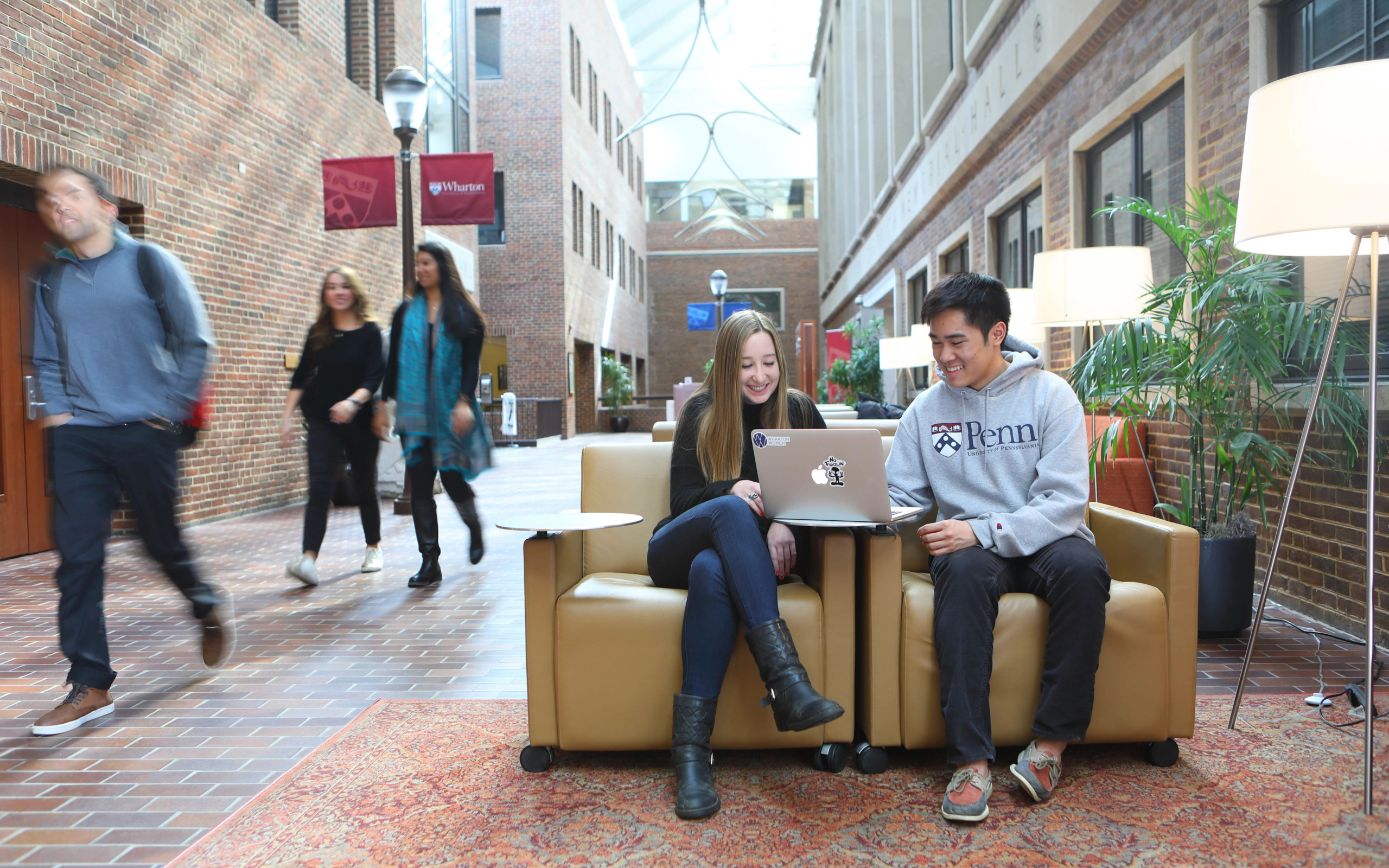
Wharton undergraduate students
Wharton Welcomes New Vice Dean Of Undergrads: Cait Lamberton
Big news from Wharton – Cait Lamberton has stepped into the role of vice dean of Wharton’s Undergraduate Division, succeeding Diana Robertson, who is returning to the classroom after a transformative tenure that began in 2019.
Reflecting on her time in leadership, Robertson says, “I started in July of 2019, and then, of course, COVID hit us in March of 2020. It was such an extraordinary time.” Despite the pandemic disruption, she says, “We have a staff of talented, dedicated people. We continue to be number one in U.S. News & World Report rankings.”
Lamberton, who joined Wharton’s marketing faculty six years ago, described the opportunity as a completely new set of challenges. “There are very few reasons to turn away from that opportunity,” she said.
ON THE TOPIC OF AI
A major theme in their conversation was the Both Robertson and Lamberton have concerns about how the technology affects student attention spans and their critical thinking skills. Even more, they are keeping close tabs on the rapid evolution of AI, with Lamberton pointing to an observation made by Wharton professor Ethan Mollick.
“A few months ago, AI couldn’t count the number of r’s in the word ‘strawberry.’ Today, you can ask it to carry out incredibly complicated requests,” Lamberton explains.
“We talk endlessly as faculty about what’s happening in the classroom with AI,” Robertson adds.
Lamberton also reflected on a summer course she took about thinking machines. The takeaway: no one knows exactly how AI will shake out. “To think about how AI will affect us in even the medium term is almost impossible, because we have no idea what it will be.”
Both women agreed that the rise of AI makes human soft skills more essential than ever. “Someone still has to stand up in front of a room and make a pitch,” Lamberton explains. “Someone still has to reach out and make the connection with a company or organization.”
Robertson agreed, reinforcing the importance of teaching students how to think critically and ethically in a world increasingly shaped by technology.
Lamberton further argues that analog skills like communication, empathy, and relationship-building – more than technical knowledge – will become core technical skills. “Being really good at the analog is going to be the thing that differentiates you.”
THE FUTURE OF WOMEN IN LEADERSHIP
The two also touched on the importance of women in leadership and the evolving culture at Wharton. “When I started at Wharton, it felt very male,” Robertson observes. “Students would say, ‘You’re the only woman professor I’ve had.’”
By the same token, Robertson commended the school’s progress in changing that image, saying, “It’s not just perception – it’s reality.”
Lamberton brought up a recent exchange with an alumni board member who challenged her to think about long-term alumni support. “She said we can’t stop sharing the stories about what happens after five years. There’s a long journey ahead.”
As Lamberton begins her tenure, she says she’s focusing on listening, learning, and identifying strategic opportunities for the program’s growth. As Lamberton heads into this role, Robertson told her of her personal experience, “The real learning for me was to be a team member and understand that I didn’t have to do everything.”
Lamberton says she’s quite excited about the collaborative nature of the role. “It’s been wonderful to not only walk out of a meeting knowing more than when I walked in, but also to walk out with more energy,” she says.
© Copyright 2026 Poets&Quants. All rights reserved. This article may not be republished, rewritten or otherwise distributed without written permission. To reprint or license this article or any content from Poets&Quants, please submit your request HERE.


