






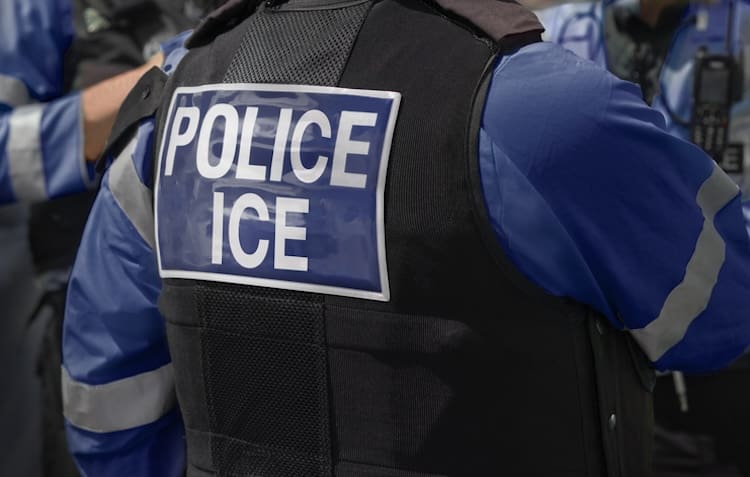
U.S. Immigration and Customs Enforcement (ICE) is a federal law enforcement agency
The world isn’t just seeing videos of U.S. Immigration and Customs Enforcement agents roughing up people on city streets. They’re seeing something far darker: government agents firing live rounds into civilian cars and killing a U.S. citizen in broad daylight.
On Jan. 7, Renee Nicole Good, a 37-year-old mother of three, was fatally shot by an ICE agent in Minneapolis during a federal immigration operation. Good had just dropped off her youngest child at school and was driving home when she was confronted by agents. Multiple videos of the encounter — which unfold like a horror clip rather than a law-enforcement interaction — show federal agents and a vehicle flying in opposite directions before shots are fired. Her death sparked protests nationwide and intense scrutiny of the Trump administration’s handling and defense of the shooting.
President Trump and his spokespeople immediately leapt to defend the agent’s actions and to cast Good as a threat or provocateur. White House officials labeled her behavior as “obstructing and resisting,” while the vice president suggested her actions were akin to “domestic terrorism.”
VIDEOS NOW RICOCHET AROUND THE WORLD SHOWING ICE AGENTS GRABBING PEOPLE
This is not just cruel rhetoric — it is the kind of narrative distortion that compounds the damage.
 Videos now ricochet around the world showing ICE agents in tactical gear grabbing people in broad daylight, pinning them to the ground, dragging them away as crowds look on in disbelief. These are not quiet, administrative actions. They are spectacles—designed to intimidate, designed to signal toughness, designed for political theater.
Donald Trump may see these images as proof of strength. Outside the United States, they look like something else entirely: a country that has turned on foreigners.
And American higher education is paying the price.
TRUMP HAS USED IMMIGRATION AS A STAGE PROP TO INFLAME HIS BASE
Trump has always treated immigration as a stage prop—something to inflame his base rather than manage responsibly. He boasts about “crackdowns,” promises mass deportations, mocks due process, and frames immigrants as threats rather than contributors. Now that rhetoric has been operationalized in ways that are impossible to ignore—and impossible to contain within U.S. borders.
Social media does the rest.
Prospective students in Mumbai, Shanghai, São Paulo, Lagos, and Paris are not parsing visa categories or regulatory nuance. They are watching people who look like them being forcibly detained. They are hearing Trump talk about foreigners as criminals. And they are drawing the obvious conclusion: If this is how America treats immigrants, why would I send my child there?
This is not hysteria. It is rational risk assessment.
The damage is already visible. International enrollment is softening at the margins. Yield is under pressure. Schools that depend on global talent—especially MBA, STEM, and professional programs—are bracing for declines that will hit budgets fast and hard. For public universities, this threatens cross-subsidies that support in-state students. For private schools, it threatens financial stability outright.
TRUMP IS BLOWING UP THE VALUE PROPOSITION FOR U.S. HIGHER EDUCATION
For decades, the U.S. sold the world a clear bargain: come here legally, work hard, pay a premium, and you’ll get a world-class education plus a fair shot at launching a career. Trump is blowing up that bargain in public, on camera, and with relish.
And here’s the cruel irony: Trump’s approach does not make America safer or more stable. It makes it appear chaotic, unpredictable, and dangerous — especially for people who are already far from home and in a foreign legal system.
No amount of glossy university brochures can counterbalance social-media clips of armored federal agents firing into a car, of mourning children, of a grieving family demanding answers. Those images travel instantly and linger far longer than any official press release.
International students are not naive. They know that sometimes difficult interactions with law enforcement occur everywhere. But when deadly force is used by federal immigration agents — and when the administration’s first instinct is to defend that use rather than call for an independent investigation — it sends a message that the United States has lost its moral and administrative bearings.
THE CONSEQUENCE OF THOSE ICE VIDEOS ON THE WORLD’S SOCIAL MEDIA
For U.S. business schools and higher education more generally, the consequences are not abstract:
Parents in India, China, Brazil, Nigeria, and Europe are asking a simple question: Why risk it? Why spend $200,000 on an MBA or $300,000 on a U.S. undergraduate degree when your child could face arbitrary scrutiny, visa uncertainty, or worse—public humiliation or detention amplified online? Why not choose Canada, the UK, Australia, or Europe, where immigration enforcement does not dominate the news cycle?
This is not hypothetical. Admissions officers quietly report that these videos come up in recruiting conversations. So do Trump’s promises of mass deportations, tighter work authorization, and aggressive enforcement. The result is hesitation at best—and attrition at worst.
The damage compounds quickly.
International students subsidize American higher education. They pay full freight. They support faculty lines, research budgets, and financial aid for domestic students. In many STEM and MBA programs, they account for 40% to 60% of enrollment. Lose them, and the math breaks fast—especially for public universities and tuition-dependent private schools already under financial strain.
But the long-term costs go far beyond balance sheets.
INTERNATIONAL STUDENTS ARE AMONG AMERICA’S MOST EFFECTIVE AMBASSADORS
International students are among America’s most effective ambassadors. They return home with professional networks, cultural affinity, and often lifelong ties to the U.S. economy. They become CEOs, ministers, founders, and investors who understand—and often favor—American institutions and values. When the U.S. drives them away, it doesn’t just lose tuition revenue. It forfeits influence.
Trump’s immigration enforcement may play well to his political base. But to the rest of the world — including the world of global talent that American universities have spent generations cultivating — it looks like a country that has forgotten how to balance security with basic humanity.
That matters. For higher education, it might matter most of all.
John A. Byrne is the founder and editor-in-chief of PoetsandQuants.com.
DON’T MISS: OPT Under Threat? What It Means for MBA ROI, Jobs & International Students or B-School Deans Brace For Long-Term Decline In International Students
© Copyright 2026 Poets & Quants. All rights reserved. This article may not be republished, rewritten or otherwise distributed without written permission. To reprint or license this article or any content from Poets & Quants, please submit your request HERE.


