





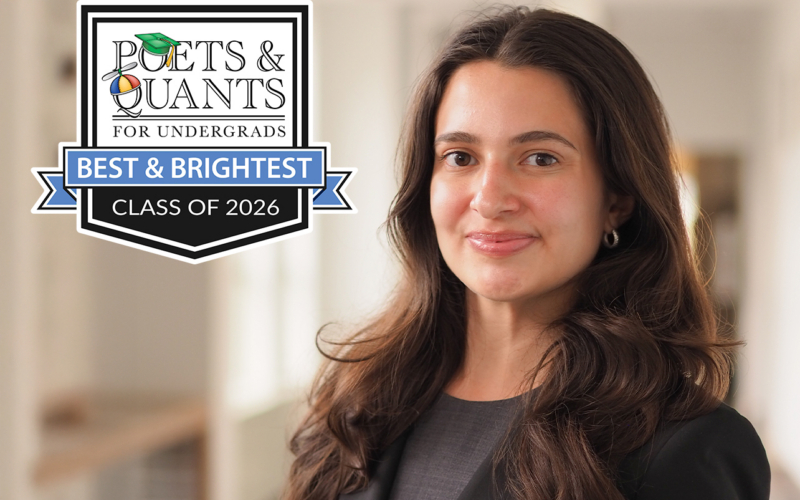
Cristina Grace Liberto
Indiana University, Kelley School of Business
“I am grounded and curious, always learning and exploring how thoughtful work can create value.”
Fun fact about yourself: I had a variety of lemonade stands starting at the age of five, including selling potato chips, Swedish Fish, and even tap water in little Dixie-cups.
Hometown: Chicago, Illinois
High School: Lane Tech College Prep High School
Major: Marketing, Business Operations, and Business Analytics
Favorite Business Course: M344 Creativity and Communication
Extracurricular Activities, Community Work and Leadership Roles During College:
Honors and Awards
- William R. Fry Scholar
- Kelley Honors and ACE student:
- Hudson and Holland Scholar
- Dean’s Scholar
- Founder’s Scholar
- Hutton Honors Student
Involvements
- Dean’s Insights Board (Vice president and member)
- 180 Degrees Consulting (Associate director of operations, team manager and consultant)
- Alpha Kappa Psi (DEI associate director and member)
- Study abroad in Spain and Singapore
- First Generation Investors (Curriculum consultant, marketing director and tutor)
- Jellison Living Learning Center resident
- Kelley Office of Community and Access (Mentor)
- Financial Opportunity Program (Mentor)
Where have you interned during your college career?
- Sophomore and Junior Summer: Boston Consulting Group, Chicago, summer associate (June 2025- August 2025), summer GFL associate (June 2024- August 2024)
- Study Abraod Semester: Imageryst, Madrid, intern (March 2025-May 2025)
- Freshman Summer: Willkie Farr and Gallagher, Chicago, legal research intern (July 2023- August 2023)
Where will you be working after graduation? I will be returning to Boston Consulting Group Chicago as an associate
What is the biggest lesson you gained from studying business? Pressure is a privilege. As a business major, you’re constantly posed with pressure, whether it is back-to-back meetings that leave little time for homework or alumni coffee chats where you feel pressure to entertain a professional with whom you have little in common with except your alma-mater. My mood was negatively impacted by the constant pressure to perform, which was very often as an over-involved student. I assumed the only way to feel better was to lower my goals.
After working at Boston Consulting Group my sophomore summer, I gained perspective. I realized how much of a privilege I had to be at Kelley and face pressure from classes to student organizations. I used to be insecure being constantly surrounded by high-achievers. Now, I realize those people were inspirations to me and ‘pressured’ me to reflect on my own habits. I used to be annoyed if I looked at my schedule and had back-to-back meetings and classes. Now, I realize those days teach me how to maximize my time and get the most out of it. It’s not even so much the outcomes of these situations that prepared me for my internships, but the mere experience of pressure itself. College is the best place to develop this skill because the stakes are real but still forgiving.
My biggest lesson is that pressure does not have to equal stress. It’s about how you frame the situation in your mind. The solution to my low mood wasn’t to push away the pressure, but to see my challenges as opportunities. As the years went on at Kelley, I’ve reframed my thinking to be grateful for my everyday pressures which have made all my learning more fun. It’s even pushed me to do more, all with a smile now.
As I enter my career, I know new pressures will emerge, and they’ll require continued reframing. I’m both nervous and excited, knowing this mindset will help me learn faster and maintain perspective. My advice to incoming business students is to adopt this mentality early. Instead of wishing demanding school weeks go away, savor them recognizing that you’re training valuable skills from time management to composure under pressure that will compound for the rest of your career.
What advice would you give to a student looking to major in a business-related field? Many business students like me arrive on campus ready to ‘drink the corporate Kool-Aid’ — joining organizations, filling their calendars, and chasing competitive recruiting timelines. This discipline matters, and ambition is not a bad thing. But one of the most important lessons I’ve learned is that success in business and in our own lives comes from alignment.
Business teaches you how to solve problems and build strategy. At its core, business is about alignment between your skills and your role, a company and its customers, and ultimately, your actions and your values. The experiences you’ll gain the most from are the ones that align with who you are and what your passionate about at that moment in time.
By the end of my freshman year of college, I was a burnt-out over-achiever. I was proud of my GPA and involvements but feeling unfulfilled because I had neglected my social and spiritual life. Throughout your career, you’ll constantly face this same question: ‘Where should I invest my time and energy right now?’
My advice to business students is to use college not only to build your resume but define your values and mission statement so you can make decisions about your time and energy more easily. That might include a meaningful career—but also strong relationships, a rich spiritual or faithful life, and time to pursue your passions. Your career alone won’t provide those things unless you intentionally work for them on a regular basis. Imbalance is normal at times, but you can’t Amazon Prime many of those important things.
College is one of the last periods of life where you have the time and space to reflect, experiment, and grow personally. Take advantage of it. Work hard for the career you want but work just as hard to define and work towards the life you want.
Looking back over your experience, what is the one thing you’d do differently in business school and why? I would have sought novelty as much as possible on campus. Novelty is important for the brain, as it builds neuroplasticity, which boosts critical thinking and creativity. These are two of the most valuable skills for the workforce in today in AI – difficult to quantify but many can agree takes time and experience to build.
Looking back, I would have taken more advantage of low stakes side quests just for sake of experiencing them. Novel experiences exist all around a college campus, whether it be taking a self-defense class or talking to man who believes the moon landing was fake (two things you can experience on IU’s campus) and is always typically accessible to all students. Many of my smartest classmates look up to the most prioritized curiosity and novelty first and still were successful academically and professionally.
What is one way that your business school has integrated AI into your programming? What is one insight you gained from using AI? Kelley has a flexible AI policy where professors can choose how they integrate AI into their courses. My professors use this approach to teach students about both the strengths and limitations regarding AI.
I experienced the most drawbacks with using AI in classes related to strategy—specifically in my Marketing Strategy course. For example, when conducting an environmental analysis of an industry like energy bars, AI could give me a decent and comprehensive overview of trends. However, it lacked the quality of deeper implications of trends needed for my paper, despite my re-prompting and such. That experience reinforced for me that AI is a powerful tool for efficiency and synthesis, but human judgment of nuances and complexities are still the gold standard for strategic decision-making for now at least.
Which academic, extracurricular or personal achievement are you most proud of? I am most proud of my time on the Dean’s Insights Board because of how my experience has challenged me professionally and personally for three years in college. As a member of the Dean’s Insights Board, we conduct primary research, every semester, a new topic from the deans regarding Kelley students. Tactically, the Board has taught me how to conduct and analyze surveys and focus groups and create a hypothesis and defend or support it. Socially, I’ve met some of my smartest classmates from a diverse set of backgrounds and have made life-long friendships.
My senior year, I’ve been given the opportunity to lead as vice president and it has been my biggest test of my leadership. I’ve learned how to navigate leadership situations. This includes learning from my own assumptions and thinking, balancing confidence with humility, and learning when to lead decisively versus when to step back and listen. I’ve grown more comfortable with leading ambiguous problem-solving, aligning diverse perspectives toward a shared goal, and leading with empathy while still holding myself and others to high standards. This experience has ultimately shaped how I think about leadership: not being the smartest person in the room but being most responsible for creating an environment for others to do their best work.
Which classmate do you most admire? I admire Dave Jankeolowitz most for his genuine humility and selflessness. Dave is driven learner. This ranges from being involved in unique organizations like the Consulting Workshop and Crimson Equity Partners to having inter-disciplinary majors including Finance and Law, Ethics, and Decision-Making. He says yes to learning opportunities, but what sets Dave apart though is how he treats people. He is consistently kind, nonjudgmental, and attentive. He’ll remember if you have an exam or an interview and always follows up simply because he cares. This thoughtfulness makes him not only an exceptional classmate, but a trusted friend.
This past year, I had the privilege of working alongside Dave as vice president while he served as president of the Dean’s Insights Board. One small but telling moment came when I accidentally ordered $75 worth of pizza for the wrong date for a board meeting. Although this was my mistake, Dave still agreed to split the bill (although he did send me multiple ‘I will never recover financially from this’ memes) and eventually we were able to get it covered. That moment reflects who Dave is as a leader and friend, generous and supportive.
Who would you most want to thank for your success? I am incredibly grateful for my family and my parents for building me into the person I am today. However, there is one person who had the most direct impact on my success as a business professional, Carmund White. I met Carmund through the Kelley Office of Diversity Initiatives MEET Kelley program during my junior year of high school. He introduced me to Kelley’s supportive community and opportunities, to go from motivated high schooler to business professional. From that programming, Kelley became my dream undergraduate business school.
Receiving the William R. Fry Scholarship through the Office of Diversity Initiatives made it possible for me to attend Kelley. Beyond access, Carmund has continued to be a light in the Kelley community uplifting students with empathy, understanding, and an unwavering belief in their potential. Every professional opportunity I’ve pursued has been built on the foundation Kelley provided, and Carmund played a pivotal role in opening that door. I am profoundly grateful for his impact on my education, confidence, and career.
What are the top two items on your professional bucket list?
1. Giving back to the city of Chicago through education: As a product of the Chicago Public Schools Kindergarten-12th grade system, I’ve experienced the value of a strong education on a student academically, professionally, and personally. Despite the poor reputation Chicago gets, there are thousands of educators and professionals who work hard to give students the holistic education and care they need to thrive. I’ve interned with a few non-profits and public institutions in Chicago to begin to understand the entire educational eco-system better. I would like to continue give back to public education in Chicago by providing insight and resources on curriculum and programming, from my perspective as a business professional as well by uplifting the voice of educators like my parents in decision-making rooms.
2. Be able to sign all my emails just C: It sounds small and silly, but a professional who can sign their emails with just their first initial means they’ve have years of credibility and personability behind them.
What made Cristina such an invaluable addition to the Class of 2026?
“Cristina is one of the most exceptional students that I have ever known. Since her first year at IU, Cristina has given selflessly to organizations, and our school community as a whole — while achieving a level of academic excellence that is challenging if that is the only thing you do.
Cristina’s is committed to community, committed to equity and committed to ensuring that amplifying all of the voices around her because she understands the importance of being seen, heard, and valued. Cristina has a bright future ahead of her and the world has a brighter future because she is in it.”
Carmund T. White, Jr., D.M.
Director of Development
Indiana University Kelley School of Business Office of Development & Engagement
DON’T MISS: 100 BEST & BRIGHTEST UNDERGRADUATE BUSINESS MAJORS OF 2026
© Copyright 2026 Poets & Quants. All rights reserved. This article may not be republished, rewritten or otherwise distributed without written permission. To reprint or license this article or any content from Poets & Quants, please submit your request HERE.


