





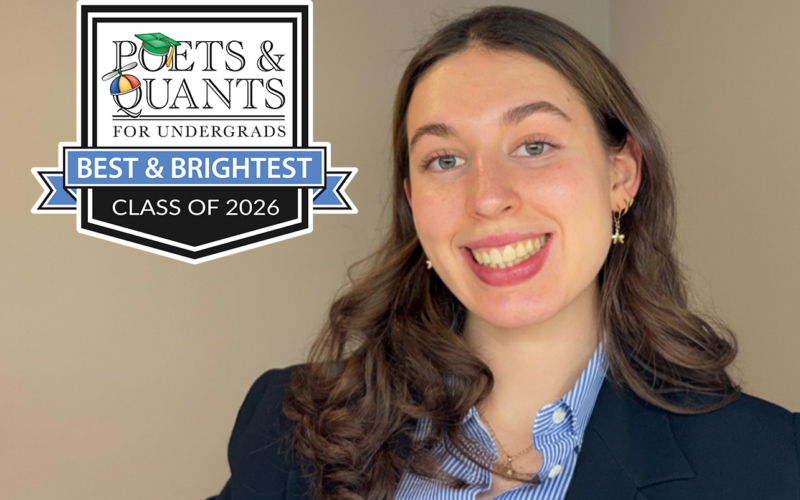
Ludovica Vittoria Barzaghi
ESCP Business School
“People-curious, socially smart, with a passion for understanding others and building meaningful relationships.”
Fun fact about yourself: I have never thrown away a lipstick with product still inside. It’s a small habit that tends to reflect how I approach things: I finish everything I start, whether it’s a university project, a life goal, or a makeup product.
Hometown: Milano, Italy
High School: Liceo Classico Tito Livio, Milano
Major: Management
Minor: Marketing
Favorite Business Course: Business Negotiations, taught by Professor Tetiana Hill
Extracurricular Activities, Community Work and Leadership Roles During College:
Best Performing Student, 2024-2025
Dean’s List (Top 10 people), 2023-2026
Founder, ESCP Volleyball Team on Madrid campus, 2024-2025
Marketing Associate, GEA Sustainability Association, 2023-2025
Where have you interned during your college career?
Summer 2025: Accenture | Strategy Consultant Intern | Milano, Italy
Summer 2024: Look Cycle | Marketing Intern | Nevers, France
Where will you be working after graduation? After graduation, I plan to pursue a role in the consumer packaged goods industry, particularly within food and beverage or cosmetics, focused on consumer insights. I am seeking opportunities that sit at the intersection of marketing and psychology, where understanding consumer behavior is central to building strong, relevant brands.
Who is your favorite business professor? While I appreciated many of the professors who taught me during my time at ESCP, one name came to mind almost instantly when I read this question: Professor Andrew Shagrin. I admire him most for his exceptional teaching ability and his deep understanding of pedagogy and cognitive science, which he consistently translates into effective learning environments for his students.
He is a professor with rules, a quality I have always valued: clear, transparent, and well-enforced guidelines that ensure everyone is on the same page. Among them, the one that had the greatest positive impact on my learning experience was his no-electronics policy: no phones, no computers, and no tablets in class. Through this approach, he led me to rediscover the value of paper-and-pen notetaking, together with the effort and the messiness of it. My notes looked terrible, but – and he knew this – I can still recall every page of that notebook, even three years later. I now show up to class with nothing but paper and pen, having found handwritten notes far more effective for recall.
Within the classroom, the rule was initially frustrating; however, his emphasis on active engagement quickly became evident, and students naturally became more involved. As a result, distractions decreased and his classes evolved into genuinely interactive learning spaces.
While such a rule is not strictly necessary at college level, as students are capable of choosing their own notetaking methods and managing digital distractions. However, it was inspiring to see a professor care so deeply about his students’ success and apply teaching methods so intentionally to foster focus and participation.
What is the biggest lesson you gained from studying business? Professional and personal success extend far beyond grades and are not defined by being simply smart or studious, rather by becoming an interesting, curious, and engaged person. Much of the most meaningful growth actually happens outside the classroom, where you can shape who you are and how others perceive you.
Committing to your personal development is one of the most valuable investment decisions you can make in your twenties. You can do this by developing your personality, cultivating well-rounded interests, seeking opportunities, and learning how to engage meaningfully with others. Ultimately, investing in curiosity, self-development, and human connection is what allows you to stand out and build lasting relationships.
What advice would you give to a student looking to major in a business-related field? Resist the instinct to compete. Business schools, and business environments more broadly, are extremely competitive. This makes it easy to fall into the mindset that collaboration and teamwork come at the expense of individual success.
Do not walk into classes viewing other students as your enemies: those who might rank higher than you, secure the internship you want, or outperform you in exams. While competition is inevitable in both professional and personal contexts, my advice is to keep it to a minimum among peers.
Collaboration simply works better: two people can share more resources than one; two perspectives offer greater insight; and two minds can achieve a deeper understanding than one working alone. In collaboration there is richness, diversity, and a more engaging learning experience.
I say this as someone who is naturally driven and holds herself to demanding standards. When I was first introduced to rankings and percentiles in business school, I became increasingly focused on individual performance and significantly less collaborative. Although this approach yielded strong results, it proved inefficient and isolating: I spent weeks repeating material to myself, searching for answers online, and sometimes struggled to stay focused.
That perspective changed during my second year, when my flatmate and I reviewed our notes together shortly before a Finance exam. We walked up and down the sidewalk in front of the university, explaining concepts to each other. Suddenly, everything clicked: she had the answers to my questions; I had the answers to hers. That was the moment when we truly understood the power of collaboration, and how beneficial it could be for the both of us.
I later observed the same dynamic in the workplace, during one of my internships, where colleagues were approachable, generous with feedback, and never missed an opportunity to support each other.
Therefore, my advice is this: work hard, put in the effort, attend classes, take thorough notes, and build your own understanding first. Then, collaborate with peers who are equally prepared. When surrounded by capable, driven people, do not fear free-riding, and do not let the competitive pressure intimidate you. Doing so will not only deepen your understanding, but also make the learning process more efficient, engaging, and memorable.
Looking back over your experience, what is the one thing you’d do differently in business school and why? If I could go back in time, I would want to engage more deeply with the places I was living in. I had the opportunity to study in four different countries over three years, yet I often remained within the university bubble, focused on classes, coursework, and building new social circles each year. While that experience was enriching, I regret not taking fuller advantage of being immersed in different societies.
I wish I had gone beyond learning the languages of each country and actively engaged with local communities through activities, conversations, and work experiences, to better understand how people think, collaborate, and approach work. Doing so would have strengthened my cultural intelligence and given me a richer understanding of how different environments shape perspective, behavior, decision-making and business practices. For future students, I would emphasize that international education becomes truly transformative only when you step outside the classroom and connect with the world around you.
What is one way that your business school has integrated AI into your programming? What is one insight you gained from using AI? I believe ESCP was among the first universities to collaborate with OpenAI, granting all students free access to ChatGPT Edu. Beyond providing access to the tool itself, the school quickly introduced a new mandatory course on how to use AI effectively, providing guidance on prompting, but also on understanding its limitations, risks, and ethical implications, skills that are increasingly relevant skills in today’s workplace.
My main insight from using artificial intelligence is that it can significantly accelerate processes in terms of speed, efficiency, and short-term results. However, it can also hinder long-term understanding if used uncritically. Personally, I noticed this particularly in language learning: relying on AI to complete exercises or homework made the process faster, yet it weakened my ability to retain and recall what I had “learned”.
In this sense, while AI can accelerate short-term performance, it can also quietly replace the cognitive effort that true learning requires. Learning remains a non-negotiable process for keeping our minds active, and AI is most valuable when it complements, rather than replaces, that effort.
Which academic, extracurricular or personal achievement are you most proud of? One of the achievements I am most proud of is co-founding the volleyball team on ESCP’s Madrid campus, where no such team previously existed, together with my friend Manon.
Starting the team required navigating several challenges. The university sports department could offer limited funding and no operational support, and we had no prior knowledge of the local sports ecosystem or contacts in Madrid. We had to find a suitable court, manage a budget that covered only a fraction of the total costs, and assess whether there was enough interest among students to make the project viable. Through surveys, conversations, and careful financial planning, we mapped potential participants, secured funding, and structured a sustainable model for weekly training sessions.
In the early stages, I trained the team myself, but I later recognized the value a professional coach could bring. This led me to search for one, and I eventually found Joseph, whose involvement significantly elevated the quality of training and strengthened team cohesion. By December, the team included around 30 students who trained together every week. In March, our women’s team, of which I am part, won the intercampus university competition in Paris, an achievement made possible by consistent training and a strong team spirit.
What makes this experience especially meaningful to me is not just the outcome, but the community that formed around the project. Seeing people show up every week with enthusiasm, build friendships, and feel part of something we created together has been incredibly rewarding. This experience taught me what it truly means to build a project from zero, convince others to believe in an idea, and deliver on the value promised. Above all, it reinforced my belief in collaboration: without the commitment of every student who joined and the help and support of my friends, this team would not exist.
Which classmate do you most admire? I did not fully understand what determination and discipline meant until I met Lily Macdonald.
Lily wakes up every morning and goes for a run, regardless of the weather, her schedule, or whether it is exam season. That same mindset carries into everything she does. She has an exceptional ability to prioritize what matters most and then work relentlessly toward it, never compromising on quality. During the last exam session before Christmas, she managed to simultaneously secure a highly competitive internship after multiple assessments, apply to and be accepted into an excellent master’s program with a scholarship, attend all her classes, maintain her training routine, and still excel academically. Watching her, one could believe she has more than 24 hours in a day!
What I admire most, however, is not just what she achieves, but how she does it. Lily never leaves important things for “tomorrow.” Even when tired, she makes sure to get things done properly and on time. She delivers excellent work, consistently, without shortcuts. This approach also makes her an exceptional leader: she brings structure, clarity, and reliability to any team she is part of, a quality she has demonstrated in both academic group projects and extracurricular settings.
On top of this, she is also the person I turn to when I have doubts or difficult decisions to make, someone who understands me deeply and offers unwavering support, regardless of the situation. She combines high standards with genuine warmth, always greeting people with a sincere smile and an open heart.
Studying together, collaborating on group projects, and sharing a home over the past three years allowed me to see her values in action every day. Lily has made me more disciplined and more intentional in how I approach my own commitments. I admire her because she proves that consistency, clarity of priorities, and quiet determination can make even the most demanding goals achievable.
Who would you most want to thank for your success? I will forever be grateful to my parents, who have always made sure that I had the freedom and the preparation to choose my own path.
From a very young age, they sent my brother and me to summer camps across the UK and the US so that we could learn English. At the time, this was often a painful experience for me, as being far from home was difficult. Only later did I fully understand the value of those years, something I will never thank my parents enough for. They pushed me to learn a language that would allow me to communicate with people across the world for the rest of my life. More than that, they indirectly provided me with the understanding of different social and economic systems, cultures, organizations, and ways of thinking.
That early exposure to new and unfamiliar environments gave me the opportunity to develop independence and self-reliance, and helped me gradually adapt to the feeling of being abroad. This was essential in preparing me for what ESCP represents: changing campuses every year and constantly adjusting to new people and contexts. Over time, this fostered intellectual flexibility and openness to different perspectives.
I owe it to my parents that today I can walk into a room with confidence, feel a sense of belonging even where I am a foreigner or an outsider, express myself in multiple languages, and understand the cultural context behind people’s ideas and actions. They consistently created the conditions for me to seize a variety of opportunities and shape my own future, and they continue to do so every day.
What are the top two items on your professional bucket list? The first item on my professional bucket list is to work abroad and build my career in an international environment. Having studied and lived in multiple countries, I have learned that exposure to different cultures, work styles, and social norms is one of the most powerful forms of education. I am deeply motivated by environments that challenge my assumptions and force me to adapt, listen, and understand how people think and make decisions in different contexts.
The second item on my professional bucket list is to be helpful to others, particularly to children. Through my experiences as both a camper and later a summer camp counselor, I discovered how rewarding it is to support young people as they grow, overcome challenges, and gain confidence. I am especially drawn to working with shy and introverted children, as I recognize parts of myself in them and understand the importance of having someone who sees and supports them.
One long-term aspiration of mine is to found a high school. I am deeply passionate about education, highly critical of existing systems, and convinced that strong communities are built through thoughtful learning environments. Creating a space where young students feel supported, challenged, and encouraged to become themselves would be the most meaningful way for me to give back.
What made Ludovica such an invaluable addition to the Class of 2026?
“I met Ludovica in September 2025 during the Business Negotiation module at the London Campus.
From the outset, Ludovica distinguished herself as a highly determined and goal-oriented individual. She is also a natural “people person,” with strong interpersonal skills that make her an excellent team player. The Business Negotiations module is highly interactive and centered on simulation-based exercises, which provided ample opportunity to observe how she approaches complex group tasks.
Ludovica consistently took an active and constructive role in debates and negotiations. She demonstrated strong analytical thinking, composure under pressure, and a clear ability to guide discussions toward effective outcomes. In addition to her collaborative mindset, she displayed notable leadership potential throughout the course.
She is an empathetic and sociable individual who works efficiently and applies her knowledge and skills effectively to complex challenges. Her performance in the module was outstanding, earning her excellent results.
Ludovica is an exceptional candidate for this recognition, as she combines drive, intellectual ability, and interpersonal strength in a way that will undoubtedly contribute to her continued success. She has my highest recommendation.”
Dr. Tetiana Hill
Affiliate Professor, ESCP Business School
DON’T MISS: 100 BEST & BRIGHTEST UNDERGRADUATE BUSINESS MAJORS OF 2026
© Copyright 2026 Poets & Quants. All rights reserved. This article may not be republished, rewritten or otherwise distributed without written permission. To reprint or license this article or any content from Poets & Quants, please submit your request HERE.


