





Haas courtyard picture (Noah Berger, Haas School of Business)
Success rarely runs in a straight line. Like a river, each turn builds strength until it finds its way forward. For many transfer students, that journey begins far from its destination in community college classrooms, late-night study sessions after work shifts, or commutes that test both patience and purpose.
Each transfer path is its own river, some fast, some winding, though all moving toward the same ocean of opportunity. At UC Berkeley’s Haas School of Business, those rivers converge. I’ve met classmates whose paths prove that the most difficult route often leads to the most rewarding destinations. I know because mine did too.
It was a quiet summer morning in my first semester at Berkeley. I sat in the Haas courtyard with a matcha in one hand and a worn stack of community-college notes in the other. The air was crisp, the kind that wakes you up before your first class. For the first time, I wasn’t rushing to clock out of work before a midterm or catching the last bus home after a late night in community college. I had made it to Berkeley, but the feeling hadn’t quite settled in.
For a moment, the courtyard felt unreal — it was the same place I’d once pictured from a cramped bus seat. Indeed, there’s pride – but also humility and appreciation – because you know how easily it could have slipped away. And that’s when I realized that was the transfer experience. We don’t take our arrival for granted. We carry our pasts with us. It is our grind, gratitude, and growth that have paved our way forward.
Later that semester, I met two talented classmates whose stories echoed that same duality of doubt and determination: Nathalia, who transferred twice before finding her place at Haas and her future at EY, and Tommy, a former Marine who has brought his mission-focused mindset from the military to finance and a role at the Union Bank of Switzerland.
For many of us, transferring can feel like a detour, a longer, winding route toward the same dream everyone else seems to reach faster. But what we call detours are often where tangible lessons begin. Their stories, and those of transfer students everywhere, offer a roadmap for anyone who has ever wondered if their detour still leads somewhere meaningful.
Spoiler: it does.
STEP 1: SEE THE DETOUR AS THE EDUCATION
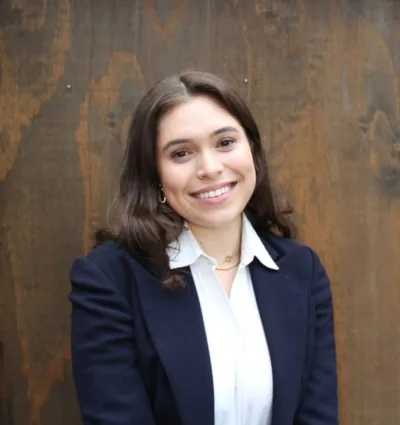
Nathalia Bernstein, Class of 2026
Transferring isn’t a shortcut, it’s a climb. Many of us start from distant horizons, like De Anza, Diablo Valley, or Santa Monica Community College, where the prospect of being admitted to Berkeley feels so far away. Many nights were spent navigating transfer websites like Assist.org, comparing unit requirements for each distinct school, and realizing that not every ‘transfer agreement’ guarantees a spot.
The interplay between college life and the real world taught us something no classroom can: grit. By the time transfer students arrive on a four-year campus, we’ve already learned how to advocate for ourselves, network from scratch, and turn every quiet stream of effort into rapids that propel us forward.
If you’re still in community college right now, start building those skills early. Form a relationship with your professors, ask for feedback, or join a transfer club. Those habits of curiosity, initiative, and persistence are the same ones that will help you thrive once you reach your dream college and, by extension, anywhere we go afterward.
STEP 2: CONFIDENCE WITHOUT ATTITUDE, NOT COMPARISON
At business school, it’s easy to feel like you’re behind when you’re a transfer student. Everyone around you seems to have a head start: summer internships, networks, and polished LinkedIn profiles. But transfer students carry something more powerful: tenacity.
At Haas, our education is built around four defining principles: Confidence Without Attitude, Question the Status Quo, Beyond Yourself, and Students Always. These resonate differently for transfers because we’ve already lived those core values. Indeed, many of us balanced full-time work with full-time school, commuted countless hours each way, or helped our families keep the lights on while working to keep our GPAs above 3.8.
Accordingly, the grind builds gratitude. It’s why we show up to every office hour, cohort event, club, or conversation. It’s not to prove ourselves, but to make the most of what we’ve yearned for.
For Nathalia Bernstein, that mindset began early in her family’s small tax office, where late nights and client calls taught her the value of perseverance and people skills.
“Since high school, I’ve worked at my family’s tax firm alongside my grandfather, a CPA. He taught me that accounting isn’t just about numbers: it’s about trust. Changing schools twice taught me how to adapt quickly, seek mentorship, and build community wherever I go. Those lessons guide how I show up at Haas — proactive, curious, and unafraid to ask questions.”
Her advice for aspiring transfers?
“Your transfer story is your strength. It shows adaptability, resilience, and initiative — the same traits Big Four firms and top employers look for… [and] believe that your path, even if unconventional, has uniquely prepared you to succeed.”

Tommy Zeng, Class of 2026
STEP 3: QUESTION THE STATUS QUO AND REDEFINE WHAT SUCCESS LOOKS LIKE
Transfer students don’t just bridge institutions: we bridge worlds. We bring perspectives shaped by lived experiences: first-generation students, working parents, immigrants, veterans, and dreamers.
When classroom cases turn to pricing strategy, we think of families who we’ve seen stretched thin by COVID-19. When we discuss “team dynamics,” we remember the jobs where teamwork meant keeping a restaurant’s gears turning on a late Friday night.
Our perspectives are rooted in the experiences we’ve lived. Through persistence, we’ve forged empathy that shapes how we see the world.
Tommy Zeng took a path even further from the conventional. After completing active duty in the United States Marine Corps, he enrolled at the City College of San Francisco before transferring to Haas and later joining the UBS Group.
That discipline and sense of mission didn’t end with his service. Instead, it evolved as he entered academia and later his career.
“In the military, I led overseas communication operations that emphasized teamwork and trust under pressure,” Tommy says. “Those experiences sparked my interest in how complex systems operate — which eventually led me to finance.”
Indeed, his transition wasn’t easy.
“Coming to Haas was a wake-up call. I had to adjust to a faster academic pace and learn to build relationships in a completely new environment,” he explains. “That experience taught me resilience — the same resilience that carried me through UBS recruiting. I treated every coffee chat, interview, and rejection as part of the mission.”
Tommy’s biggest lesson came once he arrived at Berkeley.
“At first, I felt like the least experienced person in the room,” he admits. “But I learned that humility paired with curiosity opens more doors than pretending to have all the answers.”
His perspective on success has shifted, too:
“I see success not as individual achievement but as the impact I have on my team and clients. At UBS, I measure progress by service, collaboration, and accountability — the same principles that got me here.”
Together, stories like Nathalia’s and Tommy’s remind us that there’s no single mold for success: every detour leads us to deeper roots and higher dreams. The most meaningful achievements aren’t defined by how straight the riverbed is — but by the courage to keep moving forward when it bends.
STEP 4: REMEMBER WHY YOU STARTED
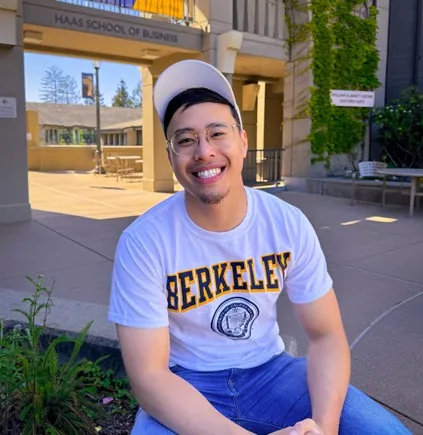
Henry’s first time visiting Haas (From: Henry Pham)
We are here because of hope. We stay here because we hustle. The communities we encounter, whether in a late-night Zoom study session or a campus courtyard, inherently serve as a reminder that education is a winding journey rather than a straight line.
As a transfer student myself, I still think back to the nights I studied on break between shifts or the mornings I caught the first bus to class, always wondering if the sacrifices would ever pay off. Those moments remind me why this path matters: every late night and early morning was proof that belief always comes before achievement.
So, if you’re reading this from a bus seat, library cubicle, or night shift break room, wondering if it’s too late— it’s not. By daring to dream, you’re already doing the hardest part by believing there’s something bright ahead.
That’s because what transfer students really bring to the table isn’t just ambition. It’s proof that opportunity, when met with persistence, can turn any detour into a destination.
Bio: Henry Pham didn’t take the “traditional” path to UC Berkeley’s Haas School of Business, but he’ll take late-night study grinds, leftover Chipotle bowls, and transfer student hustle any day. As a full-time employee, first-generation student, and champion of personal finance, he is here to transform real-life challenges into actionable plans. If there’s one thing he’s learned? Grit beats clout, and it’s not the perfect path that gets you there, but the unwavering conviction that you belong.
DON’T MISS: HOPE, HUSTLE, HAAS: 5 THINGS I WISH I KNEW BEFORE TRANSFERRING TO UC BERKELEY
© Copyright 2026 Poets & Quants. All rights reserved. This article may not be republished, rewritten or otherwise distributed without written permission. To reprint or license this article or any content from Poets & Quants, please submit your request HERE.


