






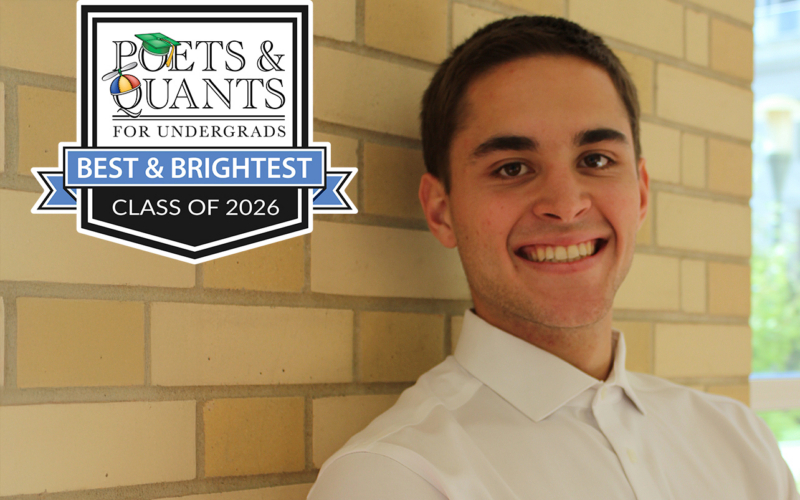
Buckley DeJardin
Carnegie Mellon University, Tepper School of Business
“Student-athlete navigating data and strategy. Driven, disciplined, and focused on turning analysis into actionable results.”
Fun fact about yourself: I appeared on Netflix’s Last Chance U, an IMDB Top 50 Netflix original series.
Hometown: San Gabriel, California
High School: St. Francis High School
Major: Business Administration, Additional Major: International Relations & Political Science
Favorite Business Course: My favorite business class is Business, Society, and Ethics (70-332). This class was especially engaging because it emphasized the responsibility businesses have beyond profit maximization. Additionally, I enjoyed the challenge of exploring ethical trade-offs embedded in business strategy. My favorite assignment included analyzing Collateralized Debt Obligations (CDOs) from a Natural Rights Libertarian perspective.
Extracurricular Activities, Community Work and Leadership Roles During College:
- Men’s Varsity Basketball – Team Captain
- Student-Athlete Advisory Council (SAAC) – MBB Representative
- UAA All-Academic Team, NABC District All-Academic Team
- Pennsylvania Special Olympics Golf/Basketball – Committee Member
- Scottie Ventures – Analyst
- Mortar Board and Pi Sigma Alpha Honors Societies
Where have you interned during your college career?
- Fidelity Investments (Boston, MA) – Equity Trading Intern
- American Enterprise Institute (Washington, D.C.) – Foreign Policy Intern
- Bates White Economic Consulting (Washington, D.C.) – Summer Consultant
Where will you be working after graduation? Bates White Economic Consulting (Washington, D.C.) – Economic Consultant I
Who is your favorite business professor? Professor Selman Erol is my favorite business professor at Carnegie Mellon. Although I never took his class, I worked with him on a research project for several years. Through our work, he taught me the importance of responsibility and intellectual rigor in research, while also helping me develop technical skills such as regression analysis and data visualization in Python and R.
What is the biggest lesson you gained from studying business? The biggest lesson I’ve learned from studying business is that all decisions involve inevitable trade-offs. I’ve enjoyed learning how to identify and quantify those trade-offs, along with evaluating them using rational, risk-adjusted analysis rather than intuition alone.
What advice would you give to a student looking to major in a business-related field? I would recommend diversifying your resume by trying professional experiences or academic courses outside of your field. Being able to differentiate yourself through interdisciplinary exposure helps you develop stronger problem-solving skills and communicate with broader audiences.
Looking back over your experience, what is the one thing you’d do differently in business school and why? One thing I would do differently at the Tepper School is participating in the International Consulting course that travels to CMU’s Qatar campus. Being able to experience business within an international context would have deepened my understanding of how cultural, political, and economic differences shape strategic decision-making.
What is one way that your business school has integrated AI into your programming? What is one insight you gained from using AI? One way that the Tepper School integrates AI into our programming is through our diverse requirement structure. Because we are encouraged and expected to explore classes that cover scientific reasoning and information literacy, we learn how to critically evaluate data, understand underlying models, and assess limitations. One insight I gained from using AI is that its value depends less on the tool itself and more on the quality of the questions, data, and human judgment guiding it.
Which academic, extracurricular or personal achievement are you most proud of? One personal achievement I am most proud of is consistently working 20+ hours per week throughout my undergraduate career across multiple roles: intramural officiating, desk supervising, grading, serving as a teaching assistant, and conducting research. Balancing these responsibilities alongside academic and athletic commitments required strong time management, discipline, and accountability.
Which classmate do you most admire? I most admire Kevin Sax, a former teammate and classmate of mine. I admire his knack for leadership and his steady commitment to being a role model both on and off the court. He was a great professional mentor of mine and showed consistent integrity in everything he did.
Who would you most want to thank for your success? I would like to thank my parents most for my success. They have been incredibly supportive of my pursuits and have consistently encouraged me to challenge myself. Through their example, they taught me the value of hard work, integrity, and humility, and they continue to serve as my strongest role models.
What are the top two items on your professional bucket list?
1. Lead the empirical analysis for a major expert report, designing the methodology, validating assumptions, and presenting findings that withstand cross-examination.
2. Become a key contributor to Bates White Community Connection (BWCC) and engage with supporting my new community in DC.
What made Buck such an invaluable addition to the Class of 2026?
“I am currently supervising Buck’s senior honor thesis on Iranian weapons transfers and alternative smuggling routes. I only take on one student thesis per year, and I am highly selective in my process. It was immediately clear to me when Buck reached out to me with his proposal and hypothesis, that I would select his for the 2025-2026 school year. In part, this is because Buck’s proposal is firmly rooted in the research that he has been conducting for the past 18 months—but in additional to this, he has a deep understanding of the research process itself. Buck’s proposal was highly sophisticated in its design, and something I would expect from a professional (not someone that is still a student). When I reached out to him recently to see what his primary sources would be, I was not surprised to learn that Buck was building a database of sources.
Equally important, is Buck’s integrity. This student is a team player. Buck shared with me that his identity as a basketball player has been a critical part of his character development. As a collegiate athlete, basketball has given him a great appreciation for discipline, teamwork, and working toward a shared goal. This is consistent with my own observations of this student in class. One anecdote that stands out to me, is a time when Buck realized that he had made a mistake on an application to a high-profile government agency (as it turns out, through no fault of his own). Buck rushed to make sure that a colleague of his, who was competing for the same position, was better prepared so that they did not repeat the error. A small observation that speaks volumes about this student’s true character and commitment to teamwork. I use this example of sportsmanship and character when I teach my students in Tomorrow’s Professionals, a course designed to teach students the value of professionalism and teamwork. This kind of character belongs in this field.”
Haleigh Bartos
Associate Professor of the Practice
DON’T MISS: 100 BEST & BRIGHTEST UNDERGRADUATE BUSINESS MAJORS OF 2026
© Copyright 2026 Poets&Quants. All rights reserved. This article may not be republished, rewritten or otherwise distributed without written permission. To reprint or license this article or any content from Poets&Quants, please submit your request HERE.


