



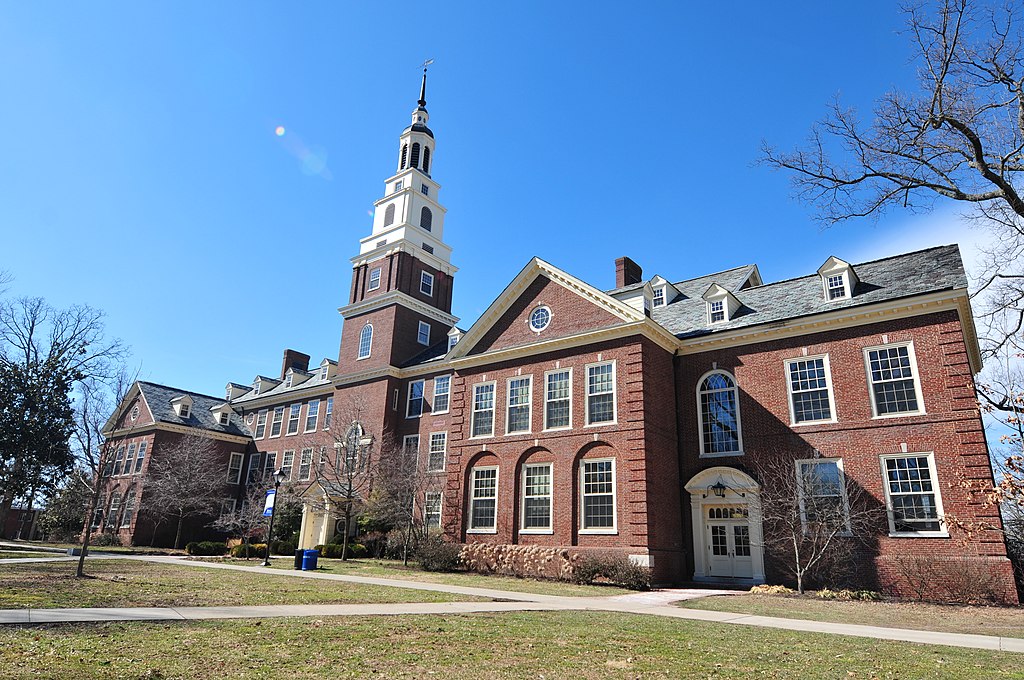
Berea College in Kentucky ranked No. 1 in Washington Monthly’s 2026 College Guide, recognized for its tuition-free model and commitment to low-income students.
Berea College did it again. The small Kentucky liberal arts college beat out Ivy giants like Princeton, MIT, and Harvard to earn the top spot in Washington Monthly’s 2026 Best Colleges for Your Tuition (and Tax) Dollars ranking.
But there’s plenty of movement underneath it. The 21th edition of the ranking that bills itself as an “answer to U.S. News & World Report” was released today with big jumps by schools like Harvard, and the University of Chicago compared to last year’s list.
Duke University rose 14 spots to No. 2. California State University–Northridge held at No. 3, University of Texas–Rio Grande Valley climbed three places to No. 4, and MIT moved up five to round out the top five. Harvard, meanwhile, jumped all the way from No. 28 last year to No. 6.
Washington Monthly’s Top 10 For 2026 |
|||||
Rank |
Name |
Net Price |
Earnings 4 Years After Graduation |
Student Loan Debt |
8-yr Grad Rate |
| 1 | Berea College (KY) | $4,297 | $42,924 | $3,591 | 66% |
| 2 | Duke University (NC) | $4,230 | $115,722 | $13,000 | 97% |
| 3 | CA State University–Northridge (CA)* | $6,270 | $59,664 | $13,872 | 71% |
| 4 | Univ. of TX–Rio Grande Valley (TX)* | $5,383 | $53,888 | $12,950 | 58% |
| 5 | MA Institute of Technology (MA) | $338 | $161,961 | $14,768 | 97% |
| 6 | Harvard University (MA) | $3,360 | $134,794 | $14,000 | 98% |
| 7 | Princeton University (NJ) | $3,074 | $108,590 | $10,320 | 98% |
| 8 | University of Chicago (IL) | $624 | $127,757 | $15,000 | 96% |
| 9 | CA State University–Los Angeles (CA)* | $3,793 | $59,756 | $13,000 | 68% |
| 10 | CA State University–Long Beach (CA)* | $7,146 | $63,140 | $14,289 | 83% |
| Note: Washington Monthly uses the average net price paid by first-time, full-time, in-state students from families earning below $75,000 per year, averaged over the three most recent years of data. It comes from federal IPEDS data | |||||
New this year, Washington Monthly ranked University of West Alabama in Livingston — population 3,436 — at No. 1 in its inaugural ranking of the Best Colleges for Rural America.
The new list furthers an argument the magazine has been making for two decades: The colleges doing the most for ordinary students don’t necessarily have the biggest endowments, most famous names, or hardest admissions offices to get through.
“We have never rewarded colleges for being exclusive,” Editor-in-Chief Paul Glastris told Poets&Quants last year. “In fact, we reward colleges for not being exclusive.”
BEREA’S SPECIAL SAUCE
Washington Monthly – a small, independent magazine focusing on public service, accountability, and policy – ranks schools not only on the return on investment a college provides, but on the good they return on society.
This year, it ranked 1,504 colleges compared to 1,421 in 2025. Schools had to award more bachelor’s than associate degrees, participate in federal financial aid, and meet minimum thresholds for enrollment and available data. Federal military academies and certain narrowly focused religious institutions are among those excluded.
The ranking is divided into four equally weighted portions:
- Access looks at both the number of Pell Grant recipients a college enrolls and whether it enrolls more Pell students than would be predicted based on factors such as test scores and the income distribution of its state.
- Affordability measures net price for students from families earning less than $75,000 as well as median federal student debt.
- Outcomes include graduation performance, the graduation gap between Pell and non-Pell students, alumni earnings compared with what would be predicted based on student characteristics, and the share of undergraduate alumni who later earn PhDs.
- Service measures participation in AmeriCorps, Peace Corps and ROTC; community engagement and voting efforts; and the share of degrees awarded in socially useful but often lower-paying fields such as health, education and social work.
It’s a methodology designed to make schools prove what they do with the students they enroll — rather than reward them simply for enrolling students who were already likely to succeed. (See WM’s detailed methodology metrics here.)
Take Berea College, a small school with less than 1,500 students about an hour from Lexington, Kentucky.
Founded by abolitionists in the 1850s, Berea was the first college in the South to educate both Black and white students, and to recruit women, Glastris says. It has remained tuition-free for more than a century. (Students pay for living expenses and books.)
The college almost exclusively serves moderate- and low-income students from Appalachia and ranks first nationally in Washington Monthly’s Pell recruitment measure. Its graduates carry an average $3,591 in student debt in this year’s data, while 66% graduate within eight years.
Some 93% of No. 4 UT–Rio Grande Valley’s 28,666 undergraduates are Hispanic and more than two-thirds are first-generation college students, according to the magazine. Its graduates earn $53,888 four years after graduation — $1,330 more than would be expected for students with similar backgrounds attending a typical college.
BEST COLLEGES FOR RURAL AMERICA
WP’s sprawling 2026 College Guide also ranks America’s best colleges for research and Hispanic-serving institutions as well as best colleges by region. Its accompanying essays tackle questions around college closures, unequal college search algorithms and how students should think about choosing a degree in the age of artificial intelligence.
Its biggest edition is a ranking aimed squarely at rural colleges, a category of higher education that rarely gets much national attention. Its Best Colleges for Rural America ranks 225 four-year nonprofit schools not simply for being located in small towns, but for how well they actually serve rural students and the communities around them. To qualify, schools had to be rurally located and relatively accessible, with acceptance rates of at least 75%.
The ranking then looks at whether those colleges enroll students of modest means, keep prices and debt manageable, and produce graduates who earn more than might be expected based on their backgrounds. It also rewards schools for recruiting students from within their own states, keeping graduates there after college, and producing degrees in fields particularly important to rural economies, including teaching, nursing, engineering, agriculture, natural resources, public administration, and social services.
At No. 1 is University of West Alabama, a public university in Livingston, a town of just 3,436 people in Alabama’s Black Belt. Founded as a teacher’s college, more than a quarter of its undergraduates and more than three-quarters of its master’s students earned education credentials in 2024. Its College of Education offers scholarships of up to $10,000 for students committed to public-school teaching, and the university is home to a Center for Reimagining Rural Education.
Some 65% of West Alabama students graduate in education or another field that Washington Monthly classifies as in short supply in rural areas, the highest share of any school in the ranking. UWA also finished first on the ranking’s earnings-performance measure. Its graduates earn a median $64,122 four years after leaving college, about $26,561 more than the magazine estimates graduates with similar backgrounds would earn after attending a typical college.
Washington Monthly’s Top 10 Best Colleges For Rural America 2026 |
||||||
Rank |
School |
Pell Recipients |
Earnings 4 Years After Graduation |
Net Price |
Student Loan Debt |
Degrees In In-Demand Rural Fields |
| 1 | University of West Alabama (AL)* | 53% | $64,122 | $13,182 | $24,944 | 65% |
| 2 | Sul Ross State University (TX)* | 55% | $49,811 | $10,546 | $15,900 | 43% |
| 3 | Georgia Southwestern State University (GA)* | 41% | $62,132 | $11,399 | $18,851 | 35% |
| 4 | University of the Cumberlands (KY) | 50% | $51,882 | $10,099 | $14,911 | 31% |
| 5 | Texas A&M–Kingsville (TX)* | 54% | $56,982 | $9,808 | $22,934 | 43% |
| 6 | Southeastern Oklahoma State University (OK)* | 41% | $56,329 | $5,773 | $17,000 | 48% |
| 7 | Northeastern State University (OK)* | 43% | $50,752 | $9,897 | $17,367 | 23% |
| 8 | Cal Poly Humboldt (CA)* | 46% | $51,571 | $9,877 | $18,000 | 35% |
| 9 | SUNY Potsdam (NY)* | 43% | $49,169 | $11,321 | $24,250 | 45% |
| 10 | University of Nebraska–Kearney (NE)* | 35% | $56,647 | $14,307 | $19,500 | 42% |
| Note: “Degrees in In-Demand Rural Fields” is the share of a college’s graduates earning degrees in academic areas that Washington Monthly says are especially important to rural communities but often face worker shortages. For the 2026 rural ranking, those fields include agriculture, natural resources and conservation, parks and recreation, engineering, health professions, public administration and social services, and education. |
||||||
See Washington Monthly’s full 2026 ranking issue here.
DON’T MISS: PRINCETON REVIEW’S 2027 BEST COLLEGES: TOP SCHOOLS FOR CAREER SERVICES, HAPPY STUDENTS, AND LOTS OF BEER AND THE B-SCHOOLS THAT CONNECT STUDENTS TO TIME’S TOP STARTUP INCUBATORS & ACCELERATORS
© Copyright 2026 Poets & Quants. All rights reserved. This article may not be republished, rewritten or otherwise distributed without written permission. To reprint or license this article or any content from Poets & Quants, please submit your request HERE.


