

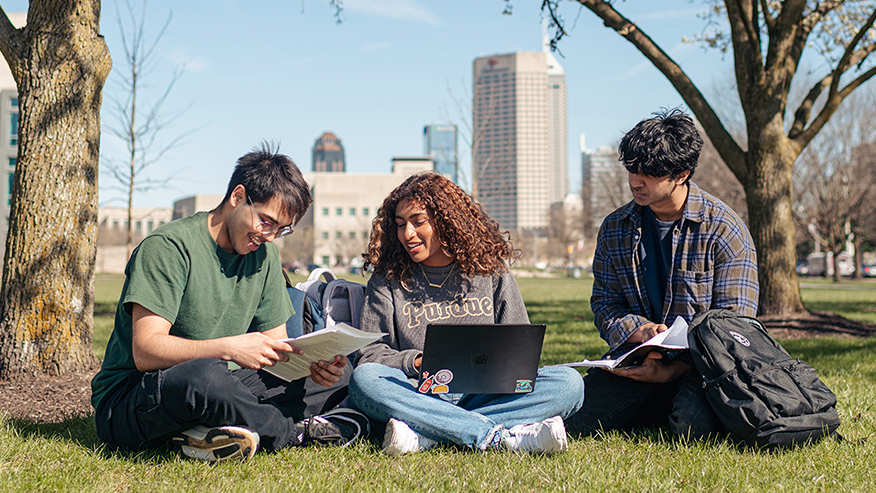
Purdue University has received a $20 million commitment from the Ricks Family Foundation to establish the Purdue Institute for Healthcare Systems Innovation within the Mitch Daniels School of Business. The institute will be based at the university’s Indianapolis location. (Purdue University photo)
PURDUE RECEIVES $20M GIFT TO LAUNCH HEALTHCARE SYSTEMS INNOVATION INSTITUTE
Purdue University has secured a $20 million commitment from the Ricks Family Foundation to establish a new institute focused on healthcare systems innovation. The institute will be housed within the Mitch Daniels School of Business and based at Purdue’s Indianapolis location.
The new Purdue Institute for Healthcare Systems Innovation will focus on improving the efficiency and effectiveness of healthcare delivery. It will examine how treatments, devices, and care pathways are priced, reimbursed, and adopted, with an emphasis on cost-benefit analysis and policy design.
The institute will draw on expertise across disciplines, including engineering and pharmacy, to study healthcare from both economic and clinical perspectives. University leaders say this cross-functional approach is key to addressing complex challenges in the U.S. healthcare system.
Locating the institute in Indianapolis places it close to major hospital systems, insurers, and medical technology firms. The proximity is intended to connect research with real-world practice and policy, allowing findings to inform decisions across the healthcare ecosystem.
The gift also supports broader university priorities, including its One Health initiative and expansion in Indianapolis. Leaders say the institute will serve as a central hub for research and collaboration, with new leadership roles and operations set to be established in the coming phases.
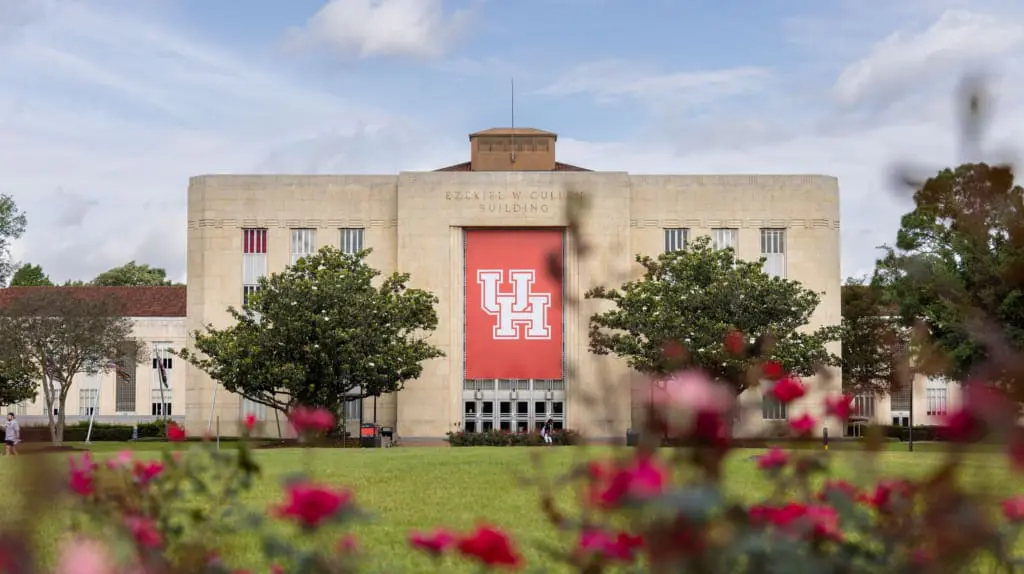
The University of Houston ranked among the top 100 U.S. institutions for utility patents granted in 2025. (University of Houston photo)
UNIVERSITY OF HOUSTON BUILDS INNOVATION PIPELINE THROUGH PATENTS AND STARTUPS
The University of Houston is strengthening its position as an innovation hub, driven by steady gains in patents and startup activity. The university system ranked among the top 100 U.S. institutions for utility patents granted in 2025, highlighting its focus on turning research into real-world applications.
The ranking, compiled by the National Academy of Inventors, placed the University of Houston System No. 64 nationally and No. 3 in Texas, based on 32 utility patents issued last year. These patents give inventors exclusive rights to commercialize new technologies and are often seen as a key measure of innovation output.
Recent inventions span a range of fields, from robotic prosthetics that improve mobility to research aimed at extending battery life. Faculty are also working on materials that could make artificial intelligence devices faster while reducing energy use, reflecting the university’s emphasis on energy and technology research.
Beyond research, the university is focused on commercialization. Its Technology Bridge and Innov8 Hub support students and faculty in launching startups based on their inventions. That effort has led to record-setting years for startup creation, helping drive regional economic development and workforce growth.
University leaders say the goal is to build a cycle where research leads to startups, which in turn fuels more innovation. Recent recognition of seven faculty members as senior members of the National Academy of Inventors further signals the university’s growing influence in research and commercialization.
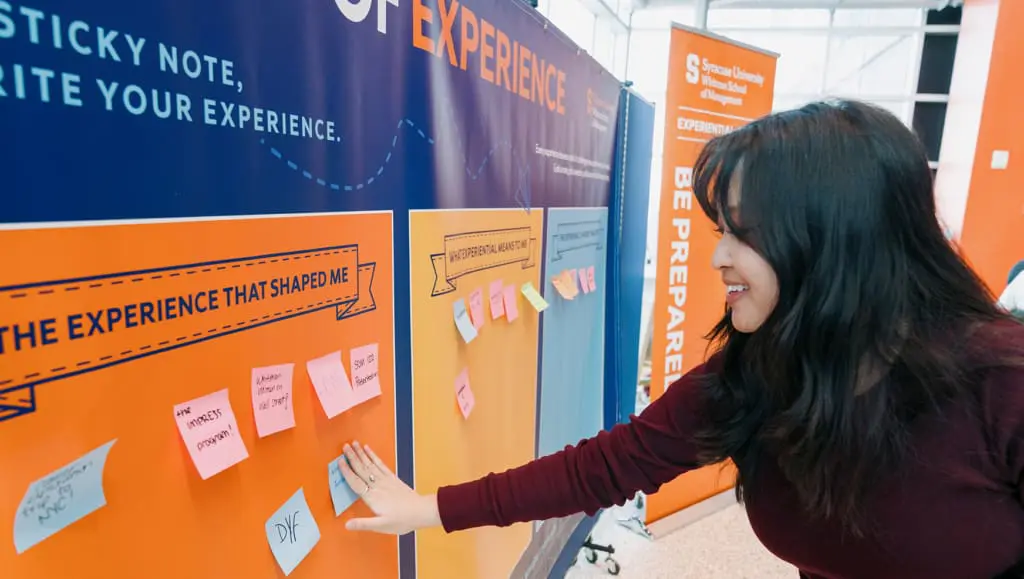
Students collaborate on a project at the Whitman School of Management, where a new Experiential Center brings together hands-on programs like global immersions, case competitions, and consulting projects under one coordinated structure.
SYRACUSE WHITMAN LAUNCHES EXPERIENTIAL CENTER TO UNIFY HANDS-ON LEARNING
The Whitman School of Management at Syracuse University has launched a new Experiential Center, bringing together its applied learning programs under one coordinated structure. The move is part of the school’s Transformation 2030 plan, which aims to strengthen student outcomes through hands-on education.
The center serves as a hub for programs that were previously spread across the school. These include global immersions, case competitions, study away opportunities, consulting projects with companies, the Goodman IMPRESS professional development program, and the Orange Business Angel Network. The goal is to create a more connected experience for students.
Leaders say the effort is designed to make experiential learning a core part of every student’s path. The center is organized around four pillars: global exposure, innovation, collaboration, and career readiness. Each pillar is meant to guide how students build skills over time.
Students will move through a sequence of experiences during their time at Whitman. Early coursework may include applied AI projects, followed by immersive programs, competitions, and consulting work with companies. Later opportunities can include venture analysis through the school’s angel network, giving students exposure to investment decisions.
The center will also rely on alumni and employer partnerships to deliver these experiences. Industry mentors will help guide projects and coach student teams, while also expanding professional networks. School leaders say the model is meant to connect classroom learning with real-world application at every stage.
SHMS PARTNERS WITH CHENG CHUNG DESIGN TO EXPAND HOSPITALITY DESIGN TRAINING
Swiss Hotel Management School has partnered with Cheng Chung Design to strengthen its hospitality design specialization within the Bachelor of Arts in International Hospitality Management program. The collaboration is aimed at giving students more direct exposure to industry practices and design management.
The agreement focuses on connecting academic learning with real-world design work. CCD will work with SHMS to share industry insights and support knowledge exchange in design management, helping students understand how design shapes hospitality experiences.
The partnership also creates new career pathways. CCD will engage with students and graduates for internships and job opportunities, offering a direct link to one of the leading firms in hospitality design. The goal is to give students clearer entry points into the industry.
As part of the agreement, the two organizations will introduce an annual Leadership Excellence Award in design. The award will be presented at graduation and recognize students who demonstrate strong leadership and alignment with industry standards.
School leaders say the collaboration reflects a broader push to blend creativity with operational skills in hospitality education. By aligning with a global design firm, SHMS aims to better prepare students to design and manage hospitality environments that meet both business and guest needs.
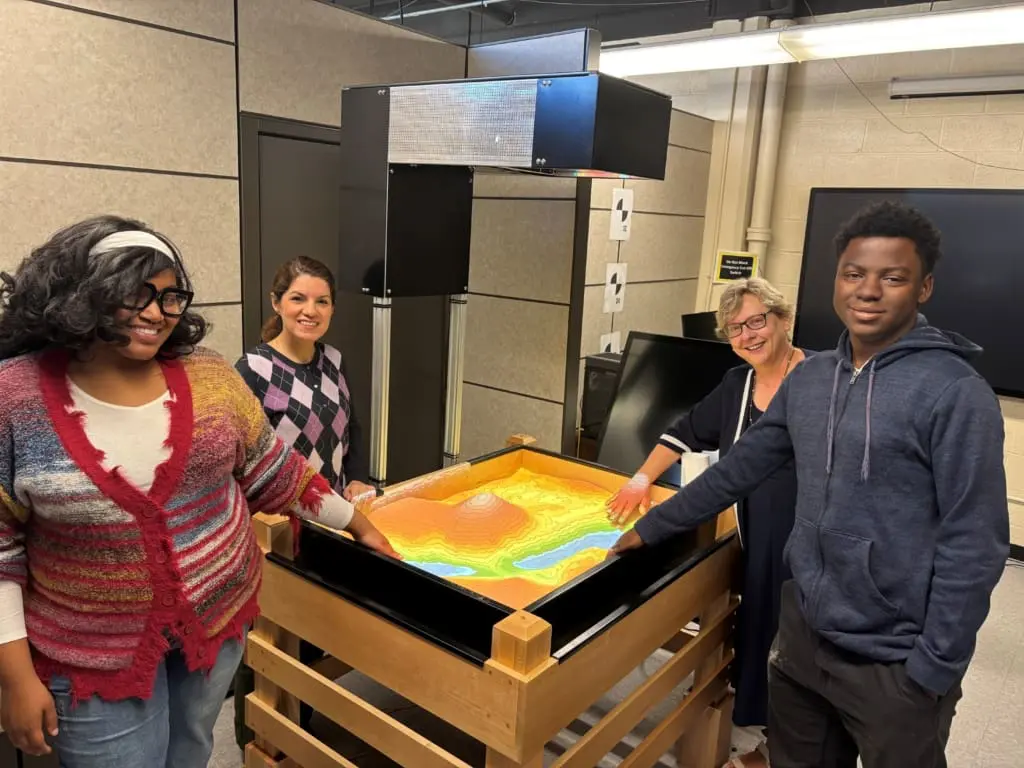
Undergraduate researchers at North Carolina Agricultural and Technical State University work on projects using data and economic analysis to address coastal flooding risks and develop new clean energy solutions.
N.C. A&T STUDENTS DRIVE RESEARCH IN COASTAL RESILIENCE AND CLEAN ENERGY
Undergraduate students at North Carolina Agricultural and Technical State University are contributing to federally funded research projects focused on coastal resilience and sustainable energy. Backed by more than $2 million from NASA and the U.S. Department of Energy, the work blends science, economics, and data analysis to address environmental and economic challenges.
One project, funded by NASA and conducted in partnership with Morgan State University, is developing a geospatial risk assessment tool. The tool uses Earth observation data to help East Coast communities identify infrastructure vulnerabilities and plan for flooding. Students are helping assess the economic impact of flooded croplands in eastern North Carolina, adding a financial lens to the research.
At the same time, a Department of Energy-backed project is exploring a new approach to energy production. Working with the University of Wyoming, researchers are testing a plasma-catalytic process that converts methane and carbon dioxide into usable chemical products. The project also examines the potential economic and workforce impacts tied to this emerging technology.
Students involved in both initiatives are building dashboards and applying quantitative tools to translate research into practical insights. Their work is aimed at helping community planners and local stakeholders identify new opportunities tied to energy development and climate adaptation.
Faculty leaders say the projects reflect a broader push toward interdisciplinary learning. By combining economics with environmental science and engineering, students gain experience that prepares them for careers in research, policy, and data-driven decision making. The work also highlights how universities are linking academic research to real-world challenges facing communities.
DON’T MISS: MEET THE 19-YEAR-OLD GRADUATE COMBINING DATA SCIENCE DEGREE WITH NAVY SERVICE AND REPLACE OR REINVENT? B-SCHOOLS CONFRONT UNCERTAINTY AROUND AI, JOBS, AND THE B-SCHOOL PIPELINE
© Copyright 2026 Poets & Quants. All rights reserved. This article may not be republished, rewritten or otherwise distributed without written permission. To reprint or license this article or any content from Poets & Quants, please submit your request HERE.


