



Bachelor students from around the world study together at three of ESCP’s five campuses, each located in a different European city: Paris, Berlin, London, Madrid, and Turin.
ESCP Business School in France is launching two interdisciplinary bachelor’s degrees tied to its plan to transform into a broader European university.
A new three-year Bachelor in Management, Science & Technology will serve as a flagship program for the ESCP School of Technology, which is scheduled to open in 2027. At the same time, a four-year dual degree in politics, economics and management, created with Sciences Po, signals the academic direction of ESCP’s planned School of Governance, expected to launch in 2029.
Both programs will welcome their first cohorts in fall 2027, enroll about 40 students and move them across multiple European campuses. Together, they represent ESCP’s effort to move beyond the traditional boundaries of a standalone business school and become what it calls the first European University of Management by 2030. This vision led to ESCP’s selection as Poets&Quants’ Business School of the Year for 2025.
“We are not building a comprehensive university with silos,” Cédric Denis-Rémis, dean of the new School of Technology, tells Poets&Quants. “We are building a hybrid university in the field of management.”
THREE YEARS, THREE EUROPEAN CAPITALS
ESCP first unveiled its School of Technology as part of Bold & United, its strategic plan for 2026 through 2030. The idea is not to turn ESCP into an engineering school, but to bring science and technology and into the education of future business leaders.
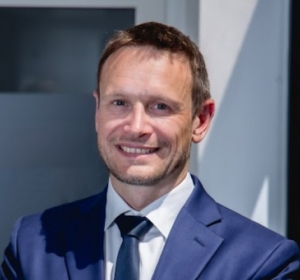
Cédric Denis-Rémis, Dean of the ESCP School of Technology
The new Bachelor in Management, Science & Technology is aimed at students who are interested in business but do not want to give up physics, chemistry, biology or mathematics.
Like ESCP’s flagship Bachelor In Management, students will study at three different ESCP campuses during the three-year program. The inaugural BSc cohort will spend their first year at ESCP’s Paris campus, their second in Turin, Italy, and their third in London.
Later intakes may have additional options in Berlin and Madrid as enrollment grows.
And while ESCP’s official materials describe an inaugural class of around 40, Denis-Rémis has a more precise number in mind: 42.
It is a reference to Douglas Adams’ The Hitchhiker’s Guide to the Galaxy, in which a supercomputer spends millions of years calculating the answer to the ultimate question of life, the universe and everything. The answer is 42.
“That’s why in my program I have 42 professors in my scientific advisory board, and I will start with 42 students,” Denis-Rémis says.
BRIDGING BUSINESS AND PUBLIC AFFAIRS
ESCP’s second new bachelor’s degree applies the same hybrid philosophy to politics and public affairs.
The Bachelor in Politics, Economics and Management, developed with Sciences Po, a selective French university renowned for political and social sciences, will combine those disciplines with management education.
Students will spend their first two years at Sciences Po’s campus in Reims, France. They will move to ESCP’s London campus for their third year, then finish at one of ESCP’s campuses in Berlin, Madrid, Turin or Paris. International exchange opportunities will also be available.
After four years, graduates will receive both a Sciences Po bachelor’s degree and ESCP’s Bachelor in Management degree.
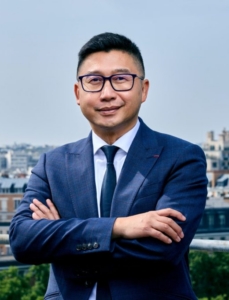
ESCP Dean Leon Laulusa
“Business leaders need to understand not only markets and organisations, but also the political, social and regulatory forces that shape them,” outgoing ESCP Executive President and Dean Léon Laulusa said in the program announcement.
“We are creating a new educational model that combines intellectual depth, international exposure and practical management expertise. Our graduates will be exceptionally well prepared to lead across sectors and geographies.”
The fully English program will also begin in the 2027–2028 academic year with about 40 students recruited from around the world.
Graduates could move into the public, private or nonprofit sectors or continue into a master’s program at ESCP, Sciences Po or another university. The two institutions will offer scholarships based on academic excellence and financial need, including awards providing full tuition exemptions.
SKILLS AI CANNOT AUTOMATE
While artificial intelligence transforms our relationship to knowledge, it makes the skills that cannot be automated even more valuable. Those include critical thinking, sound judgement, and the ability to connect different disciplines, says Sciences Po President Luis Vassy.
“By combining the humanities and social sciences with the fundamentals of management, we are creating a unique dual degree programme with ESCP. It will help our students better understand the world’s complexities and, in the future, come up with well-informed solutions.”
The politics, economics and management degree is also an early academic building block for ESCP’s planned School of Governance. That school is expected to address geopolitics, public policy, and governance within both private and public organizations.
The three-school structure — business, technology and governance — reflects ESCP’s view that future executives will not be able to treat markets, technology and politics as separate forces.
Students need to understand competition between the U.S. and China over emerging technology, Denis-Rémis says, just as they need to understand war, regulation, culture and differences between political systems.
“The world is not simple to be black or white,” he says. “We need to prepare them for this complex world.”
FOR STUDENTS WHO WANT BUSINESS, SCIENCE — AND EUROPE
Denis-Rémis describes the ideal candidate for the Bachelor in Management, Science & Technology as an academically strong 17- or 18-year-old who feels pulled between business school and a more traditional science or engineering education.
In France and other European systems, students often specialize relatively early. A student choosing a business-oriented preparatory track may leave laboratory sciences behind. A student selecting engineering may receive little exposure to marketing, finance or organizational leadership.
“If you don’t like mathematics, you don’t like physics, it’s not for you,” he says. Applicants will be expected to demonstrate a genuine interest in at least one scientific discipline, whether mathematics, physics, biology or chemistry. They will not have to be equally advanced in all four.
ESCP’s Bachelor in Management enrolls nearly 3,000 students from more than 100 nationalities, making it one of Europe’s most internationally immersive undergraduate business programs. Denis-Rémis expects the science and tech bachelor’s to be just as international.
For American students, ESCP offers a fully English-language degree built across three European countries and completed in three years. The school is also investing €320 million to modernize its campuses, including €150 million for its historic Paris République campus.
Cost could offer another advantage. For non-European students, annual tuition is about €27,800, putting the three-year tuition total at about €83,400 (or about $95,000). That’s less than half the four-year tuition and fees charged by the big brand U.S. business schools.
The program will remain slightly weighted toward management, in part because ESCP expects most graduates to continue into a master’s program or pursue careers in business. But they should leave able to communicate with engineers, scientists and doctors while making better decisions in industries shaped by complex science.
FIVE CURRICULAR BLOCKS
The degree’s three-year curriculum will be divided into five broad blocks.
The first is management, preserving the business foundation expected from an ESCP degree. The second covers soft skills, design, humanities, psychology and interactions between humans and machines.
The third combines computer science, data science and mathematics. The fourth, which Denis-Rémis describes as the most novel, focuses on scientific literacy through physics, chemistry, biology and scientific methodology.
The fifth block is experiential. Students will apply what they learn through supervised exercises, scientific projects, experimental work, hackathons, industry collaborations, and immersion experiences.
Students might build drones in a mechatronics project, for example, requiring them to draw on physics, thermodynamics, communications technology, data and programming rather than treating each discipline as a separate academic box.
Across required courses and electives, students will receive more than 280 hours of science and technology instruction each year. They will also be able to specialize in areas including artificial intelligence and deeptech, energy and climate technologies, biotechnology, and defense and cybersecurity.
The school is trying to identify knowledge that will remain useful even as individual technologies rise and fall.
“This is what I promise to the family: In 20 years, the knowledge they will learn in the school will still be useful in their life,” Denis-Rémis says.
BUILDING A FACULTY FROM THE GROUND UP
Denis-Rémis plans to hire 50 permanent faculty members for the School of Technology over the next five years.
Early recruiting will focus on fields including applied mathematics, physics and biology, areas Denis-Rémis sees as closely connected to the real economy.
The new faculty will belong to ESCP rather than operate as a detached scientific unit. Denis-Rémis expects them to collaborate with professors in finance, entrepreneurship, strategy, marketing and other management disciplines.
Students, likewise, will remain ESCP students. They will share facilities, student organizations and campus life with peers in the business school and, eventually, the School of Governance.
Denis-Rémis joined ESCP after serving as vice president for innovation, entrepreneurship and business models at France’s PSL University. A professor of entrepreneurship, his specialty is deeptech and translating scientific discoveries into companies and commercial ventures.
The School of Technology, he says, is in some ways a return to business education’s roots. European commercial schools once taught subjects such as physics and chemistry because merchants needed to understand machinery, materials and the products they transported. Over time, business schools narrowed their focus to management, economics and finance.
“The idea is just to bring science back,” Denis-Rémis says.
DON’T MISS: 3 YEARS, 3 COUNTRIES, 1 ‘SIGNATURE EXPERIENCE’: INSIDE ESCP’S PIONEERING BACHELOR BUSINESS DEGREE AND WAKING A ‘SLEEPING BEAUTY’: POETS&QUANTS NAMES ESCP OUR 2025 BUSINESS SCHOOL OF THE YEAR
© Copyright 2026 Poets & Quants. All rights reserved. This article may not be republished, rewritten or otherwise distributed without written permission. To reprint or license this article or any content from Poets & Quants, please submit your request HERE.


