




Sharon F. Matusik has been reappointed dean of Michigan Ross through July 2032 as the school expands its reach and prepares students to lead in an AI-driven economy.
Sharon F. Matusik wasn’t looking for another job when a recruiter called from the University of Michigan.
She had spent five years leading the University of Colorado’s Leeds School of Business, overseeing record fundraising, launching two MBA programs for working professionals, and expanding its research faculty by 41%. She had also forged closer ties between business and engineering, including a new building connecting the two schools.
But Michigan’s Ross School of Business had an undeniable pull.
“When I think about my field, strategy and entrepreneurship, some of the biggest ideas in the field absolutely came out of the University of Michigan,” Matusik tells Poets&Quants. “I loved my time at Colorado. We did a lot of great things at Colorado, but it’s just been such a privilege to be here.”
Now, four years after she arrived in Ann Arbor, Matusik is getting another term to build on that foundation. The University of Michigan Board of Regents voted October 15 to extend her appointment as Ross dean through July 2032.
The reappointment comes as several of the dean’s priorities are materializing at Ross. The B-school – which ranked No. 9 in Poets&Quants’ most recent MBA ranking and No. 4 in our undergraduate ranking – has opened a Los Angeles campus for executive education and Executive MBAs and welcomed its first class of undergrads into its four-year business and engineering dual-degree program.
Q&A WITH SHARON F. MATUSIK
In her new term, Matusik will have to confront larger, more prickly questions about the future of management and higher education in general. A big one is the United States’ ability to attract international talent during and after the era of Trump. Ross deliberately scaled back its international MBA share to around 30%, from a typical range of 35% to 40%, she tells Poets&Quants.
Another big question for almost every dean in the world: When AI can put information at almost anyone’s fingertips, what should students expect a business school to teach them?
“If you just think your value add is having deep content knowledge, you’re missing the mark,” she says. “How do you put these pieces to productive use? How do you think about the context more broadly?
“That, to me, is an important takeaway: You still must execute. You still have to exercise judgment. There’s a huge human element in terms of your ability to motivate a team or an organization to act.”
Matusik is building her answer to the AI question on Ross’s longstanding emphasis on action-based learning. The school has piloted career-focused learning sprints for MBA students and is developing a dashboard to track collaboration skills across classes and semesters. Because more students want control over their careers in the age of AI, the school is expanding entrepreneurship through acquisition and innovation offerings.
Since arriving in Ann Arbor in 2022, one of Matusik’s biggest surprises has been the power of the “Go Blue” mantra.
“The academic excellence absolutely was no surprise. But to see how accomplished the alumni are, how connected they are, and how much they’re willing to reach back and help people coming behind them. It is remarkable,” she says.
“People say that if you wear a baseball cap or a Michigan logo, whether you’re in the Denver airport or walking the streets of Lisbon or Cairo, people will yell out, ‘Go Blue!’ And it’s absolutely true.”
Poets&Quants sat down with Matusik just before her reappointment to talk about what’s changing at Ross, the value of a business degree in an AI era, and the challenges of leading a business school through political and economic uncertainty. Our conversation has been edited for length and clarity.
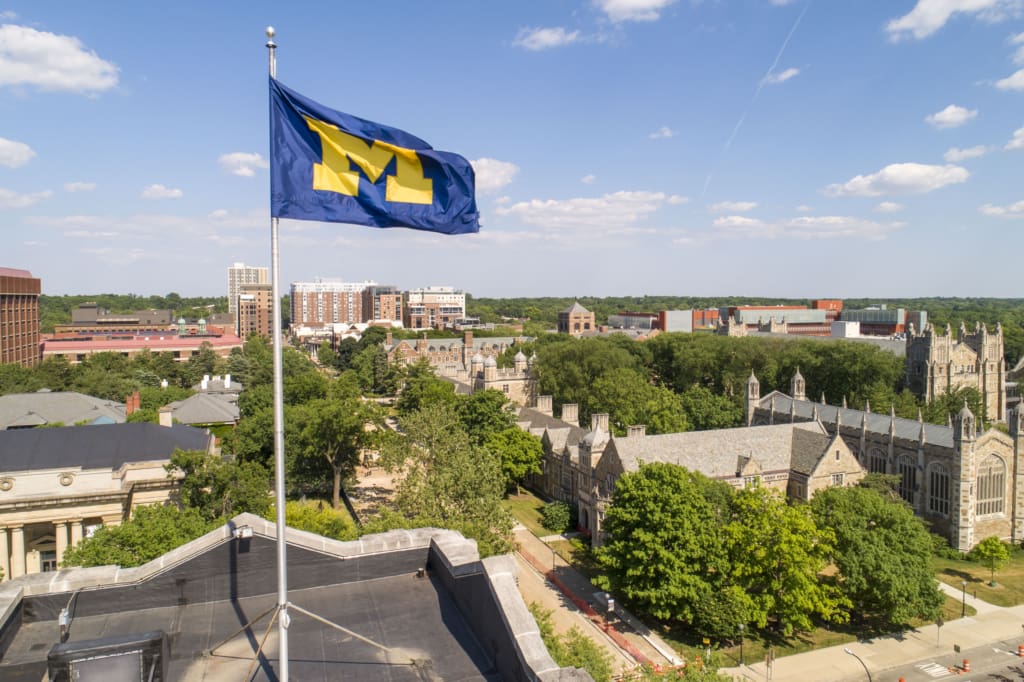
Drone Aerial photos across the University of Michigan’s central campus. Credit: Roger Hart
Coming into a school like Ross, what were some of the things you wanted to work on? You can’t come in and say, “I’m changing everything.” What were your big goals?
That’s a great question. I’m a strategy professor, so, as you would expect, I take a resource-based view. I spent a lot of time really trying to understand: What are the resources and capabilities here? What makes us special? And then how can we leverage that, given what’s going on around us?
To me, it really came down to four things that I think stand out about the University of Michigan and our business school.
One, excellence. The academic excellence here is phenomenal. One illustration of that is, when I look at the incoming freshman class, we get about 13,500 applications for 500 spots. The talent is just amazing. It’s true at the MBA level as well, and at the faculty and staff level. So that was a standout in thinking about what makes us stand apart.
Second, action. We have a really strong orientation around action-based learning and also a bias toward action. If you talk to alums or employers, they love Ross graduates because they’ll get in there and figure it out. They have analytical skill sets, for sure, but they’re problem-solvers, roll-up-their-sleeves kind of people.
When I talk to alums, they almost always will bring up their MAP (Multidisciplinary Action Project) experience and how that really helped to shape their career opportunities down the line. I think that’s always been important, but with AI, I think even more so. As we work out how we best teach about that and how we give students the skills they need, the expectations on the employer side are that graduates are coming out being able to do even more.
I think that’s what action-based learning teaches. The problem is not well defined. You have all these tools. You have access to all sorts of information. What’s important? What’s not important? How do you move forward? So we’ve really doubled down on action-based learning.
The signature learning experiences are an action-based learning kind of sprint, I would say, to complement what we’re doing on action-based learning.
The third Ross signature is impact. People care about making economic value add as well as social value add, and being thoughtful about the consequences of their actions.
And then the fourth piece is community, like the whole Go Blue pride thing. Those are the resources and capabilities that we’ve been working to leverage.
What are some examples of how you’re putting those priorities into practice?
Our first class of freshmen in the business and engineering dual-degree program just started. That’s really exciting.
We’ve launched some other really interesting classes that are action learning oriented, like a business of art class that’s co-taught with our museum. The project for the students is to recommend a piece of art for the permanent collection, then we fundraise to buy the art with a $50,000 fund each year. To have the business students together with the art orientation is really cool. It was also co-taught by a curator.
We also launched a campus in L.A. It gives us a lot more opportunities to leverage our EMBA out there and a lot of the non-degree exec ed that we do up and down the West Coast, over to Asia, over to the Middle East.
Tell us a little more about the new business and engineering dual degree. What makes it distinctive, and how do the two sides of the program fit together?
We think it’s a really amazing program because it’s an integrated BBA and BS in engineering that you can do in four years. It’s not easy, you take a really rigorous set of courses. If you think about undergrad programs, there are relatively few universities that have top-five engineering programs.
The other thing that’s really distinctive about it is they’re all cohorted for their business core. That means that every basic business class they take, they’re in the same section. So it gives faculty the chance to really focus on technology management, innovation, entrepreneurship, and really customize it for that audience.
On the engineering side, they can do what they want to do, so it accommodates a chemical engineer or a civil engineer or computer science.
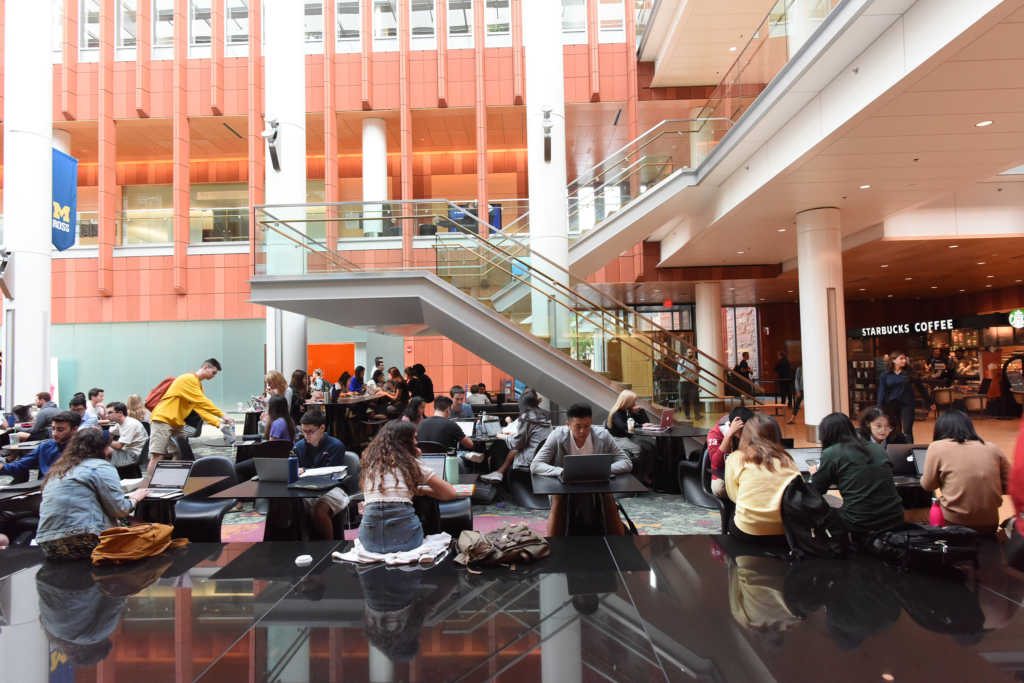
The Winter Garden at the University of Michigan’s Ross School of Business. Dean Sharon F. Matusik is doubling down on action-based learning as Ross prepares students to lead in an AI-driven economy.
In your 2026 resolutions submitted to Poets&Quants, you called this the “golden age for builders.” What do you mean?
I think it really speaks to our bias toward action, and what we’ve also been building out from our entrepreneurship and innovation offerings.
We see increasingly more students, on the MBA side in particular, who come in and really want to run a business. They may or may not have the brilliant idea on their own. So we’re pairing them with, for example, Innovation Partnerships, the university’s office that helps commercialize research. The students evaluated a technology developed here at the University of Michigan to figure out: Is there a commercial path forward?
We’ve been really scaling up our entrepreneurship through acquisition offerings as well as coaching and mentorship. If you want to come in and buy into a business that you feel you can modernize and take to the next level, we’re making sure we’ve got the right sorts of skills and experiences for students.
Then carrying that over across all of our programs—that really hands-on approach to coming up with the new business model. Even when we think about AI and what we’re doing in the AI space, of course, we want students to have the tools to do the same tasks but more efficiently. That’s a given. But we’re also trying to give them the skills and experiences so that they can come up with the new business models.
I do feel like, for this generation of students going through business school now, they’re the ones who are going to disrupt all these industries. It’s not going to be the incumbent firms that have all the embedded routines and activities and ways of doing things.
We’re trying to reinforce that in the classroom, of course, but also through this speaker series we’ve had on AI business model transformation. Mary Barra came out and talked about what’s going on in the auto industry at GM. We had Matt Baer, the CEO of Stitch Fix. He came out and talked about retail and what’s going on in the retail space. Jamie Dimon was talking about banking and finance.
We just had Rich Lesser, BCG’s global chair, out talking about consulting—that’s going to be majorly disrupted. What does that look like?
We’re trying to not only talk about it in the classroom, but also have people who are clear leaders in that field talk about what they see as the broader landscape and what they’re doing about it. So really trying to give the students the skills so that they can go out and pioneer and build the new model.
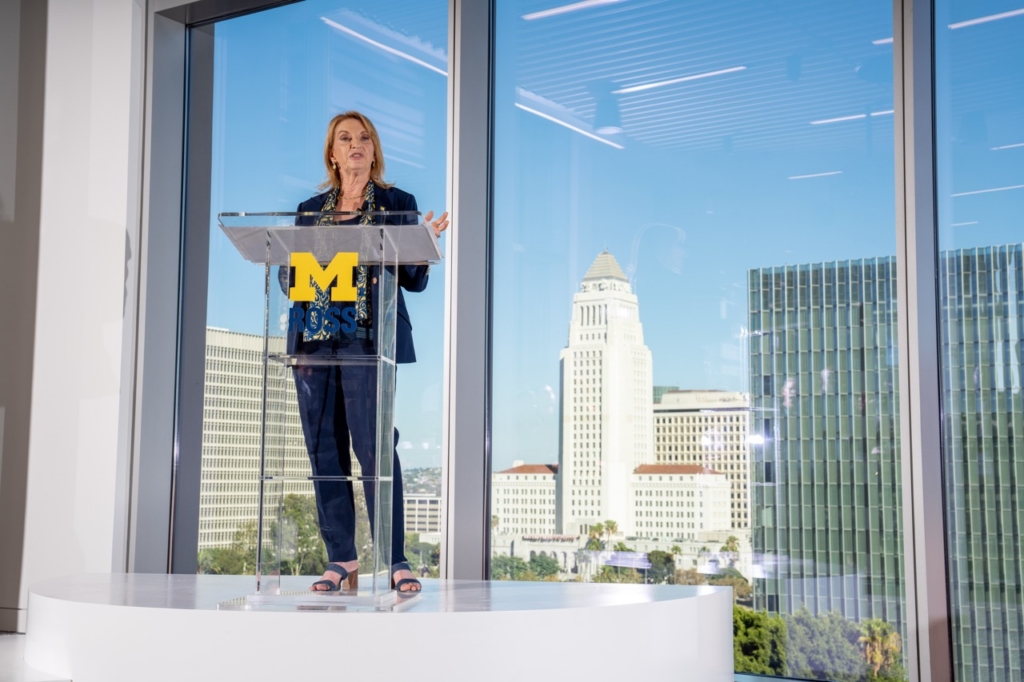
Michigan Ross Dean Sharon F. Matusik at the ribbon cutting for the school’s new Los Angeles campus, which expands its West Coast presence for Executive MBA students and executive education. Courtesy photo
When you think about the traditional MBA pipelines and what AI is going to do to those, entrepreneurship seems almost like a kind of protection. What do you think about that idea? Do you think there’s going to have to be more of an entrepreneurial emphasis in business schools?
For sure, I do. And I also see with our students, because there’s so much uncertainty out there, they want more control.
Of course, there’s always going to be a good number who want to be in consulting and investment banking and private equity, and we’ve got lots of things to support them. But I think you’re seeing more students who want to say, “Hey, I don’t want to be beholden to some organization that’s going to restructure, and I might be in, might be out. I want to be in the seat of the decision-maker.”
So I do think we’re seeing a lot more interest in that. And, by the way, it coincides with this huge intergenerational transfer of ownership of these businesses. You probably saw there was an article recently that Jamie Dimon penned, talking about how these companies don’t have succession plans. It’s a huge thing.
I think it’s a real opportunity, especially because you’ve got all sorts of people going to business school. Some are more creative; they might have the idea themselves. But a lot just love business.
With students and families questioning whether a four-year degree is worth the time and money, some European programs offer a three-year alternative at a fraction of the cost. Has Ross felt pressure to shorten its degree or address concerns about tuition?
Great question. There haven’t been any serious campus-level discussions. I will say I think a Michigan degree is such a great deal if you’re an in-state student. The other thing we’re really proud of is, if you’re a Michigan resident and your family income is below $125,000, it’s free.
In-state, out-of-state, I spend a lot of my time raising scholarship dollars to make sure that, if you have financial need, we’ve got enough private support to help fill that gap. That’s something we spend a lot of time thinking about.
I think right now there’s so much that comes with the college experience. Personally, I’d hate to see it go to three because internships are so important. We do all this action-based learning. This is the time, if you want to take that music class, or that chemistry class, or that poli sci class, you should do it.
I think if you’re trying to rush through just to check the box, you miss out on all the different things that are available to you.
AI adds another layer to that question of value. If students can now learn so much on their own with these tools, what do they still need business school for? Where are schools getting that response right, and where are they falling short?
It’s interesting because I’ll use the example of Rich Lesser from BCG. This was a question that was asked of Jamie Dimon and asked of Rich. He said, “If you think about what we look for today versus what we looked for about five years ago, it’s pretty much the same. You need that judgment. You need the analytical thinking.”
Yes, this is a tool where you can pull the content knowledge much more quickly, much more effectively. But you still need to understand what you’re talking about, whether it’s right or not right, whether you’re asking the right questions in the first place.
I do think if you just think your value add is having deep content knowledge, you’re missing the mark. It’s how do you put these pieces to productive use? How do you think about the context more broadly?
This goes back to classic strategy stuff, too. Just because companies might have the same resources, they’re not equally able to act on the same opportunity. You and I can know the exact same things, but I work at the Ross School. I’m able to marshal different resources than you. So even though we might have the same content knowledge, our ability to act on it is not the same.
That’s one of the reasons we’re doubling down on action-based learning. Yes, you can pull up that knowledge more quickly, but what do you do with it?
I think people get caught up in all this: “Oh my God, AI can generate the same thing for me as it can for you. We don’t need as many people to act on it.” Yes, you do. You need to really make sure you’ve got the right team that can act on it in the way that makes the most sense, given what you’re trying to accomplish.
Knowing how to act on it, that takes judgment. That takes critical thinking.
Those skills matter once graduates are on the job, but what if AI is shrinking the entry-level opportunities available to them? Are you seeing any signs of that in your placement numbers or hearing it from employers?
Our placement data was almost exactly the same as last year. So we’re not seeing it yet. Bachelor’s and MBA, they tracked almost exactly where they were last year.
We’ll see whether that holds or not. We’re hopeful that the students are getting the kinds of experiences they need.
Beyond hiring, have there been pauses or later start dates? Have you seen any changes in getting employers to come to recruitment fairs or anything like that?
We’re finding more people coming in, actually.
Everyone can now write a perfect resume. So, we’re seeing somewhat of an uptick in people who want to be on campus to meet and recruit people face to face. It is sort of an irony, right, as the technology gets more and more sophisticated.
Let’s talk a little about how you’ve been rethinking the MBA experience, particularly the personalization. What does that look like, and what’s different from how it used to be?
We just pilot-tested these signature learning experiences, designed to give people an action-based learning sprint early on that’s tied to their career interests. We’re looking to put that in orientation next fall.
We’ve restructured how we’re teaching management and organization so it’s much more just in time to support how students are developing their skills. It also allows for more personal reflection as they progress through the year.
There’s an element on the front end about leadership and what you want out of your career. They’re getting team and collaboration skills right before they go into MAP. So we’re pacing it out in a way that fits their personal development and when they’ll need the skills.
We’ve changed some of the sequencing of our core courses. Students interested in finance, for example, can take that right when they get here because firms are recruiting earlier and earlier.
Another big piece is we’re creating a team and collaboration dashboard, so students get developmental feedback across classes and semesters. It’s a way to develop your leadership, team, and collaboration skills across the program and look for themes you might not get in a one-off, where your peers evaluate you and you get a four out of five.
Those are some of the things we’re particularly excited about, along with really doubling down on MAP, making sure we’ve got great projects, and integrating AI into the classroom.
Since 2025, we’ve been reporting on the Trump administration’s efforts to cut research funding, dismantle DEI programs, and restrict international students’ access to U.S. universities. Speaking as an educator, what do you see as the long-term risks of those actions—for higher education and for the country?
I think education serves as a great social mobility mechanism. And I think the really big one is we are the engine of innovation.
If it doesn’t happen at universities, where is the basic science going to take place? That gets to the original development, the commercialization aspect that we’ve talked about.
I would say the third piece is really on the international level. Don’t we want to be a place where the best and the brightest from across the world want to come? Those are, I would say, the big pieces.
The latest that came out was about how universities might have to pay $70,000 to sponsor a student for OPT.
When you put all those pieces together, it just means, as a country, we’re creating an environment that’s not very welcoming to international students. Period. Full stop.
It’s just one more thing that sends the message: If you’re not from here, you’re not welcome to come. That really is, I think, a loss. We want to be the magnet for the top talent around the world.
If you lose that reputation, do you get it back?
Not quickly. That’s something we’ve really been thinking a lot about, and that’s why we’re working very hard on different ways we interact with the global environment.
If it means fewer degree-seeking students coming here to Ross, how do we still train the leaders of the future who are going to thrive in a globally interconnected world? Let’s do more exchange programs. Let’s make sure we’re bringing students in for a semester if they can’t be here to seek a whole degree. We’re really proud of the numbers of exchange students who are coming in.
Let’s send our students out. Make sure they have the experience of working and experiencing different cultures by being in those countries, in a way that maybe they can’t get if they don’t have someone in their cohort who’s from another country. We’re doing a lot more of these shorter-term exchange programs, like the one with Aalto University School of Business.
What percentage of your MBA students are international?
We were typically in the 35% to 40% range. We deliberately scaled back this past year, and we haven’t really done the projections in terms of what we’re going to do with this cycle. But we intentionally scaled back from that 35% to 40% range to be around 30%.
And there are some countries that are just not getting the visas.
Is that sustainable for Ross if it stays at 30% and never goes back up?
Yes, it’s sustainable at 30%.
As someone who covers business schools, I hear a lot about courageous leadership and standing up. But when the attacks on DEI and the lawsuits targeting schools like Harvard and the University of Pennsylvania began, it didn’t seem like many people were speaking up, even from business schools. How do you think American universities have stood up to this?
I think it’s a great question. Actually, Lee Bollinger—he was the president here, and then he was president at Columbia for, I don’t know, 20 years. He just wrote a book.
He’s going to be on campus really soon. He’s a lawyer by training, and he’s written a lot on First Amendment rights and things like that.
I think it’s a complex environment. We are a public university. Our regents are elected officials. There are only four states that have elected regents, and Colorado is one. The other two are Nevada and Nebraska.
So there are all sorts of dynamics. For us as the business school, there are certain things that I have decision rights over and certain things that I don’t. I think that’s become more pronounced across the board, and it’s not just public versus private. There’s been a much more deliberate assessment of: If the university has a position on X, the business school shouldn’t have a different position.
I think that’s been a dynamic that has become more pronounced. It’s more articulation of where the decision is coming from, in a way that maybe was a little more relaxed in the past.
And the stakes are high, very high. Some of the universities that the administration has gone after—those are big stakes. I think, rightly so, it shouldn’t be my decision to put the university in that spotlight.
The university typically raises about $2 billion in federal funding. And they are literally researching big stakes things like curing cancer.
It’s tricky days, and I think there’s a lot more time that has to be spent on these legal issues and what the university can and can’t comment on. It’s unfortunate because I think it takes time away from delivering on the academic mission, but it’s important in terms of preserving our ability to do things like research.
Looking ahead, what do you hope will be different about Ross at the end of your tenure compared with the start? What changes do you hope will be in place?
We’re really working hard on our reach and reputation broadly. I think L.A. is a great step in that direction. I think our executive residence is a great step in that direction.
I would hope that we are perceived as producing really great thought leadership and students who are very competent in an AI era. And I hope we continue to elevate how we take advantage of all the academic excellence across fields, across the university.
Using the dual degree as an illustration, I think those are the kinds of skill sets for the future. Continuing to leverage that relationship with engineering and the technology fields, as well as in the fields of art, working across the campus, I think is going to help differentiate us.
Then, back to action-based learning, I would hope that our students are the most desirable out there because they’ve had the kind of educational experience that sets them up for long-term success.
DON’T MISS: FAVORITE TRADITIONS & EVENTS AT TOP BUSINESS SCHOOLS and TRUMP PROPOSES $70K OPT FEE – PLUS $30K MORE FOR STEM GRADS – AND B-SCHOOLS WOULD PAY
© Copyright 2026 Poets & Quants. All rights reserved. This article may not be republished, rewritten or otherwise distributed without written permission. To reprint or license this article or any content from Poets & Quants, please submit your request HERE.


