

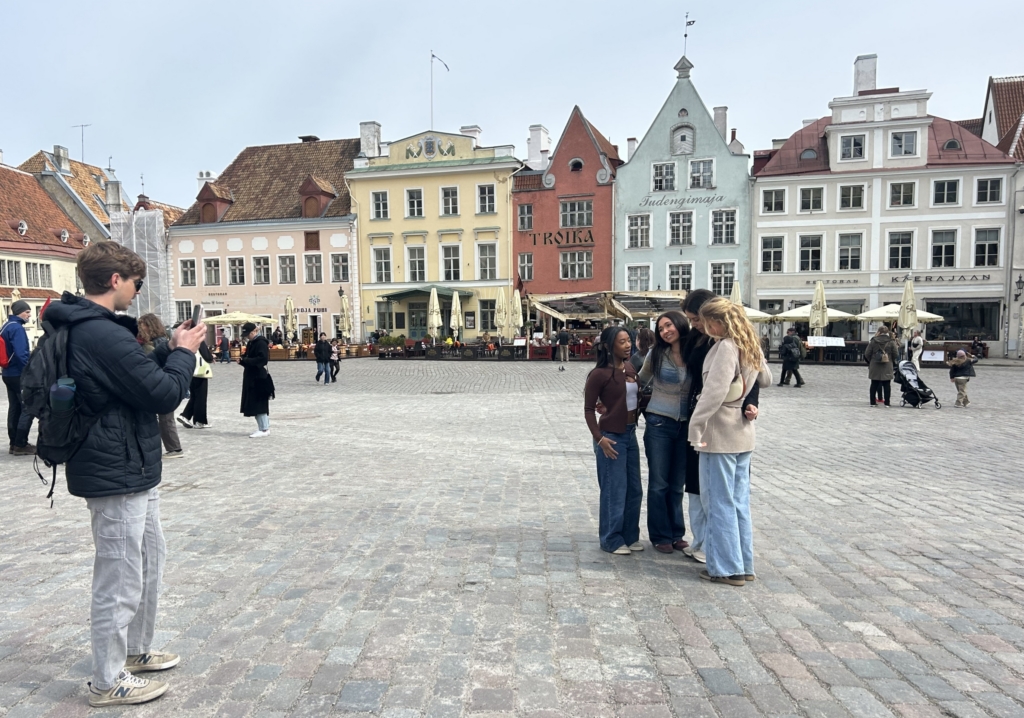
Michigan Ross students pose for photos in Tallinn’s medieval Old Town during a day trip from Helsinki to Estonia as part of Ross’ three-week immersion at Aalto University School of Business. Ross expanded its short-term global immersion model in 2026 to include programs at NHH Norwegian School of Economics, ESCP Business School’s Berlin Campus, WU Vienna University of Economics and Business, Hong Kong University of Science and Technology, and ESSEC Business School’s Rabat Campus in Morocco.
Sophie Parenti has always wanted to travel. But before this spring, the farthest the University of Michigan business student had ventured from her home in California was to see family in Canada.
As a UofM gymnast, she juggles team competitions, a demanding training schedule, and a full class load at the Ross School of Business. A semester-long study-abroad exchange just isn’t realistic.
But on a recent Saturday, Parenti boarded a crowded ferry crossing the Baltic Sea. Finnish travelers hauled carts stacked with cheap beer and liquor from Tallinn, Estonia, back to their homes in Helsinki. Nearly 40 of her Ross classmates wandered through the ferry bars, shopping areas, lounges, and mini casinos spread across nine decks.
The rising junior is spending three weeks in Finland through Ross’ short-term immersion partnership with Aalto University School of Business, taking classes alongside Finnish and other international students.
“Three weeks in May was a perfect time for me to take advantage of this opportunity,” says Parenti, a business major who is minoring in Spanish.
Ross launched the partner-school immersion model last year as a small pilot designed to make global study more affordable and accessible for students like Parenti. One year later, the number of partner institutions has doubled, participation has nearly quadrupled, and cost to students has been cut by a third or more. Now, peer schools are reaching out to see whether the model could work for them.
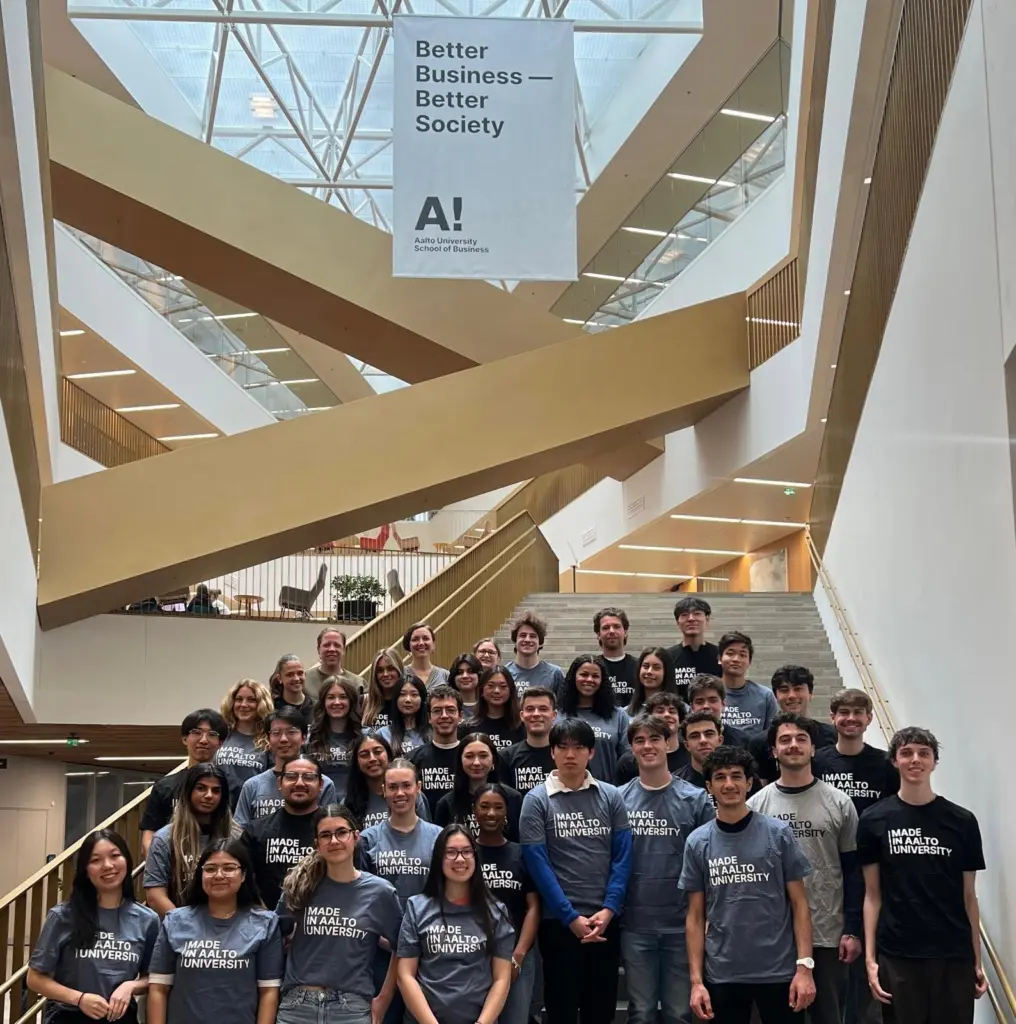
Thirty-seven University of Michigan Ross School of Business students attended intensive three-week courses at Aalto School of Business during Ross’ short-term immersion program in May. In total, 167 Ross undergraduate and one-year master’s students participated in short-term immersions at six partner institutions in 2026, compared to 32 students who joined Ross faculty-led immersions in 2024.
A DIFFERENT MODEL FOR STUDY ABROAD
Ross devised the new exchange model in 2025 when Jessica Oldford, managing director of Ross Global Initiatives, challenged her team to rethink how Ross approached global immersion. A self-funded, first-generation college student herself, Oldford wanted to build programs that more students could realistically access.
They identified three major barriers to traditional study abroad – time, imbalance, and cost.
Many Ross students cannot fit semester- or year-long exchanges around athletics, internships, work schedules, or rigid academic programs. At the same time, more international students want to study in Ann Arbor than Ross has students able to go to their partner institutions.
Traditional faculty-led programs, while much shorter, are expensive, relying on third-party vendors for logistics like housing, travel, and facilities. Such immersions can cost students several thousand dollars apiece.
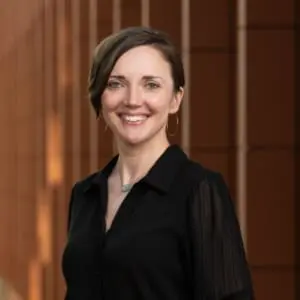
Jessica Oldford, managing director of Ross Global Initiatives
So, Oldford and her team got creative. Instead of third-party vendors and professor contacts, they reached out to several exchange partners instead. Those schools already had classrooms, faculty, local networks, and cultural expertise in their home countries. Students could earn Ross credit while studying directly alongside local students.
Ross first tested the model with a one-week immersion over spring break at WU Vienna University of Economics and Business. It cost students roughly $950 plus airfare, far below the roughly $3,000 price tag for Ross’ previous faculty-led spring break trip to Italy.
In May 2025, more Ross students spent three weeks at Aalto and at Hong Kong University of Science and Technology (HKUST), with donor support reducing costs to about $900 per student or fully funding the experience altogether.
In total, 77 Ross undergraduates and one-year master’s students participated during the pilot year, compared to 32 students who joined Ross’ faculty-led Italy immersion in 2024.
The numbers skyrocketed from there. For 2026, Ross doubled the number of partner exchange schools to six while increasing participation nearly fourfold – to 169 undergrads and one-year master students, and up to 250 when you include MBAs who went along. Students now participate in short immersions across Europe, Asia, and North Africa, with donor support reducing most program costs to between $500 and $900.
“We’re thrilled that our new model of short-term global programs is resonating so strongly with students,” Oldford says. “The biggest thing for us is offering high academic quality while creating access.”
Ross is now looking to expand the model into new regions through trusted partner schools. Each program works a little differently, designed around what benefits both institutions and what creates a sustainable long-term partnership.
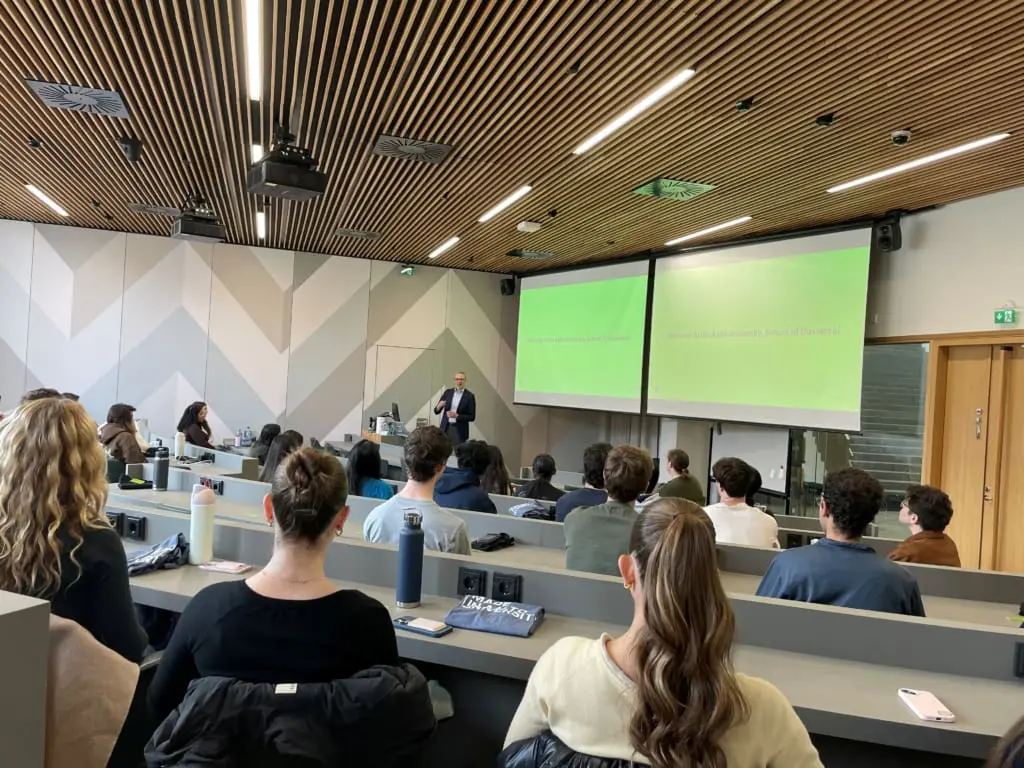
Aalto Dean Timo Korkeamäki welcomes students from University of Michigan Ross School of Business to Aalto University School of Business on May 3 at the start of Ross’ three-week immersion program in Finland. The short-term exchange embeds Ross undergraduates and first-year master students directly into Aalto classrooms alongside Finnish and international students as part of a growing partnership designed to expand access to global study experiences.
WHAT’S IN IT FOR AALTO?
If Ross gets more students to more countries for less money, what do its partner schools get? Just look to Aalto University School of Business, a highly selective Finnish B-school with growing global ambitions.
One immediate advantage is that the model opens up more study slots in Ross for Aalto students. Aalto will send 482 students abroad next year to about 150 partner universities, including about 20 students that will spend a semester at Ross, says Saila Kurtbay, Head of International Affairs at Aalto. That’s the largest class of Aalto students to study at Ross to date, but demand often exceeds the number of exchange slots Ross can offer.
The more students Ross sends to Aalto through the new immersion model, the more exchange slots it can open to Aalto.
The partnership also gives Aalto something the school has been actively courting: visibility.

Timo Korkeamäki, dean of Aalto School of Business
Visitors are often blown away with the school’s combination of academic rigor and unique blend of business, engineering, and arts, says Dean Timo Korkeamäki. The university was established in 2010 with the merger of three of Finland’s most highly ranked universities: Helsinki University of Technology, Helsinki School of Economics, and the University of Art and Design Helsinki. Many describe it to the dean as a “hidden gem.”
“We don’t want to be here just hidden anymore,” he adds. “I love giving American bachelor students exposure to what we have here.”
As important, the Ross partnership fits into Aalto’s broader push to become globally connected. In its most recent strategy discussions, Aalto faculty put internationalization up with academic excellence and sustainability as central pillars of the university’s identity.
“We are a big fish in the small Finnish pond, but we are working so hard to be a reasonable-size fish in the global context,” Korkeamäki says.
Aalto educates its students to be world citizens, and its stated goal is that two thirds of its students will study outside of Finland. Korkeamäki earned his own bachelor’s degree in Sweden before completing his MBA and PhD in the United States, often finding himself the only Finn in the classroom. He wants to replicate that diversity in Aalto classes too.
“It’s not an easy way to do group work, but it’s a very enriching study experience,” he says. “The best experience for our Finnish students is having international people in the same classroom participating in these conversations.
“Maybe it takes international visitors for us to learn what’s special about us too.”
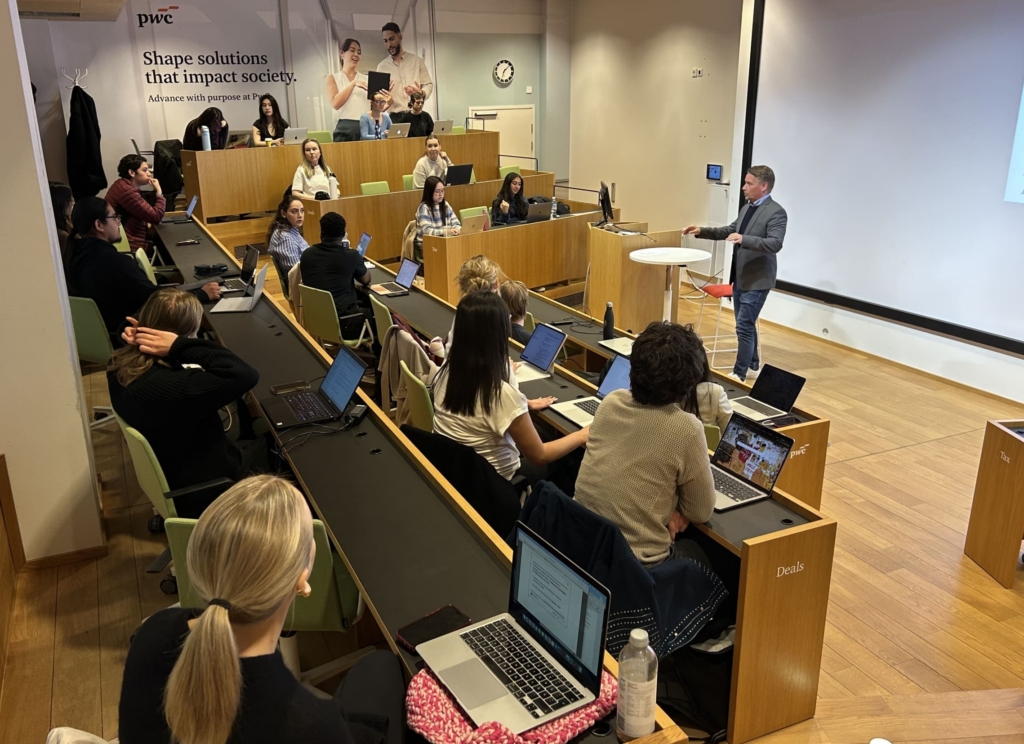
Students from University of Michigan Ross School of Business attend “Strategic Retail Management and Marketing” alongside master’s students at Aalto University School of Business during Ross’ three-week immersion program in Finland. The course, taught by Arto Lindblom, integrated Ross undergraduates directly into Aalto classrooms with Finnish and other international students.
INSIDE THE AALTO CLASSROOM
Teaching his master-level course, “Analytics for Sustainability,” Alexei Gloukhovtsev focuses less on what problems analytics can solve and more on what happens to human judgement when everything becomes numbers and algorithms.
Rather than asking what analytics can do, he asks students to consider what they should – and should not – do.
“What do we assume when we take a problem and decide that analytics can solve it? What questions of ethics, justice, and fairness get lost in the process? Can we assume that models are objective?” asks Gloukhovtsev, Senior University Lecturer at Aalto
His three-week intensive course examines how quantitative systems can appear objective while masking inequality or bias. Students in class discuss AI hiring systems that may discriminate against women or minorities, predictive policing tools that reinforce racial disparities in parole hearings, and healthcare algorithms that prioritize efficiency over vulnerable populations.
One thing he’s noticed teaching a mix of Aalto master’s students and Ross undergrads – something that is hard to miss, actually – is that the Americans will offer their two cents.
“They are definitely very eager, active participants in class,” Gloukhovtsev says. “The cliché is that Finnish people tend to be more reserved and you need to coax things out of them. It’s certainly not the case with the Ross students.”
The Ross students’ energy changes the classroom dynamic in a positive way, he says. Maybe even making it easier for the local students to speak up.
Gloukhovtsev’s is one of six Aalto classes Ross students chose from during their immersion, each worth three Ross credits. The courses were compressed from six weeks down to the three to fit the Ross program’s timetable and offered during Aalto’s “Period V,” a flexible fifth term designed for intensive classes, projects, and special programs. Courses ranged from negotiation analytics and international strategy to organizational communication and geopolitics.
For Hourshid Sadat Ghahari, a second year master’s in marketing student, the five or six Ross students immediately stood out in her “Strategic Retail Management and Marketing” course taught by Arto Lindblom.
“I was really struck by their proficiency in the program, how familiar they were with the material, and how sharp they were. Not that I underestimated the level of education in Finland, because it is very high. But the difference was noticeable, especially as undergraduates,” she says.
Ghahari, who previously earned an MBA in her native Iran before coming to Aalto, says the exchange reinforces something Aalto has long struggled with: Despite strong rankings and academic quality, many students outside Europe still know little about the school. Bringing American undergraduates into the classroom helps change that, she says, while also exposing Ross students to perspectives and experiences they wouldn’t encounter at home.
“Aalto has been very humble,” she says. “This is an opportunity to promote itself.”
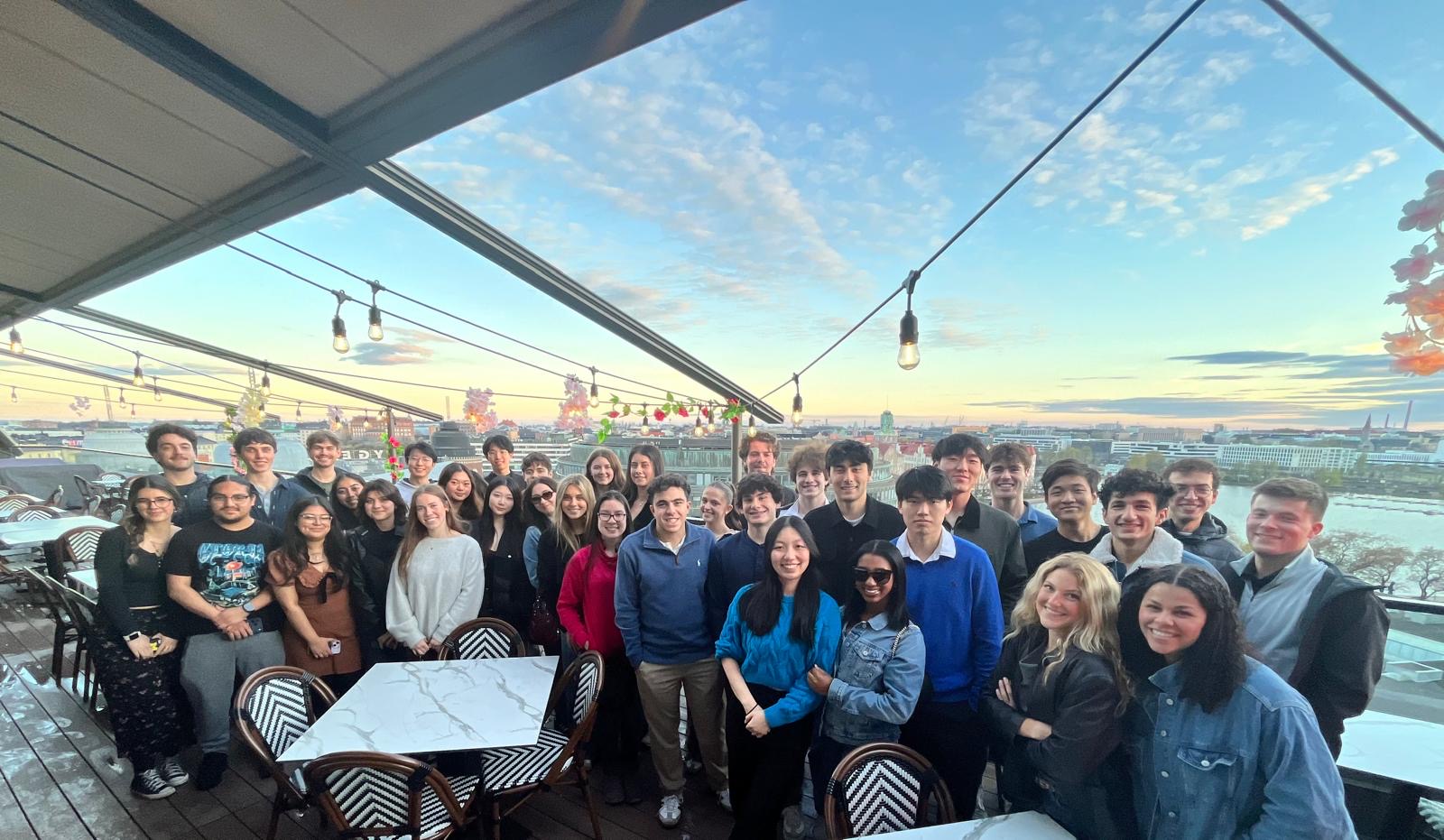
Michigan Ross students pose for a photo overlooking Helsinki after their welcome dinner during Ross’ three-week immersion at Aalto University School of Business. Unlike traditional faculty-led study trips, students in the immersion live independently in flats near campus and are responsible for navigating public transportation, arranging meals, and managing daily life in the city on their own.
EXCHANGE AS GLOBAL COMPETENCY
Each year, Ross hosts roughly 350 incoming exchange students, one of the largest exchange programs among U.S. business schools. Those students become Ross students through and through, integrating directly into Ross courses, clubs, advising systems, and campus life. They even become Ross alumni.
“We get to have students from around the world integrated into our classrooms, and we consistently get feedback from faculty who love having them. I think the students coming in do more for our community than we do for them,” says Laura Haas, Director for Global Student Experiences with Ross. “The incoming students have always been the best part of the work.”

Carolyn Yoon, associate dean for community and global initiatives
Interest in Ross’ short-term exchanges is spreading. Later this month, Haas and Kurtbay will present the model at the NAFSA: Association of International Educators annual conference alongside representatives from NHH Norwegian School of Economics and WU Vienna University of Economics and Business.
“We’ve had partner schools reaching out to say, ‘We want to be a part of that,’” Haas says.
For both Ross and Aalto leaders, the exchanges are teaching global competency at a time when many countries, including the United States, are looking inward both politically and culturally.
“It’s critical for the professional development of these students, many of whom will go into leadership positions,” says Carolyn Yoon, a professor of marketing and Associate Dean for Community and Global Initiatives at Ross.
“Business is global. Many of them will have very limited exposure to other cultures or diversity writ large, and global immersions are really the best way for them to learn about others, appreciate differences, and develop compassion and empathy. These are skills they need to be good leaders.”
Yoon added: “The work is more critical in this day and age. I think it is that much more important for us to reach out to the rest of the world and to be really good global ambassadors.”
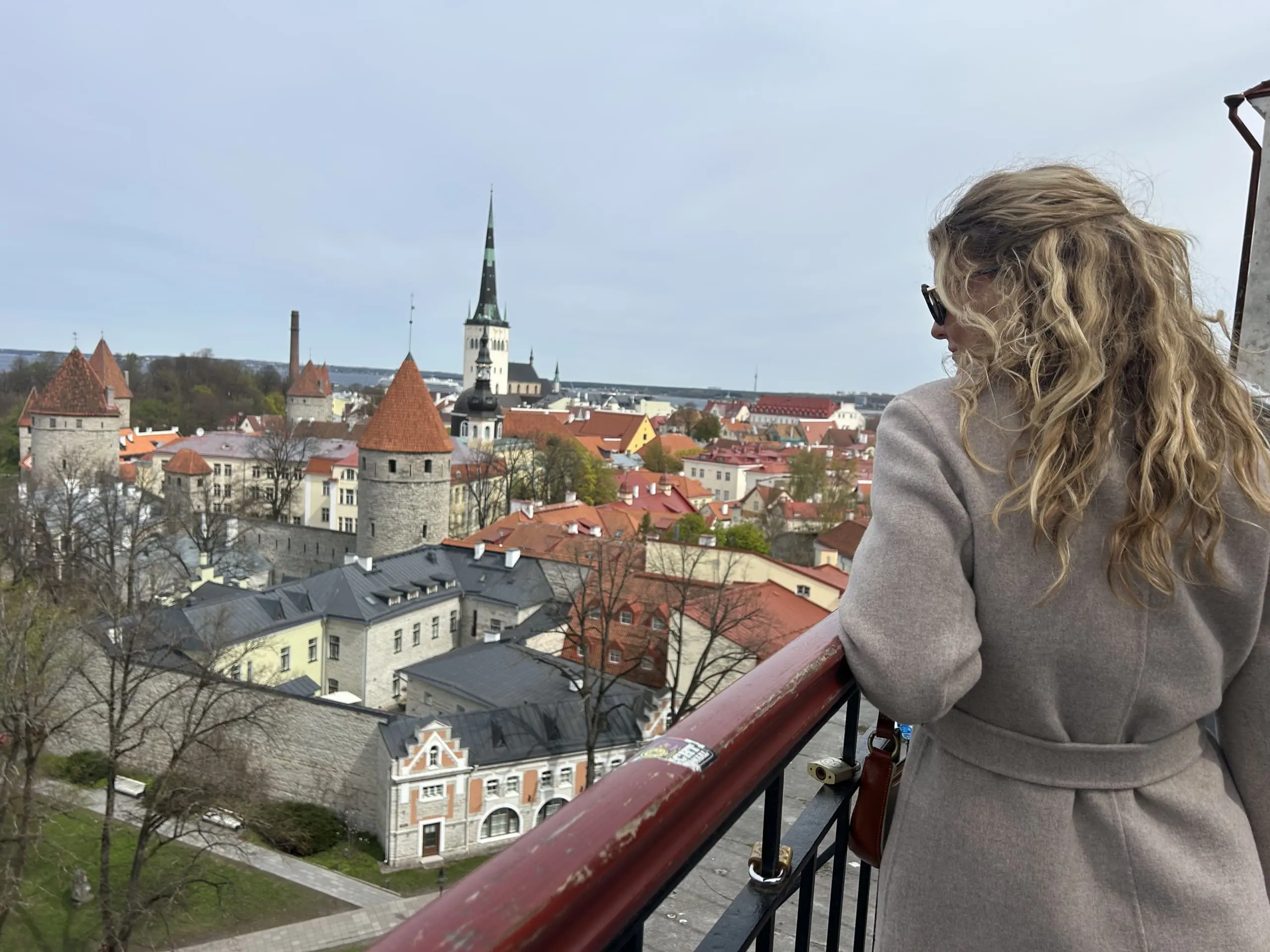
A Ross student overlooks the red rooftops and church spires of Tallinn’s medieval Old Town from the city’s historic stone defense walls during a day excursion from Helsinki.
THE QUIET LESSONS OUTSIDE MICHIGAN
On that day trip to Estonia, Kayla Demick looked up at Fat Margaret, the nickname Russian sailors gave the famously rotund tower guarding the edge of Tallinn’s medieval Old Town. Cobblestone streets led her between church spires, merchant houses, and cafes packed with tourists escaping the chilly wind.
She wouldn’t have been there at all, however, had it not been for the scholarship provided by Ross donors and alumni.
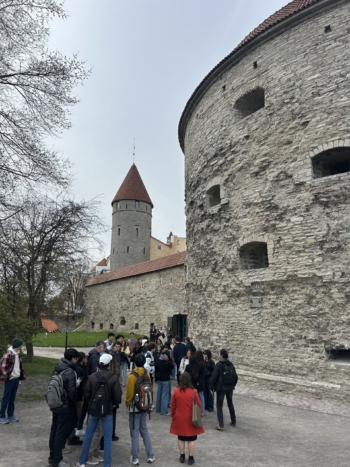
Ross students gather beneath Fat Margaret before a guided tour of Tallinn’s Old Town in Estonia.
The value of the immersion extends beyond credits or site seeing, says Demick, a rising junior studying business and international relations. Finland has its own pace, classroom culture, and way of thinking about the world. The experience opened her to perspectives she would never have considered in Michigan, just as travel is supposed to do.
“It’s a completely different world,” she says. “I feel like being open minded in general is pretty good. It’s something we should all aim for.”
For Parenti, some of the biggest lessons she learned came outside the classroom – listening to the quiet solitude of the water surrounding Helsinki, watching a soccer game with locals, practicing Spanish with an international student from Spain.
In the first week of her Aalto course, “Influential Organizational Communication,” taught by Pekka Pälli and Christa Tammenluoto, she was assigned to a Finnish group for a team project. They ended up talking for two hours at lunch, long after the work had finished.
“In the states, you don’t really get to know people as individuals like that. You kind of just work on your project together,” she says.
“I’ll probably stay in touch with my group here.”
DON’T MISS: 13 BIG LESSONS YOU LEARN IN BUSINESS SCHOOL and GOING BLUE: FROM COMMUNITY TO OPPORTUNITY – HOW THE BLACK BUSINESS SOCIETY SHAPED MY INTERNSHIP JOURNEY
© Copyright 2026 Poets & Quants. All rights reserved. This article may not be republished, rewritten or otherwise distributed without written permission. To reprint or license this article or any content from Poets & Quants, please submit your request HERE.


