






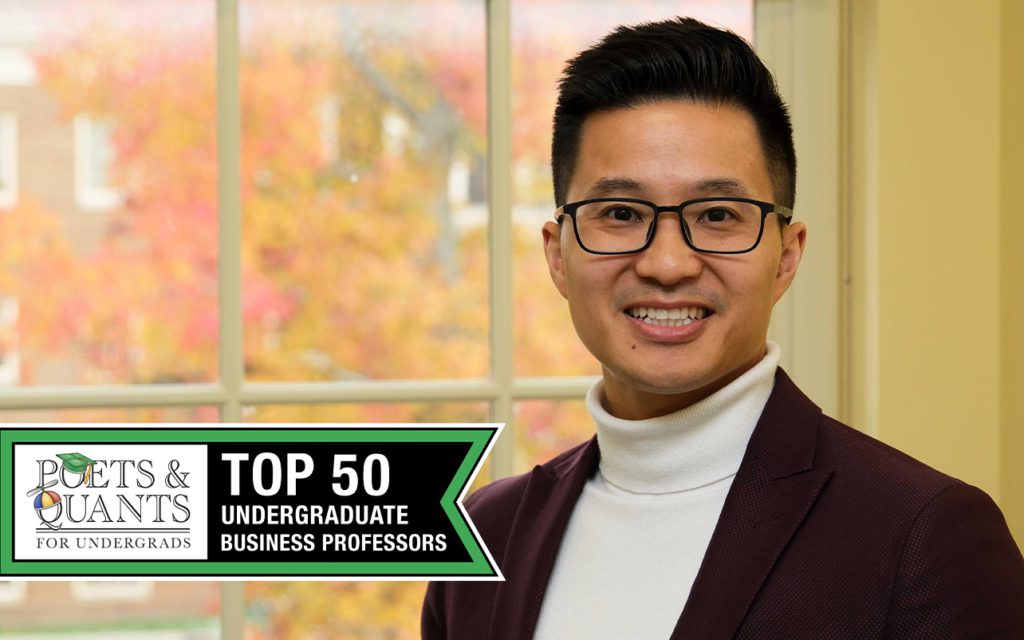
Peter Nguyen
Farmer School of Business
Miami University
“Professor Nguyen has profoundly shaped business education and practice by pioneering the integration of analytics into marketing curricula, equipping students with critical skills for data-driven roles in an era defined by AI, machine learning, and the rise of unstructured data. His work has elevated the Farmer School of Business at Miami University as a leader in preparing students for the demands of modern marketing roles.
“As chair of the Analytics Curriculum Committee, he has led efforts to embed data and analytics throughout the marketing curriculum. Through in-depth interviews and analysis of LinkedIn job postings, Nguyen researched the skills most sought after by top employers, sharing actionable insights with faculty to ensure students are equipped with cutting-edge competencies. He has also spearheaded the development of analytics modules for the Principles of Marketing course, ensuring all students at the Farmer School of Business gain proficiency in Excel and develop confidence in working with data. These efforts not only enhance his own teaching effectiveness but also set a standard of excellence for the broader academic community.”
Peter Nguyen, 37, is Assistant Professor of Marketing in the Farmer School of Business at Miami University in Ohio, where he studies how customer language—what people say and how they say it—reveals hidden needs, intentions, and future behaviors. His research explains why certain linguistic cues reliably predict customer decisions and when they fail, particularly among highly knowledgeable and valuable customers. By applying machine learning and text analytics to social media posts, online reviews, and customer transcripts, he identifies patterns in customer communication that help firms detect dissatisfaction earlier and make more intelligent, data-driven decisions.
He earned his Ph.D. in Marketing from the Ivey Business School at Western University in Canada, where he was awarded the prestigious Joseph-Armand Bombardier Canada Graduate Scholarship. His research has appeared in the Journal of Consumer Research and Journal of Consumer Psychology, and he is a recipient of the 2023 Marvin Jolson Award for Best Contribution to Sales Management Practice.
At Miami University, Nguyen teaches marketing research and analytics. A hallmark of his course is its immersive social media monitoring project in which students scrape and analyze real-time data from platforms such as TikTok, YouTube, and Reddit. Students learn to apply sentiment analysis, topic modeling, and generative AI tools to uncover consumer insights and craft data-driven marketing strategies.
His teaching emphasizes analytical rigor paired with persuasive storytelling, an approach students consistently describe as transformational for their confidence with data. He has received a number of teaching awards at Miami University, including the 2022 Richard K. Smucker Teaching Excellence Award, 2023 Gifford Junior Faculty Teaching Innovation Award, 2025 David W. Rosenthal Case Method Teaching Award, and finalist for the 2025 E. Phillips Knox Distinguished Teaching Award.
Across both research and teaching, Nguyen brings an energy centered on relevance, clarity, and intellectual curiosity. He constantly weaves current trends, emerging technologies, and real-world data into his classes so students understand not only how analytics works, but why it matters and why it is relevant to student lives.
Outside of academia, he is the proud father of two young boys, Arthur and Jasper. When not in the classroom or in the dataset, you’ll likely find him running along the Ohio River, hiking in the mountains of Colorado, or on a pickleball court; his favorite blend of competition, precision, and fun.
BACKGROUND
At current institution since what year? 2019
Education: PhD Marketing, Ivey Business School, Western University; MSc Neuroscience, Western University; BSc Medical Sciences and Psychology, Western University
List of Undergraduate courses you teach: Analytical Research and Reasoning for Marketers, a hands-on marketing analytics course where students use Excel, R, and generative AI tools to analyze real-world data and communicate insights through clear, compelling data storytelling.
TELL US ABOUT LIFE AS A BUSINESS SCHOOL PROFESSOR
I knew I wanted to be a business school professor when … I actually never set out to become a business school professor. In university, I simply followed the courses I loved—psychology, statistics, and neuroscience. That curiosity eventually pulled me into research, where I realized how much I enjoyed asking questions no one had answered yet. Before I knew it, I was designing studies, analyzing data, and realizing that academia was a place where curiosity and creativity could truly thrive. I didn’t plan it, but I’m grateful I stumbled into it.
What are you currently researching and what is the most significant discovery you’ve made from it? Right now, I’m studying how the language business customers use—whether in emails, interviews, or account discussions—can reveal what they really think about a supplier and what they’re likely to do next. One of the most surprising discoveries from my current research is just how much you can learn from a few subtle linguistic cues. My colleagues and I analyzed thousands of transcript pages of organizational customer communication and found that beyond emotional tone, how often customers talk about the past is a remarkably powerful predictor of whether they’ll renew a contract or walk away.
What’s fascinating is that customers rarely say, “We’re unhappy” or “We’re leaving.” Instead, their language shifts. They become slightly more negative, and they start talking far more about what happened rather than what’s happening now or what could happen in the future. That subtle shift toward past-tense language is meaningful; our research shows that a 1% increase in past-tense focus raises the odds of losing a multimillion-dollar RFP by about 11%.
In short, companies can spot defection risk much earlier, often long before the customer says anything explicit, simply by paying attention to how their customers speak.
If I weren’t a business school professor, I’d be … Probably a magician or an MC. These are two hobbies I’ve always loved because they blend storytelling, timing, and the ability to hold an audience’s attention. On a more athletic note, I’d happily spend my days training as an aspiring pro pickleball player. And if I had taken a different academic path, I likely would have ended up in the medical field. Each of those careers taps into something I value: curiosity, performance, and helping people.
What do you think makes you stand out as a professor? I think it’s the combination of empathy and energy. I’m deeply attuned to how students are feeling. When the room is confused, overwhelmed, or losing momentum, I pick up on it quickly and adjust on the spot. At the same time, I bring a lot of enthusiasm and presence to every class session. That mix of perceptiveness and high energy creates an environment where students feel both supported and engaged, and where even complex analytical concepts start to feel accessible and intuitive.
One word that describes my first time teaching: Awakening
Here’s what I wish someone would’ve told me about being a business school professor: That this career path even existed. I grew up in Canada in a first-generation immigrant family, and while my parents emphasized education, I had very limited exposure to what academic careers looked like. I heard about becoming a doctor or a lawyer, but nothing that reflected what I truly loved—teaching, explaining ideas simply, and thinking deeply about why people behave the way they do.
I wish someone had told me earlier that being a professor can be the perfect fit for people who enjoy breaking down complex problems for others and love developing ideas at the highest level through research. It’s not a path for everyone, but for the right person, it is incredibly fulfilling.
Professor I most admire and why: I’d have to give that honor to my Ph.D. advisor, Shane Wang, now at Virginia Tech. Shane is one of those rare people who can be incredibly direct and blunt, yet deeply understanding and empathetic at the same time. That combination shaped me in ways I didn’t fully appreciate until later.
When I entered my Ph.D. program, I still wasn’t sure whether the professor path was for me. It wasn’t until I started working closely with Shane that I could really see myself in this career. He believed in my potential long before I did, and he played a huge role in shaping the researcher and teacher I’ve become. I’m here today largely because of his guidance, his honesty, and his faith in me.
TEACHING BUSINESS SCHOOL STUDENTS
What do you enjoy most about teaching business students? I love watching students who don’t see themselves as “quant people” develop real confidence with data. Seeing them move from nervousness to an intuitive understanding of analytics and then learning to tell a compelling story with data. That is incredibly rewarding. That transformation is one of my favorite parts of teaching.
What is most challenging? Grading has never been my favorite part of the job. But I’ve learned to reframe it as an opportunity to help students grow, and that mindset makes a big difference. One approach that’s been surprisingly effective is giving video-based feedback on group projects. It’s the closest thing to sitting down with students and talking them through their work. They not only hear what I’m saying but how I’m saying it—the tone, the encouragement, the guidance. As someone who’s very people-oriented, that format lets my empathetic and constructive side come through, and it turns a traditionally tedious task into something genuinely meaningful.
In one word, describe your favorite type of student: Curious
In one word, describe your least favorite type of student: Disengaged
When it comes to grading, I think students would describe me as … Fair, clear, and genuinely focused on helping them grow. I put a lot of care into my feedback, often through video, so students can hear not just what I’m saying but the tone and intention behind it. Even when the grade is tough, they know I’m rooting for them and giving them the guidance they need to improve.
LIFE OUTSIDE THE CLASSROOM
What are your hobbies? I love anything that keeps me active or curious. I’m an avid runner and enjoy working out, and you can often find me on a pickleball court whenever I can sneak in a match. Outside of fitness, I’m deeply into the world of points and miles—tracking credit card rewards, airline programs, and hotel loyalty strategies has become a surprisingly fun (and very practical) hobby. It’s a mix of movement, strategy, and optimization that fits my personality pretty well.
How will you spend your summer? Like most tenure-track professors, a big part of my summer will be dedicated to research—writing, analyzing data, and pushing projects forward. I also try to fit in a trip whenever I can. This summer we’re taking the whole family, including our little ones and their grandparents, to Banff and Lake Louise. It’s an absolutely stunning place, and we’re excited to explore it together.
Favorite place(s) to vacation: My wife and I love exploring new places; our philosophy is that the world is our oyster, and we’re always excited to find the next spot to discover, especially with my points-and-miles hobby making travel a bit more fun and strategic. With two very young kids at home, we’ve been keeping our trips within North America, but we’re looking forward to venturing farther once they’re a little older. Honestly, our favorite place to visit is always the next one. There’s something exciting about planning and anticipating the next adventure.
Favorite book(s): I’ve always loved books that make me think differently about people and decision-making. Thinking, Fast and Slow by Daniel Kahneman is a long-time favorite for how it unpacks the quirks of human judgment. And lately, with two little ones at home, I’ve been reading a lot of children’s books, and realizing that some of the best life lessons come with very few words.
What is currently your favorite movie and/or show and what is it about the film or program that you enjoy so much? We actually don’t watch much TV at home, especially with two young kids, so I’m pretty out of the loop on current shows. Most of my downtime goes toward running, pickleball, or planning our next trip. My wife and I joke that our “date nights” happen every evening after the kids go to bed—when we work out together in our basement and finally get a chance to talk about the day and the deeper things we didn’t have time for. It’s not a traditional movie night, but it’s our favorite routine.
What is your favorite type of music or artist(s) and why? My music taste really depends on the moment. When I’m relaxing, I love playing pop instrumental music. It sets a calm, focused tone, and it’s actually the soundtrack students hear as they walk into my class.
When I’m looking for something more upbeat, especially for dancing or working out, I turn to Latin music. I fell in love with reggaeton, salsa, and bachata years ago when I spent a couple of months living in South America, learning the language and the culture. The rhythm, the energy, and the way the music brings people together were a big part of that experience, and it still brings back great memories.
These days, though, I also listen to a lot of kids’ music thanks to my two-year-old. And surprisingly, it’s brought back something I hadn’t used in years: beatboxing. It’s a skill I picked up as a teenager, and every now and then I’ll bring it out because it never fails to make my little ones light up. It’s a small thing, but a fun way to connect with them.
THOUGHTS AND REFLECTIONS
If I had my way, the business school of the future would have much more of this … A thoughtful balance between advanced analytics and human-centered skills. Students absolutely need to be fluent in AI, data, and the tools that will shape the future of business. But they also need empathy, curiosity, and the ability to communicate clearly. The real magic happens when those two worlds meet. I’d love to see business schools invest even more in developing students who can use powerful technologies without losing the human judgment, connection, and creativity that make great marketers and great leaders.
In my opinion, companies and organizations today need to do a better job at … truly listening to their customers. Businesses collect huge amounts of unstructured feedback—emails, reviews, transcripts, and social posts—but they often miss what customers are actually trying to say. When you pay attention to the nuances of language, you start to see early signs of dissatisfaction, shifting expectations, and emerging needs long before they show up in a dashboard. Companies that listen more deeply and respond more thoughtfully build stronger relationships and make far better decisions.
I’m grateful for … the students and mentors who have shaped my journey. My students push me to be better every year, and my mentors believed in me long before I fully believed in myself. Their trust and encouragement played a huge role in helping me grow into the professor I am today.
I’m grateful for Miami University and the Farmer School of Business. It’s a beautiful campus and an incredibly supportive community. My colleagues have been welcoming since the day I arrived, and we continually challenge and encourage one another to grow as teacher-scholars. That sense of collaboration and shared purpose is something I value deeply.
And above all, I’m grateful for my family and the chance to do work I genuinely love. Being a professor is a privilege—I get to spend my days thinking, teaching, learning, and creating—but none of it would be possible without the support of my wife, our two little ones, and their grandparents. They’re the foundation that makes everything else possible.
DON’T MISS THE ENTIRE ROSTER OF 2025’s 50 BEST UNDERGRADUATE BUSINESS SCHOOL PROFESSORS.
© Copyright 2026 Poets & Quants. All rights reserved. This article may not be republished, rewritten or otherwise distributed without written permission. To reprint or license this article or any content from Poets & Quants, please submit your request HERE.


