






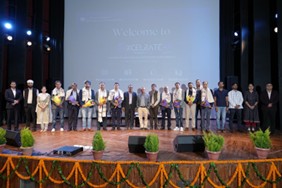
The Future of AI And Business At IIT Mandi’s AiXcelrate 4.0
Most business students today are probably already using AI to brainstorm ideas, analyze information, build presentations, or simply get through an assignment. What about on a larger scale though? What does it look like when AI moves from something people use to something businesses build their strategies around?
This was the central topic of AiXcelrate 4.0, a two-day AI and leadership conclave organized by the School of Management at the Indian Institute of Technology Mandi a week back. The event hosted a mix of industry leaders, practitioners, faculty, and students, where they explored what comes after simply adopting AI. They focused on how organizations can and are leveraging strategy, growth, and scale for their businesses.
A PLACE FOR AI, AND A PLACE FOR HUMANS
A few years ago, the question for many companies was simply whether or not they should adopt AI. Now, many have adopted it and they’re considering to what extent they should use AI in their businesses.
During a panel focused on the shift from automation to strategic advantage, Ashley D’Acouza, Chief Data Officer at Hindustan Coca-Cola, shared his thoughts against assuming that widespread access to AI automatically creates a competitive advantage
“The AI advantage is still far away. We are still in the experimentation phase,” he said.
He believes that outcomes depend on leadership, strategic vision and an organization’s ability to connect available technologies with its specific business requirements.
The question of responsibility naturally leads some to think, ‘If AI can increasingly handle certain kinds of work, what should people then focus on?’ AiXcelrate 4.0 explored this question on its second day. Guest speakers discussed how businesses can move from AI adoption toward customer acquisition, personalization, innovation, better decision-making and revenue growth.
Rohit Kilam, Chief Technology Officer at HDFC Life, shared his beliefs surrounding the changing division of labor between people and technology. “The verifiable will increasingly be taken over by AI, but the unverifiable will remain. That is where humans will continue to stay relevant,” he says.
This distinction will likely become increasingly important as business students enter the workforce. AI may be able to process information, identify patterns and handle tasks – yet there will still be a need for human leaders. These will be leaders who interpret incomplete information with context, understand people, weigh competing priorities, and decide what to do when there is no obvious answer.
FROM THE CLASSROOM TO THE BOARDROOM
A key part of the student experience at AiXcelrate 4.0 was the Industry Case Competition, sponsored and powered by 6D Technologies. MBAs and Integrated MBA students had the opportunity to tackle an industry-oriented business challenge themselves.
In teams of 4-5 students, they analyzed the problem, developed recommendations, and defended their ideas before a jury that included industry representatives. Instead of hearing how businesses are approaching AI, they were sent forth into the thick of it to think through a real-world problem and make the case for their own solution. Team Tactical Minds was the winning team.
Connecting what students learn in management education with the questions businesses are facing right now is incredibly crucial, and that’s what this two day get together was able to do.
“As artificial intelligence becomes increasingly embedded in organizations and society, leadership cannot be defined only by how quickly we adopt new technologies,” says Prof. Laxmidhar Behera, Director, IIT Mandi. “Institutions such as IIT Mandi have an important role in preparing leaders who can combine technological capability with responsibility and social purpose.”
© Copyright 2026 Poets & Quants. All rights reserved. This article may not be republished, rewritten or otherwise distributed without written permission. To reprint or license this article or any content from Poets & Quants, please submit your request HERE.


