



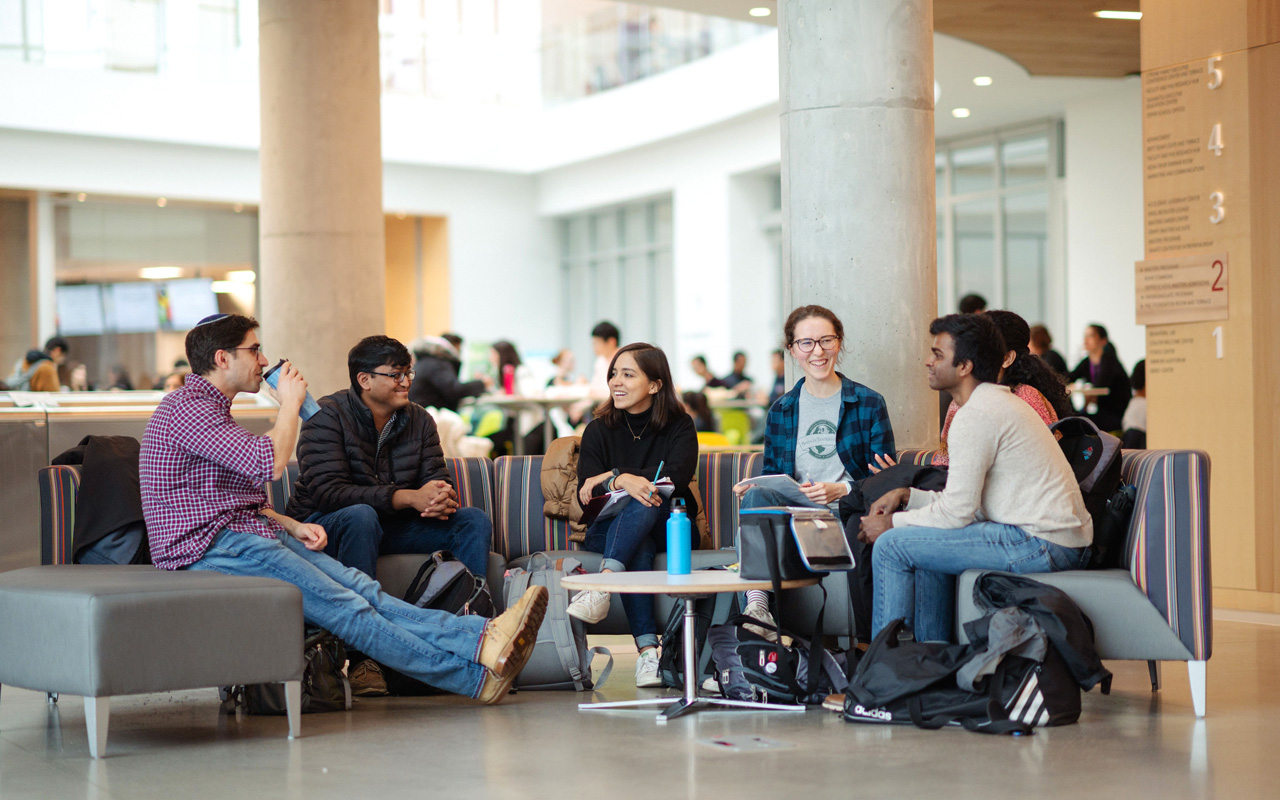
Students at the Tepper School of Business at Carnegie Mellon University. Courtesy photo
Carnegie Mellon Receives A Record $3-Billion Gift To Build A Future In Miami
Three billion dollars is a lot of money for just about anything. It’s definitely enough money to change the future of a university.
Carnegie Mellon University just released an announcement that hedge fund billionaire and Citadel CEO Ken Griffin has just pledged $3 billion to the school. To put this into perspective, that’s the largest singular donation in the entire history of higher education.
The money will go to supporting both the university’s flagship campus in Pittsburgh and a new campus in Miami. That means that Carnegie Mellon will be able to significantly expand its footprint in two very different markets.
Now for the details. Carnegie Mellon shared that $2 billion will be used to create a new 35-acre campus in Miami’s Wynwood neighborhood, with the remaining $1 billion will support initiatives in Pittsburgh. This includes a major investment in the university’s renowned School of Computer Science. The university said the Miami campus is expected to serve thousands of undergraduate and graduate students, with a focus on creating spaces for students to solve real-world challenges.
BECOMING PART OF MIAMI’S TECH FUTURE
Carnegie Mellon is already widely-recognized for its strengths in computer science, robotics, machine learning, and engineering. Griffin believes that bringing this to Miami could help transform the city into an even stronger hub for business and technology. “The opportunity to bring Carnegie Mellon to Miami places our city at the heart of humanistic and scientific advancement,” Griffin says.
As a result, business students here will have a chance to learn at the intersection of technology, entrepreneurship, artificial intelligence, and industry.
Carnegie Mellon President Farnam Jahanian said the university sees the moment as an opportunity to rethink what higher education can look like in an era of rapid technological change. “Artificial intelligence represents one of the defining intellectual developments of our time, and it demands that we rethink how we educate students, conduct research and partner with others,” Jahanian says.
The Miami campus is expected to focus on major challenge areas including human health and biological discovery, national security, energy and climate resilience, and advanced manufacturing and industrial transformation. Instead of keeping education and research in separate academic silos, CMU plans to bring students, researchers, industry leaders, and government partners together to tackle some of the world’s biggest challenges.
“Miami can meet this moment by making sure it anchors its talent,” says Miami Dade College President, Madeline Pumariega. “To have CMU join that family [of institutions] helping to build the next generation of leaders and astronauts and computer scientists, is really exciting.”
Next Page: 25 Hidden Gem Colleges
© Copyright 2026 Poets&Quants. All rights reserved. This article may not be republished, rewritten or otherwise distributed without written permission. To reprint or license this article or any content from Poets&Quants, please submit your request HERE.


