





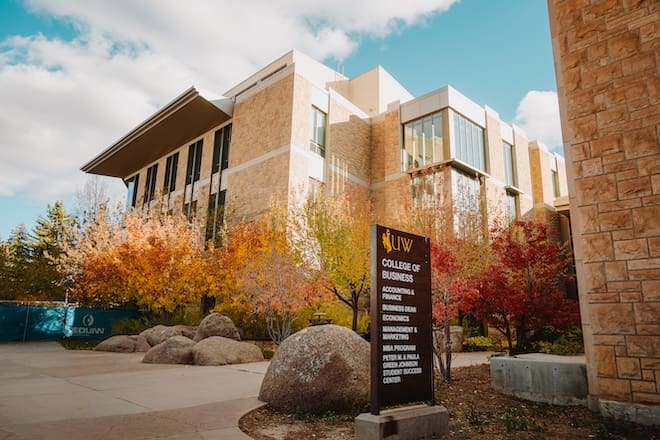
Total enrollment at the University of Wyoming College of Business reached 1,551 in fall 2025, up 18 percent from 1,317 in fall 2021. Courtesy photos
The most ambitious career Scott Beaulier could picture for himself in college was running a McDonald’s.
Beaulier grew up in Iron Mountain, Michigan, in a family poor enough to stand in government cheese lines. His father left when he was young, leaving his mother to raise three children under five. As a first-generation college student, Beaulier worked most weekends, including fast food shifts that started around 4:15 a.m.
He could see a future where, with a trip to Hamburger University along the way, he might one day own a franchise. That was his “absolute imaginable upper limit,” he writes in a September 25 essay on his Substack, The Arena.
That limit changed when Beaulier took an economics class from David Prychitko, a professor at Northern Michigan University in Marquette. Prychitko encouraged Beaulier to take more courses and eventually spent a year meeting with him one-on-one to prepare for graduate school – a term Beaulier says he had, to that point, never encountered.
“Dave saw something I couldn’t see yet in myself,” Beaulier writes.
FROM MACON TO LARAMIE
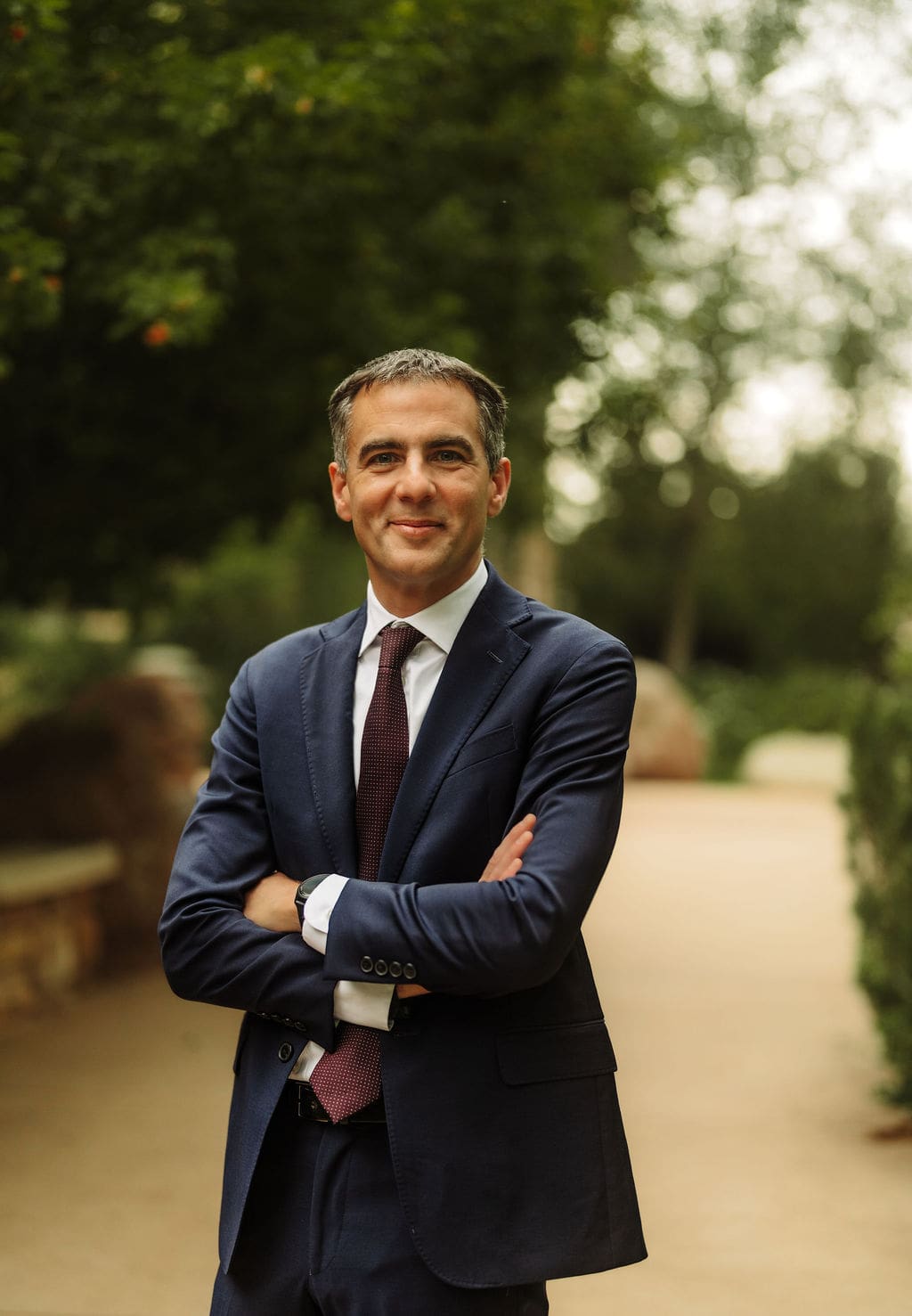
Scott Beaulier, dean of the University of Wyoming College of Business, says the school has what it takes to compete with the SEC for students. “We can be a player nationally”
In the summer of 2000, Beaulier loaded almost everything he owned into a Plymouth Neon and drove from Michigan to Washington, D.C., to begin graduate school in economics at George Mason University. He can still picture the drive through Indiana that evening, he writes, the sun setting and the feeling of being completely on his own. He had several good offers.
“Other people apparently thought I could do this,” Beaulier writes. “I just didn’t know if they were right.”
The stipend was $15,000 plus a tuition waiver, and rent in Alexandria ran $900 a month. “You don’t need an economics Ph.D. to recognize the problem,” he writes.
He became an economist and built a career in universities. Several of his moves, he says, came down not to a location but to a person. At Mercer University in Macon, Georgia, he took a job over a possible move to Malibu, California, because of an economist named Skip Mounts.
“I wasn’t really choosing Macon over Malibu,” Beaulier writes. “I was choosing a person.”
Not every move worked. A later jump to a college in the Midwest, made to be closer to home, felt like a mistake within months, and after 10 months he called Mounts and went back to Mercer. Next came Troy University in Alabama, where former Federal Reserve vice chairman Manley Johnson gave him room to build, and then North Dakota State University, where he became a very young dean about a decade ago. In 2022, he arrived at the University of Wyoming as dean of the College of Business. It sits in Laramie, in the state’s southeast corner, not far north of the Colorado border.
Now 48, Beaulier says success has not made hard decisions any easier. In the essay, he describes being asked to fill in on 48 hours’ notice for a leadership talk in Jackson, Wyoming, hundreds of miles from Laramie in the state’s northwest, in front of MBA students and business leaders. He ended by asking the audience to think about their own Neon, a consequential decision they had been postponing in search of a little more certainty. His own path, he says, only looks sensible in hindsight.
“It didn’t look logical through the windshield of that Neon,” he writes.
THE SEC PLAYBOOK
Four years into the job, Beaulier is quick to share credit. He joined a video interview about the University of Wyoming College of Business alongside three members of his leadership team: senior associate dean Chase Thiel, senior assistant dean Ben Cook, and Justine Tydings, an assistant dean who directs the college’s Student Success Center, which he calls part of the school’s “secret sauce” at the undergraduate level. He turned to each of them for the specifics in their areas.
Between them, they have the numbers to make the case. Total enrollment reached 1,551 in fall 2025, the highest in the five academic years of data the college supplied and up 18% from 1,317 in fall 2021. Graduate enrollment is up 38% over that stretch, from 240 to 332, and undergraduate management majors have roughly doubled. Job placement has risen four straight years, from 79.5% to 85.1%. Beaulier says the endowment has grown from roughly $100 million to almost $120 million since he arrived.
None of that is the benchmark Beaulier has in mind. He is looking at the SEC.
“We have a lot of the things going for us that the SEC does,” Beaulier says. “And the SEC is attracting students like crazy.” He points to the University of Florida, which he says drew 90,000 applications this fall for 7,000 seats. Wyoming, he concedes, doesn’t have that.
“We have a little less sunshine,” Beaulier says. “It’s a little colder in the winter. But I think there’s an opportunity if we can just turn the needle on the student experience here and have a winning football team and just have programs that are really dynamic and exciting for people. We can be a player nationally.”
THE ONLY GAME IN TOWN
Beaulier traces the college’s financial muscle back about 15 years, to a former dean named Brent Hathaway, who later left for UNLV. Hathaway raised money for the college’s building while the state was lining up its own funding. When the state ultimately paid for the building, the private gifts went into what became the college’s excellence funds.
Today, philanthropy and alumni support account for 20 to 25% of the college’s annual budget, Beaulier says. The college’s foundation figures show $3.99 million in new donor gifts in fiscal 2026, $2.27 million of it spendable and $1.72 million added to endowment principal. Payouts from endowments added $4.03 million, for a total of $6.3 million in new spendable funding, and the endowment’s market value rose about $10.6 million.
“I haven’t looked at the most recent Mountain West schools, but I bet we are still the best-funded in the Mountain West,” Beaulier says. “We were light years ahead of most of them the last time I checked.”
The pitch to donors has three parts: return on investment, a curriculum built around ethics and leadership, and geography. Wyoming is the state’s only four-year university, which Beaulier, who came from a North Dakota system with 11 universities, says changes the math.
“There you’re competing with a lot of distractions, and a system that has 11 universities in the state,” Beaulier says of his time at NDSU. “So being the one leads to a magnetic element of fundraising.”
There is also a new lever. The Wyoming legislature put up $10 million per year in matching funds during its last session, according to Beaulier.
“Donors are extremely responsive to getting leverage on their money,” Beaulier says.
Next Page: The dean who left for Colorado State, the 5-year plan behind the growth, and how an online MBA rebuilt the college’s budget
Disclosure: Poets&Quants rankings editor Kristy Bleizeffer earned her MBA from the University of Wyoming in 2023. She and Editor-in-Chief Marc Ethier have also earned bachelor’s degrees from UW.
© Copyright 2026 Poets&Quants. All rights reserved. This article may not be republished, rewritten or otherwise distributed without written permission. To reprint or license this article or any content from Poets&Quants, please submit your request HERE.


