






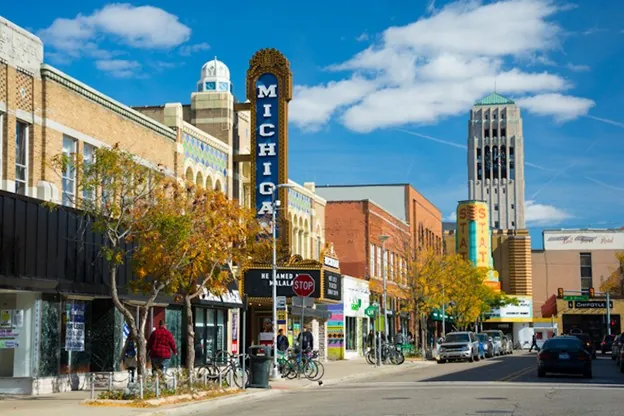
Ann Arbor, home of the University of Michigan
The 20 Most Educated Cities
If you’re mapping out your future, whether that’s landing internships, applying to grad school, launching your career, or deciding where to live after college, it helps to know which cities truly prioritize education.
“Higher education doesn’t guarantee better financial opportunities in the future, but it certainly correlates with it,” says WalletHub analyst Chip Lupo. “The most educated cities provide good learning opportunities from childhood all the way through the graduate level.”
WalletHub’s latest ranking of the 150 largest U.S. Most & Least Educated metros give a shoutout to the metros that attract the highest-educated workforces. Their ranking uses two weighted dimensions: Educational Attainment (80%) and Quality of Education & Attainment Gap (20%). Attainment measures how many adults hold high school diplomas, bachelor’s degrees, and graduate degrees – essentially how educated the population is. The Quality & Gap score looks at public school performance, university strength, access to learning opportunities, and how well cities close racial, gender, and income‑based education gaps.
MOST-EDUCATED METROS
| Rank | City | Score | Attainment Rank | Quality & Gap Rank |
| 1 | Ann Arbor, MI | 94.48 | 1 | 2 |
| 2 | Durham–Chapel Hill, NC | 85 | 2 | 1 |
| 3 | San Jose–Sunnyvale–Santa Clara, CA | 82.67 | 4 | 3 |
| 4 | Washington–Arlington–Alexandria, DC–VA–MD–WV | 81.93 | 3 | 36 |
| 5 | Madison, WI | 79.62 | 6 | 16 |
| 6 | San Francisco–Oakland–Berkeley, CA | 78.92 | 8 | 7 |
| 7 | Raleigh–Cary, NC | 77.88 | 7 | 22 |
| 8 | Boston–Cambridge–Newton, MA–NH | 77.78 | 5 | 65 |
| 9 | Austin–Round Rock–Georgetown, TX | 76.46 | 10 | 4 |
| 10 | Seattle–Tacoma–Bellevue, WA | 75.21 | 11 | 8 |
| 11 | Portland–South Portland, ME | 71.85 | 13 | 57 |
| 12 | Denver–Aurora–Lakewood, CO | 71.37 | 12 | 77 |
| 13 | Colorado Springs, CO | 69.94 | 14 | 43 |
| 14 | Bridgeport–Stamford–Norwalk, CT | 69.71 | 9 | 146 |
| 15 | Provo–Orem, UT | 69.55 | 17 | 41 |
| 16 | Portland–Vancouver–Hillsboro, OR–WA | 67.83 | 20 | 20 |
| 17 | Huntsville, AL | 67.69 | 22 | 10 |
| 18 | Minneapolis–St. Paul–Bloomington, MN–WI | 66.72 | 15 | 96 |
| 19 | Baltimore–Columbia–Towson, MD | 66.56 | 16 | 93 |
| 20 | Albany–Schenectady–Troy, NY | 66.49 | 18 | 86 |
Digging deeper into the data, Ann Arbor, MI stands out as the clear leader. This city had an overall with a score of 94.48 and the highest educational attainment in the country. Right behind it, Durham–Chapel Hill, NC landed in a strong second place, powered by the academic influence of Duke University and the University of North Carolina.
Tech-driven metros also make a strong showing. San Jose, San Francisco, Seattle, and Austin all land in the top 10. That just goes to show that today’s innovation hubs are built on education pipelines that feed directly into their economies.
On the other side of the country, Washington, D.C. and Boston remain near the top as well, even with wider education gaps, thanks to their unmatched abundance of universities and research institutions.
SURPRISES IN THE MIDDLE
Possibly some of the most interesting takeaways come from the middle of the top 20. Huntsville, AL ranks just 22nd in educational attainment, but climbed all the way to No. 10 in quality and gap. In other words, even though fewer residents hold higher degrees, the local education system here performs far better than its overall attainment ranking would suggest.
Bridgeport–Stamford–Norwalk, CT ranks 14th overall despite a steep gap ranking of 146, highlighting how proximity to elite academic and professional hubs can boost a metro’s standing even amid inequality. The area lacks a major flagship university within its core cities but sits about 20 miles from Yale University and within commuting reach of the broader New York City education and job ecosystem (with the University of Connecticut also about 1.5–2 hours away).
Rounding out the top 20 is Albany, NY, which proves that smaller metros can still deliver strong educational outcomes and hold their own alongside much larger hubs.
“Building highly educated cities isn’t just about attracting talent – it requires a coordinated, long-term approach across education, housing, and workforce systems,” says Seton Hall professor Daniel Katz on Wallethub’s site.
Next Page: University of Kentucky’s Gratton College Dean Retires
© Copyright 2026 Poets&Quants. All rights reserved. This article may not be republished, rewritten or otherwise distributed without written permission. To reprint or license this article or any content from Poets&Quants, please submit your request HERE.


