






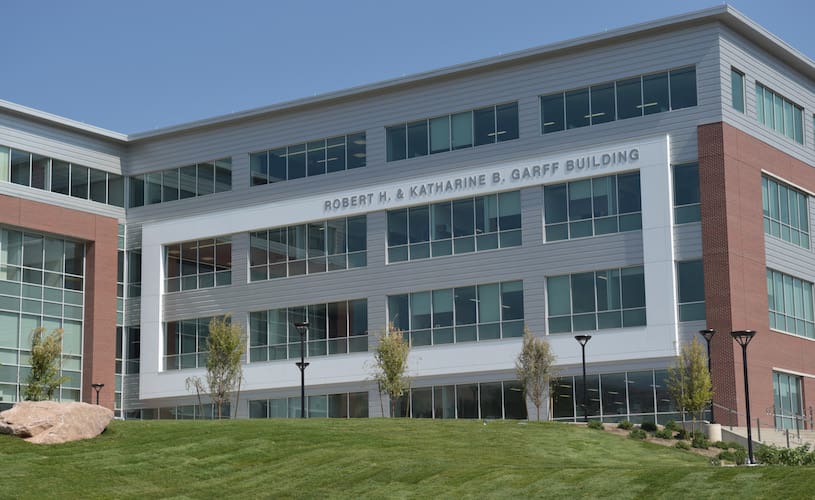
Ask Scott Schaefer how the University of Utah’s newest academic division got its name, and he’ll laugh. QAMO – pronounced like “Cuomo” – stands for Quantitative Analysis of Markets and Organizations. It was chosen by committee.
“It’s how you say economics without using the word economics,” he says.
The awkward name hides an ambitious idea. QAMO is an economics major housed in the David Eccles School of Business. Schaefer, its inaugural chair since the division formed in 2023, thinks it’s a preview of where public higher education is headed.
“I would not be surprised in public higher education if you don’t start seeing much tighter linkages between econ departments and business schools,” he says. “I think we’re kind of at the leading edge of this.”
A BUSINESS-FLAVORED ECON MAJOR
Schaefer has spent his career where economics meets business. He earned his PhD at Stanford’s Graduate School of Business and taught at Northwestern’s Kellogg School of Management for 10 years before coming to Utah.
QAMO’s goal, he says, was to help business students use economics to make business decisions. “It is a business-flavored econ major,” he says.
Few public universities have anything like it. Schaefer points to similar programs at Wharton, Chicago, Cornell and Indiana’s Kelley School. “It’s a little bit of a rare beast,” he says.
It didn’t fit the mission of Utah’s economics department at the time, so the program was incubated inside the business school’s finance department. Eventually it became a separate faculty unit, because faculty “often work better when they’re more narrowly defined,” Schaefer says.
WHO STUDIES QAMO
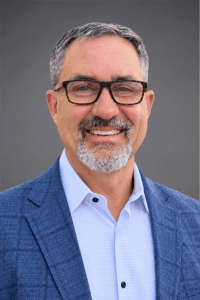
Utah Eccles’ Scott Schaefer: “AI has allowed us to pivot towards so much more thinking and so much less working on the details of computer languages. So for us, it’s amazing”
The undergraduate major has close to 200 students. It’s heavily quantitative, so it attracts students who took calculus in high school or are willing to build their math skills in college. Many arrive from engineering after deciding it isn’t for them.
About a quarter of QAMO students double-major, and another quarter add a minor elsewhere on campus. Schaefer’s classrooms mix math, political science, English and computer science students.
“This undergrad classroom in QAMO is kind of filled with thinkers who are interested in a variety of things,” he says.
One of them is Indiana Plant, a junior double-majoring in QAMO and anthropology, who interns at Bain & Company next summer. She told P&Q she chose Utah largely for the program.
FOUR PATHS
Where do graduates go? “This is the number one question I get,” Schaefer says. His answer: four places.
The first is consulting. QAMO teaches students to break a problem into its components, “all those things that would make you good at a consulting interview,” he says.
The second is data analytics. Students do a lot of econometrics, and many fall in love with it and become data or strategy analysts.
The third is business careers more broadly. QAMO majors can add a minor or emphasis in finance, marketing, or operations and supply chain. They get more quantitative rigor and somewhat less business breadth than other Eccles students, Schaefer says. “It’s a little bit of a shotgun blast,” he says. “But they’re so fun to watch on LinkedIn.”
The fourth is public policy, for students who love the rigor but not the business world. Several alumni work at think tanks in Washington, D.C., and some current students are applying to the Federal Reserve.
AI IN THE CLASSROOM – AND THE HIRING MARKET
AI has changed how QAMO teaches. Five years ago, Schaefer says, a faculty member teaching econometrics or data analytics spent about 70% of the time debugging students’ code. Now that time goes to thinking.
“What are the ways that data can trick you?” he says. “AI has allowed us to pivot towards so much more thinking and so much less working on the details of computer languages. So for us, it’s amazing.”
The hiring side worries him more. Schaefer studies employment relationships, and while he stresses he has no hard evidence, he suspects AI is part of why today’s labor market is low-hire, low-fire. Employers flooded with AI-polished applications may no longer be able to tell strong candidates from weak ones, so they hold on to the employees they know.
“I think this is throwing a wrench in just the hiring mechanism itself,” he says.
His advice to students: “Number one, network, number two, network, number three, network.” Uploading a résumé to a jobs website “as horrible as that was two years ago, it’s even worse now,” he says. QAMO is responding with more active learning, more presentations and more time getting students to talk.
RESEARCH WITH REAL-WORLD STAKES
The division is still small and hiring, and it has invested in industrial organization economics. Schaefer points to colleague Paul Eliason, part of a research team whose work on the dialysis industry uses Medicare data to track what happens when chains roll up independent clinics.
The research found that acquired clinics shifted to less expensive, less-trained staff, among other changes. “There’s evidence that there’s some issues that the healthcare system ought to be taking a look at,” Schaefer says.
With a major medical center on campus, the organization of the health care industry – part private, part public, part nonprofit – is a natural area for a business school, he says.
ADVISING THE PRESIDENT
Schaefer also advises University of Utah President Taylor Randall, the former Eccles dean. His work has included enrollment management, tuition discounting and the mix of in-state and out-of-state students. He has also worked on intercollegiate athletics, which he calls “fraught these days in public higher ed,” and on the role of standardized testing in admissions.
Utah remains test-optional for undergraduates. Part of the reason is California: the university wants applications from students there, and California’s public universities don’t require test scores. Utah’s out-of-state share has risen dramatically, Schaefer says, and many of those students come for the business school.
THE ECONOMICS OF ECONOMISTS
Schaefer’s bigger prediction comes down to money.
At most public universities, economists sit in a college of arts and sciences or social and behavioral sciences. There, he says, “they stand out like a sore thumb,” because their market salaries are far higher than those of most colleagues. In a business school, surrounded by well-paid finance and accounting professors, they fit in.
Business schools also have a revenue tool that arts and sciences colleges often lack. Many public universities charge differential tuition for business degrees. An economics major is practical, leads to good outcomes and requires expensive faculty, Schaefer says. Students may be willing to pay more for it.
“So how are these institutions going to afford expensive economists if they’re kept in a college with other social scientists and can’t charge closer to a market price for the degree?” he says. “Well, the answer is you make an organizational change.”
The hard part, he says, will be the economists themselves. In a business school, they’ll have to deliver what a business dean expects: business-relevant content and close attention to the jobs their students land.
“If we want to be part of this business school, I’ve got to keep Dean Dirks happy,” Schaefer says with a laugh. “I’ve got to do all the things that business professors do.”
He expects those kinds of pressures to reshape public higher education over the next 20 years. Could that make QAMO a national brand?
“It’s going to happen in higher ed in this country over the next 20 years,” Schaefer says. “I think over time, those pressures will come to bear. And it’s happening here.”
DON’T MISS LASSONDE AT 25: A FOUNDING STUDENT LEADER RETURNS TO RUN UTAH ECCLES’ STARTUP ENGINE
© Copyright 2026 Poets&Quants. All rights reserved. This article may not be republished, rewritten or otherwise distributed without written permission. To reprint or license this article or any content from Poets&Quants, please submit your request HERE.


