
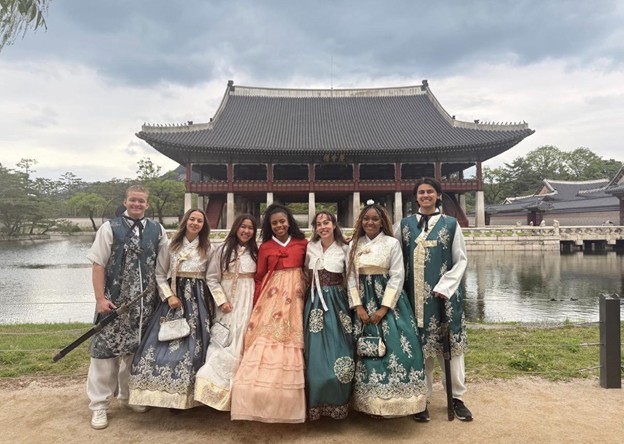
Seoul Travel Group at Gyeongbokgung Palace
As I enter the final semester of my senior year, I’m reflecting on where I was this time last year. Toward the end of fall at the University of Michigan’s Ross School, there’s a familiar energy that settles in—especially among juniors. I start to hear conversations drift toward housing abroad, where people are going and countdowns to departure. You hear names of cities repeated in the Winter Garden—Barcelona, London, Paris—and it feels like everyone is moving toward the same milestone: going abroad during the winter semester of their junior year.
Seeing that same excitement this year made me pause. Not out of regret, but with gratitude.
Ross intentionally carves out the winter semester of junior year so students can study abroad without falling behind academically. It’s a privilege, and for many students, it works perfectly. For me, it didn’t. My academic path and personal circumstances meant that the traditional winter-semester abroad option wasn’t realistic. At the time, I quietly assumed that meant studying abroad just wasn’t in the cards for me.

View of Hong Kong Island from Tsim Sha Tsui
A TRIP OF A LIFETIME
September of my Junior year, I decided to apply to the short-term study abroad programs that Ross has to offer students. This wasn’t something I had planned on doing, and I forgot it was even an option until I met with my Academic Advisor to discuss the pros and cons of going abroad for the full semester. I applied to both Finland and Hong Kong study abroad programs that would be happening in May after my Junior year. I had already come to accept that I wouldn’t be going abroad and was content in that decision. That initial disappointment that I felt quickly shifted into excitement when I was accepted into Ross’s short-term study abroad program in Hong Kong that November.
Ross offers several short-term global programs, typically during spring break or in May, where students spend about a month immersed in another country while taking a focused course. When I applied, I saw it less as a “replacement” for traditional study abroad and more as a last chance to experience something global before graduating. What I didn’t expect was how deeply it would reshape how I think about business, opportunity, and my place in the world.

Horse Race in Hong Kong
‘THE CROSSROADS OF THE WORLD’
From the moment I arrived in Hong Kong, everything felt faster, denser, and more interconnected. It wasn’t until I was there that I realized just how international the city truly is. What I expected to be a huge adjustment didn’t feel as daunting as I had imagined—many people spoke English, and in some ways, the city felt oddly familiar. Still, there was so much I didn’t expect to see or experience, such as a skyline like New York, framed by stunning mountains and clear blue water. The city itself was a lesson, towering buildings pressed against mountains, global finance intersecting with centuries-old culture. It was impossible not to feel like you were standing at the crossroads of the world.
One of my favorite things about Hong Kong was how alive the city felt at every hour of the day. Huge eight story shopping malls seemed to appear on every corner. Wherever you turned, they were stacked vertically, underground, and woven seamlessly into daily life. The pace of public transportation had its own charm – fast, efficient, and nonstop – making it easy to move across the city without ever slowing down. Late nights often ended with boba that cost the equivalent of two American dollars, or bowls of ramen that genuinely felt life-changing after long days of class and exploration. One of the most surprising cultural experiences was attending the horse races, which felt as significant and electric as football games back home, revealing how deeply tradition and entertainment are embedded in Hong Kong. What grounded all of that intensity, though, were the surrounding waters, mountains and hikes scattered throughout the city. Just minutes away from dense urban life, you could be surrounded by nature and quiet, with dazzling views that reminded me how unique Hong Kong truly is, a place where movement, culture, and balance coexist in a way I had never experienced before.

Kendyll pictured with Professor Cassian Cheung at the end of the program presentation
LEARNING HOW TO DO BUSINESS IN HONG KONG
Academically, the experience was just as impactful. We learned the foundations of business in Asia through Doing Business in Hong Kong/China with Professor Cassian Cheung. He didn’t just teach frameworks, but consistently contextualized them, explaining how history, culture, government, and societal norms shape the way business operates across the region. He taught in a way that challenged us to unlearn the ways of thinking we were used to applying to business in the U.S. and at Ross. He made it clear that conventional approaches don’t always translate in environments shaped by entirely different cultures, systems, and standards. Rather than learning frameworks in theory, we were pushed to put them into practice. We were given real-world case studies grounded in the Asian market. We were given the opportunity to apply what we were learning in real time through case studies on ESG, market entry, and governance, along with engaging group projects and guest lectures spanning sustainability, public policy, marketing, and corporate affairs.
What made the course stand out was how practical it was. Feedback was specific and actionable, discussions pushed us beyond familiar Western assumptions. Real-world examples anchored every lesson. Those ideas came to life even further outside the classroom. We made many company visits to places like Google Hong Kong, Cyberport, the Legislative Council, Lee Kum Kee, Hong Kong International Airport, the Swire Archives Centre, and the Hong Kong Racing Museum. These visits connected classroom discussions to real-world business applications. By the end of the program, I didn’t just gain a deeper understanding of doing business in Asia, I also gained a different perspective on the type of work I could do and the span of opportunities that are possible internationally.

Shopping in Seoul
TRAVELING FROM HONG KONG TO SEOUL
But what made the experience truly special was the people.
Our cohort was small, with less than 30 students, which meant connection came quickly. We weren’t just classmates: we were navigating a new country together, figuring out public transportation, trying new foods, and processing everything we were learning in real time. Those shared experiences turned into real friendships.
During the program, a group of six of us traveled to Seoul, South Korea for a weekend. That trip fundamentally shifted how I understood what it means to navigate unfamiliar spaces. I could feel the difference immediately after stepping out of the airport. Unlike Hong Kong, where English signage was everywhere, Seoul felt far less accommodating linguistically, and navigating the city required a new level of awareness and adaptability. That unfamiliarity made everything feel more immersive. We visited Gyeongbokgung Palace, wore traditional hanbok, wandered through massive shopping districts, and made our way up to N Seoul Tower, taking in views that reminded me how far from home we really were. Somewhere between trying Korean street food and discovering new obsessions like Pop Mart, we bonded in ways that only happen when you’re figuring things out together. The trip wasn’t just about seeing another country, it was about learning how to move confidently through environments where nothing is designed for your comfort, and realizing how much growth comes from that discomfort.

Kendyll (Left) Pan-Asia Alumni Reunion
MEET THE ALUMNI
One of the most eye-opening moments of the program happened back in Hong Kong at the Pan-Asia Alumni Reunion. An alumni event, it moves to different cities in Asia each year, making it a rare opportunity for us to be able to attend. The event took place in the Hyatt Regency Hong Kong, Tsim Sha Tsui, filled with hundreds of people. It included alumni living and working across Asia, local professionals, and individuals who traveled year after year to attend. The energy in the room was unlike anything I had experienced before: it felt global, deeply connected, and unmistakably Michigan.
Seeing alumni who had built entire lives and careers abroad made the idea of working internationally feel tangible rather than unrealistic. I was especially struck by the presence of donors and alumni who made opportunities like this program possible, reinforcing how strong and invested the Ross/Michigan network truly is. Being in that space made it clear that Ross extends far beyond Ann Arbor; it is a global community that actively shows up for its students. That realization stayed with me long after the event ended, reshaping how I think about the long-term impact of the relationships and networks I am building now.

Cohort at Lee Kum Kee Company visit
Not only were we able to attend the reunion, but the alumni were incredibly supportive and genuinely excited to engage with current students. Their enthusiasm extended beyond the event itself, so much so that we were invited to a seven-course meal sponsored by an alum who wanted even more time to connect with students after the reunion. Being in such an intimate setting surrounded by alumni whose careers spanned finance, consulting, entrepreneurship, and public service was both inspiring and energizing. Bonding over our shared experience as University of Michigan students – past and present – made the evening feel especially meaningful and memorable.
It was one of those moments where the scale of the Michigan network fully clicked. Not just in size, but in strength. As students, we’re told about the Michigan alumni network and how deep it is. However, the moments where you truly get to experience the strength of that network truly puts into perspective how valuable it is. These weren’t just distant connections we could have on LinkedIn. They were people eager to foster meaningful relationships and support us. It was a reminder that the value of a Michigan education doesn’t stop once you leave Ann Arbor.

Evening Star Ferry Tour
WHAT I LEARNED
Looking back, I’m grateful that my path didn’t follow the most common timeline. Not going abroad in the winter semester felt, at the time, like a door closing. Instead, it pushed me toward an experience that was uniquely mine. Hong Kong showed me that global exposure doesn’t have to fit a single mold and that sometimes, the opportunities that feel like Plan B end up shaping you the most.
Now, when I see juniors buzzing about going abroad, I don’t feel like I missed out. I feel grounded in what I gained. Studying abroad through Ross taught me that business is truly global, that community can form anywhere, and that flexibility often leads to growth. Most of all, it reminded me that there’s no one “right” way to do college, only the way that challenges you to see more, think bigger, and step outside what you thought was possible.
Kendyll Martin is a BBA student at the University of Michigan Ross School of Business, originally from Detroit, MI. At Michigan, she has combined her interests in business and community through her roles as Vice President of membership for the Black Business Undergraduate Society, Community Service Co-Chair for Sister2Sister, Student Engagement Coordinator at Trotter Multicultural Center, and BBA Student Ambassador. Outside the classroom, Kendyll interned with McDonald’s on the U.S. People Team, and she also works in real estate to promote equitable housing opportunities in Detroit. She’s passionate about using business as a force for inclusion and empowerment, and hopes to build a career at the intersection of people, culture, and strategy. After graduation, she will begin her career with McDonald’s on the U.S. People Team.
DON’T MISS: GOING BLUE: ROOTED IN COMMUNITY – MY JOURNEY TO CONFIDENCE AT ROSS
© Copyright 2026 Poets & Quants. All rights reserved. This article may not be republished, rewritten or otherwise distributed without written permission. To reprint or license this article or any content from Poets & Quants, please submit your request HERE.


