




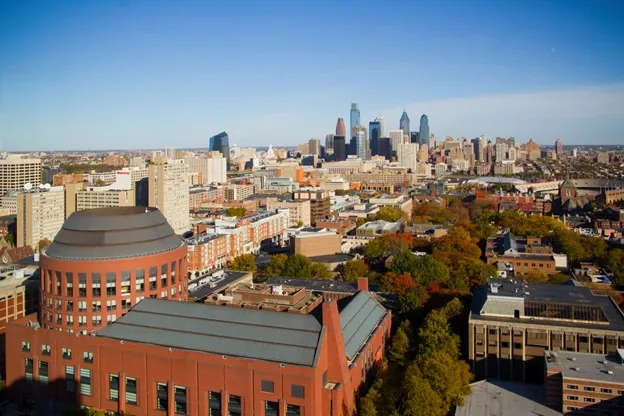
The Wharton School’s Huntsman Hall at the University of Pennsylvania. Courtesy photo
WHERE GRADUATES EARN THE MOST
Business and engineering schools feature prominently among the colleges with the highest reported median 10-year salaries post graduation — including several well outside the overall top 100.
University of Pennsylvania leads the salary comparison at $151,328. Kettering University, ranked No. 222 overall, comes next at $133,455, followed by Stevens Institute of Technology at $131,329. Both edge out overall ranking leader MIT, whose graduates have a reported median salary of $131,182.
Babson College rounds out the top five at $130,610. The business-focused school ranks 86th overall, another reminder that a college’s position on the full list tells only part of its career outcomes story. Bentley University, ranked No. 182, also makes a strong showing at $123,326.
One public institution stands out among these mostly private schools: South Dakota School of Mines and Technology. Despite finishing 312th overall, it posts a median alumni salary of $127,200, just above Stanford’s $126,916. Its reported average debt of $7,879 is also among the lowest in this group.
The table below shows 15 colleges with strong salary outcomes, alongside their overall ranks, average grant aid and average debt.
Forbes Top Colleges Highest Post-Grad Salaires |
||||||
Rank |
Name |
State |
Type |
Av. Grant Aid |
Av. Debt |
Median 10-year Salary |
| 5 | University of Pennsylvania | PA | Private not for profit | $65,458 | $11,278 | $151,328 |
| 222 | Kettering University | MI | Private not for profit | $25,641 | $11,736 | $133,455 |
| 118 | Stevens Institute of Technology | NJ | Private not for profit | $33,897 | $12,571 | $131,329 |
| 1 | Massachusetts Institute of Technology | MA | Private not for profit | $61,734 | $11,176 | $131,182 |
| 86 | Babson College | MA | Private not for profit | $48,173 | $9,822 | $130,610 |
| 125 | Franklin W Olin College of Engineering | MA | Private not for profit | $43,290 | $6,807 | $127,948 |
| 312 | South Dakota School of Mines and Technology | SD | Public | $5,334 | $7,879 | $127,200 |
| 6 | Stanford University | CA | Private not for profit | $62,755 | $11,418 | $126,916 |
| 190 | Worcester Polytechnic Institute | MA | Private not for profit | $31,545 | $12,372 | $125,702 |
| 134 | Rensselaer Polytechnic Institute | NY | Private not for profit | $43,517 | $8,964 | $124,697 |
| 79 | Lehigh University | PA | Private not for profit | $46,731 | $10,642 | $124,208 |
| 182 | Bentley University | MA | Private not for profit | $33,673 | $13,215 | $123,326 |
| 155 | Rose-Hulman Institute of Technology | IN | Private not for profit | $32,484 | $13,849 | $122,648 |
| 25 | Carnegie Mellon University | PA | Private not for profit | $48,107 | $8,203 | $122,362 |
| 2 | Princeton University | NJ | Private not for profit | $68,727 | $9,046 | $121,773 |
ROI: PRINCETON LEADS, BUT CUNY DOMINATES
High salaries are only part of the college payoff equation. What students actually pay to earn those degrees — and how much debt follows them out the door — matters, too.
Princeton University rose from third to first in Forbes’ separate ranking of The 25 Colleges With The Highest Payoff. Its generous financial aid helps explain how an elite private university with a hefty sticker price can also deliver strong value. According to Forbes, Princeton covers tuition, food and housing for most families earning under $150,000, while most families earning up to $250,000 receive enough aid to cover tuition.
But public colleges dominate the next stretch of the list. City University of New York campuses claim seven of the top 10 spots, led by Hunter College at No. 2 and Brooklyn College at No. 3. Queens and Lehman round out the top five, followed by Baruch at No. 6.
Their advantage is straightforward: relatively low tuition, the ability for many students to save money by living at home, and access to New York City’s job market.
Baruch offers a particularly compelling example. Forbes lists its annual in-state tuition and fees at $7,464 for 2024–2025, alongside a reported median base salary of $113,835 a decade after graduation. Hunter’s comparable figures are $7,382 and $99,517.
To build the ROI ranking, Forbes used think tank Third Way’s calculation of how long it takes graduates to recover their net degree costs after grants and scholarships. It also considered a borrowing index that combines median federal debt per borrower with the share of students taking out federal loans.
Forbes’ Top 25 Colleges For ROI |
|||||||
ROI Rank |
Overall Rank |
Name |
In-State Tuition & Fees |
Out-of-State Tuition & Fees |
Av. Grant Aid |
Av. Debt |
Median 10-year Salary |
| 1 | 2 | Princeton University | $62,688 | $68,727 | $9,046 | $121,773 | |
| 2 | 169 | CUNY Hunter College | $7,382 | $15,332 | $9,755 | $7,107 | $99,517 |
| 3 | 150 | CUNY Brooklyn College | $7,452 | $15,402 | $9,482 | $7,386 | $103,370 |
| 4 | 138 | CUNY Queens College | $7,358 | $15,488 | $9,057 | $6,042 | $104,801 |
| 5 | 368 | CUNY Lehman College | $7,410 | $15,360 | $10,151 | $5,044 | $96,130 |
| 6 | 106 | CUNY Baruch College | $7,464 | $15,414 | $10,114 | $5,856 | $113,835 |
| 7 | 6 | Stanford University | $65,910 | $62,755 | $11,418 | $126,916 | |
| 8 | 309 | CUNY John Jay College of Criminal Justice | $7,470 | $15,420 | $9,966 | $7,411 | $96,701 |
| 9 | 102 | CUNY City College of New York | $7,340 | $15,290 | $9,763 | $5,559 | $105,796 |
| 10 | 7 | California Institute of Technology | $65,898 | $72,373 | $11,846 | $117,278 | |
| 11 | 16 | Rice University | $64,144 | $56,199 | $10,792 | $109,721 | |
| 12 | 1 | Massachusetts Institute of Technology | $62,396 | $61,734 | $11,176 | $131,182 | |
| 13 | 3 | Harvard University | $61,676 | $68,015 | $12,445 | $119,708 | |
| 14 | 34 | University of Florida | $6,381 | $28,659 | $10,846 | $6,988 | $106,402 |
| 15 | 468 | California State University, Dominguez Hills | $7,449 | $20,049 | $13,951 | $4,679 | $94,317 |
| 16 | 17 | University of Chicago | $70,662 | $62,300 | $17,312 | $107,812 | |
| 17 | 19 | Williams College | $68,560 | $68,966 | $10,614 | $111,600 | |
| 18 | 4 | Columbia University | $71,845 | $67,010 | $17,037 | $117,010 | |
| 19 | 286 | California State University, Stanislaus | $8,246 | $20,846 | $12,492 | $4,896 | $101,548 |
| 20 | 215 | California State University, Los Angeles | $7,160 | $17,760 | $13,824 | $5,017 | $93,973 |
| 21 | 10 | Vanderbilt University | $67,498 | $64,404 | $12,263 | $115,467 | |
| 22 | 355 | CUNY College of Staten Island | $7,490 | $15,440 | $8,526 | $7,174 | $98,624 |
| 23 | 55 | Brigham Young University | $6,688 | $6,088 | $5,759 | $114,493 | |
| 24 | 323 | California State University, Bakersfield | $8,090 | $20,690 | $12,966 | $4,554 | $101,611 |
| 25 | 11 | Johns Hopkins University | $65,230 | $59,977 | $11,969 | $111,678 | |
METHODOLOGY
Forbes considered about 1,600 public and nonprofit institutions before selecting its top 500. It excluded schools planning to close, those with fewer than 300 undergraduates, those missing four or more metrics and the five federal military academies.
It evaluated four-year colleges using data from IPEDS, the U.S. Department of Education’s College Scorecard, PayScale, the National Center for Science and Engineering Statistics, and its own lists of influential alumni.
The seven category weights include:
- Alumni Salary (20%) – Earnings three, six, 10 and 20 years after graduation.
- Debt (15%) – Federal borrowing and repayment.
- Graduation Rate (15%) – Six-year completion, including Pell Grant recipients.
- Forbes American Leaders (15%) – Alumni leadership and major honors.
- Return on Investment (15%) – Degree costs relative to earnings premiums, including low-income students.
- Retention Rate (10%) – First-year students returning for a second year.
- Academic Success (10%) – Scholarships and PhD production.
NEXT PAGE: Forbes’ Top 50 Colleges
© Copyright 2026 Poets & Quants. All rights reserved. This article may not be republished, rewritten or otherwise distributed without written permission. To reprint or license this article or any content from Poets & Quants, please submit your request HERE.


